Many thanks to American Bach Soloists for asking me to talk about John Dryden as background for their upcoming performances of the Handel / Dryden oratorio Alexander's Feast; you can read my thoughts here.
And you can go here to get tickets to the upcoming performances; Jeffrey Thomas conducts, with soloists Anna Gorbachyova (soprano), Aaron Sheehan (tenor), William Sharp (baritone), and Maria Christina Cleary on harp. That's 26 February at St Stephen's Church in Belvedere, 27 February at First Congregational Church in Berkeley, 28 February at St Mark's Lutheran in San Francisco (4:00 start time for that one), and 29 February at Davis Community Church in Davis (7:00 start).
Showing posts with label ABS. Show all posts
Showing posts with label ABS. Show all posts
10 February 2016

26 January 2016
American Bach Soloists: Bach Favorites
Last Saturday I headed out to First Congregational Church in Berkeley for the American Bach Soloists, who were performing a program they called Bach Favorites. Despite the title, there was no sense of retread over pieces too frequently played; it was quite a refreshing evening. It opened with a cantata, Wachet! betet! betet! wachet! (Watch! pray! pray! watch!; BWV 70), which takes a surprisingly lively and even joyful view of the approaching apocalypse; granted, the text takes cheerful consolation in the redeeming power of Jesus, but I have to admit that there are plenty of times when the thought of the fire next time adds a little lift to my steps too. Right before the music started conductor Jeffrey Thomas turned to us and said that the two cantatas we would be hearing were the ones ABS performed at its first concert twenty-seven years ago. And in a spirit of authenticity, we were invited to sing along with the chorale, just like the Lutherans in Leipzig back in 1723. He led us in a little rehearsal beforehand. I declined to sing; as Sister Maria del Carmen used to tell us back in the day, her gift to God was not to sing to Him; after all, if that's what he wanted, he could have given her a better voice. I believe I was not the only one to refrain. Despite or because of this, Thomas assured us that we sounded better than had the audience in Belvedere the night before. I have no idea where Belvedere is. Thomas may well have made it up for all I know.
Anyway the cantata is mostly solos, and we had a fine set of them: Mary Wilson, soprano; Jay Carter, countertenor; Derek Chester, tenor; and Mischa Bouvier, baritone. The chorus and orchestra were as always strong, clean, and lilting. Wilson sings with ABS fairly often, but I'm not sure I had heard her before; her clear soprano made a striking effect in its one solo, bringing the sort of consolation you find in the one soprano movement of the Brahms Requiem. After this rather elaborate cantata we had the famous Toccata and Fugue in D Minor, only in a new guise: a solo violin arrangement made by our solo violinist, Tatiana Chulochnikova. Her strong, clear, steady tones seemed like an echo of the voices we had just heard. It's interesting to have the massive organ avalanche of this piece replaced by the more sinuous sound of a solo violin. After the intermission, Chulochnikova returned, this time with the orchestra, for an engaging performance of the Concerto for Violin in E Major (BWV 1042). This was, for me at least, the most familiar piece on the program, but welcome nonetheless. It was followed by a second cantata, Herz und Mund und Tat und Leben (Heart and mouth and deed and life; BWV 147). This piece was written for the feast of the Visitation of Mary to her cousin Elizabeth (mother of St John the Baptist), so I guess hearing it was my final farewell to last Christmas. It was a very satisfying end to a satisfying evening. Your next chance to hear ABS will be an all-Handel program, featuring the Handel / Dryden celebration of the power of music, Alexander's Feast. You can find out more information here.

Anyway the cantata is mostly solos, and we had a fine set of them: Mary Wilson, soprano; Jay Carter, countertenor; Derek Chester, tenor; and Mischa Bouvier, baritone. The chorus and orchestra were as always strong, clean, and lilting. Wilson sings with ABS fairly often, but I'm not sure I had heard her before; her clear soprano made a striking effect in its one solo, bringing the sort of consolation you find in the one soprano movement of the Brahms Requiem. After this rather elaborate cantata we had the famous Toccata and Fugue in D Minor, only in a new guise: a solo violin arrangement made by our solo violinist, Tatiana Chulochnikova. Her strong, clear, steady tones seemed like an echo of the voices we had just heard. It's interesting to have the massive organ avalanche of this piece replaced by the more sinuous sound of a solo violin. After the intermission, Chulochnikova returned, this time with the orchestra, for an engaging performance of the Concerto for Violin in E Major (BWV 1042). This was, for me at least, the most familiar piece on the program, but welcome nonetheless. It was followed by a second cantata, Herz und Mund und Tat und Leben (Heart and mouth and deed and life; BWV 147). This piece was written for the feast of the Visitation of Mary to her cousin Elizabeth (mother of St John the Baptist), so I guess hearing it was my final farewell to last Christmas. It was a very satisfying end to a satisfying evening. Your next chance to hear ABS will be an all-Handel program, featuring the Handel / Dryden celebration of the power of music, Alexander's Feast. You can find out more information here.

16 August 2015
American Bach Soloists: a virtuoso concert with John Thiessen

Last night I was at my fourth and final concert in American Bach Soloists's summer Festival & Academy. (There were plenty of other offerings, including a two-day baroque music marathon and the traditional Festival performances of the Mass in B Minor, but I did not go to those.) The first three performances I saw linked back to the Festival's theme for this year, Versailles and the Parisian Baroque. Saturday's concert was a bit of a departure, featuring John Thiessen on baroque trumpet – I almost wrote "playing virtuoso music for baroque trumpet" but almost any music written for that ornery instrument is virtuoso by definition. He was joined by Elizabeth Blumenstock on violin, Corey Jamason on organ and harpsichord, Katherine Kyme on viola, Steven Lehning on contrabass, Robert Mealy on violin, William Skeen on violoncello, and Kenneth Slowik on violoncello and viola da gamba.
Given its basic sound, and its consequent association with hunting and war-making, much of the trumpet music was brilliant and stirring in nature. In between horn pieces there were small chamber ensembles displaying a different type of virtuosity. I've heard awkward splats from baroque horns – I remember one performance of Messiah, years ago in Boston, when the usually expert trumpeter suddenly lost it during, of all arias, The Trumpet Shall Sound – but there were none last night, just impressive control and gleaming stretches of music. There were many short pieces, ranging from obscure to familiar, so it was a nicely varied program. First was the Sonata detta del Nero for Trumpet & Basso Continuo by Girolamo Fantini, a piece taken from a seventeenth-century volume offering sample pieces to help aspiring professional trumpeters master their craft. It was brief and brilliant.

The second piece was an air for strings by Marco Uccellini, but not the one listed in the program, which was "un bel concerto" for "la Gallina e il Cucco" – Blumenstock amusingly informed us that "the hen and the cuckoo have flown off" but I did not catch the name of the other piece from that collection that they substituted. After that Thiessen came out again, this time joined by soprano Kathryn Mueller, for Alessandro Scarlatti's cantata Su le sponde del Tebro (On the banks of the Tiber), in which the shepherd Aminta laments his unrequited love. The trumpet is an interesting choice of accompaniment for such a lament; it does its stirring martial thing when he's trying to take heart, or comparing love to war, but there are also long low soft tones that convey surprising degrees of melancholy and despair. Mueller has a clear, bright, and expressive voice. The first half ended with the Sonata in A Major for Violoncello & Basso continuo (no. 15) by Antonio Caldara and then the only trumpet work attributed to Arcangelo Corelli, the Sonata a Quattro for Trumpet, Two Violins, & Basso continuo.
The second half had some more familiar pieces, starting off with Jeremiah Clarke's Suite of Ayres for the Theatre for Trumpet, Strings, & Basso continuo, followed by Purcell's Sonata V in G Minor for strings, and then concluding with Handel's Let the Bright Seraphim from Samson. Mueller rejoined the group for that piece, and it was fun watching her and Thiessen play off each other. All in all a very satisfying concert, even for an audience still buzzing from the revelation of Sémélé.
You can check out ABS's forthcoming season here.

15 August 2015
American Bach Soloists: Semele
When I checked over the schedule for this summer's American Bach Soloists Festival & Academy, one offering that stood out even among the promised abundance was the outside-of-Europe premiere of Sémélé, one of the operas by Marin Marais, a master of the viola da gamba who is better known for his chamber works. I must not have been the only one eager to hear this piece, since ABS had to add an additional performance. That is the performance I attended, on Thursday night. I hope someone who can do something about it is paying attention to this pent-up demand for French baroque opera.

As is often the case in these works, there was a lengthy (roughly thirty minute) prologue. This one involved an inaugural ceremony in honor of the new god, Bacchus – the first bacchanal. Love and wine are invoked. Apollo shows up to approve the proceedings in honor of his half-brother's ascension to the pantheon: a nice example of the Apollonian and the Dionysian joining together. The sun god then calls on the muses to tell everyone how Bacchus came about: in the manner of our comic-book movies, it's the origin story! And that makes up the rest of the opera, though at the end the libretto doesn't actually make it clear that Semele was pregnant when jealous Juno tricked her into making Jupiter reveal himself in his glory, thereby burning the mortal to a cinder and requiring Jupiter to rescue the infant god. Presumably the audience knew the story and could put the pieces together afterward, much as Jupiter did. There are other complications of a romantic nature, typical of dramatic works of this period.
Marais proved a master of evening-length theatricals as well as briefer instrumentals: there was a delightful variety in the score, which was crammed with dances and spectacular effects such as an invocation of the Underworld (a particularly powerful moment for the men of the splendid chorus) and a striking earthquake as Jupiter approaches in his destructive glory.

The performance was done concert-style, with the singers in evening dress and holding scores, and although one of the ways in which Sémélé resembles other baroque operas is the reliance on spectacle and stage magic, this delightful performance was all so fresh and lively you could feel the flowing waters and see the green forest vistas summoned by the vividly pictorial music. (Though I would still love to see a staging, maybe by someone like Mark Morris who could take advantage of the many dance/movement interludes.)
It's all quite sumptuous and extravagant, and was magnificently performed by the chorus, the orchestra, and the very strong line-up of vocalists: Grace Srinivasan (soprano), who on Thursday substituted for the indisposed Julianna Emanski as the Grand Priestess of Bacchus in the Prologue as well as singing her regularly scheduled role as Second Shepherdess; Ben Kazez (baritone) as the Grand Priest of Bacchus; Matthew Hill (tenor) as Apollon; Corbin Phillips (baritone) as Cadmus; Rebecca Myers Hoke (soprano) as Sémélé; Chelsea Morris (soprano) as Dorine, her maid; Steven Brennfleck (tenor) as Adraste, the warrior who thinks he's going to marry Sémélé until he realizes his rival is Jupiter; David Rugger (baritone) as Mercure (occasionally disguised as Arbate, in love with Dorine); Christopher Besch (bass) as Jupiter (occasionally disguised as Idas, mortal lover of Sémélé); Sara LeMesh (mezzo-soprano) as Junon; Ryan Strand (tenor) as the Shepherd; and Hannah De Priest (soprano) as First Shepherdess.

After the intermission there was noticeable attrition in the audience, which was unfortunate but inevitable when your week-night concert doesn't even start until 8:00 PM and lasts a bit over three hours. I wish ABS would join the growing number of organizations with more realistic start times. It was well after 11:00 PM when I arrived at the Civic Center BART station, only to find I had just missed a train and had to wait almost twenty minutes for the next one. That station has really gone downhill over the past year or two. There were people openly smoking drugs down on the platform, without a single BART officer in sight, and that is not the first time I've seen that down there. A successful concert brings with it a letdown as we re-enter the world, and this was more jarring than most, though perhaps it's rather the case that a reminder of the swelling ranks of human misery in our midst brought me closer in spirit to the descending years of the French monarchy.


As is often the case in these works, there was a lengthy (roughly thirty minute) prologue. This one involved an inaugural ceremony in honor of the new god, Bacchus – the first bacchanal. Love and wine are invoked. Apollo shows up to approve the proceedings in honor of his half-brother's ascension to the pantheon: a nice example of the Apollonian and the Dionysian joining together. The sun god then calls on the muses to tell everyone how Bacchus came about: in the manner of our comic-book movies, it's the origin story! And that makes up the rest of the opera, though at the end the libretto doesn't actually make it clear that Semele was pregnant when jealous Juno tricked her into making Jupiter reveal himself in his glory, thereby burning the mortal to a cinder and requiring Jupiter to rescue the infant god. Presumably the audience knew the story and could put the pieces together afterward, much as Jupiter did. There are other complications of a romantic nature, typical of dramatic works of this period.
Marais proved a master of evening-length theatricals as well as briefer instrumentals: there was a delightful variety in the score, which was crammed with dances and spectacular effects such as an invocation of the Underworld (a particularly powerful moment for the men of the splendid chorus) and a striking earthquake as Jupiter approaches in his destructive glory.
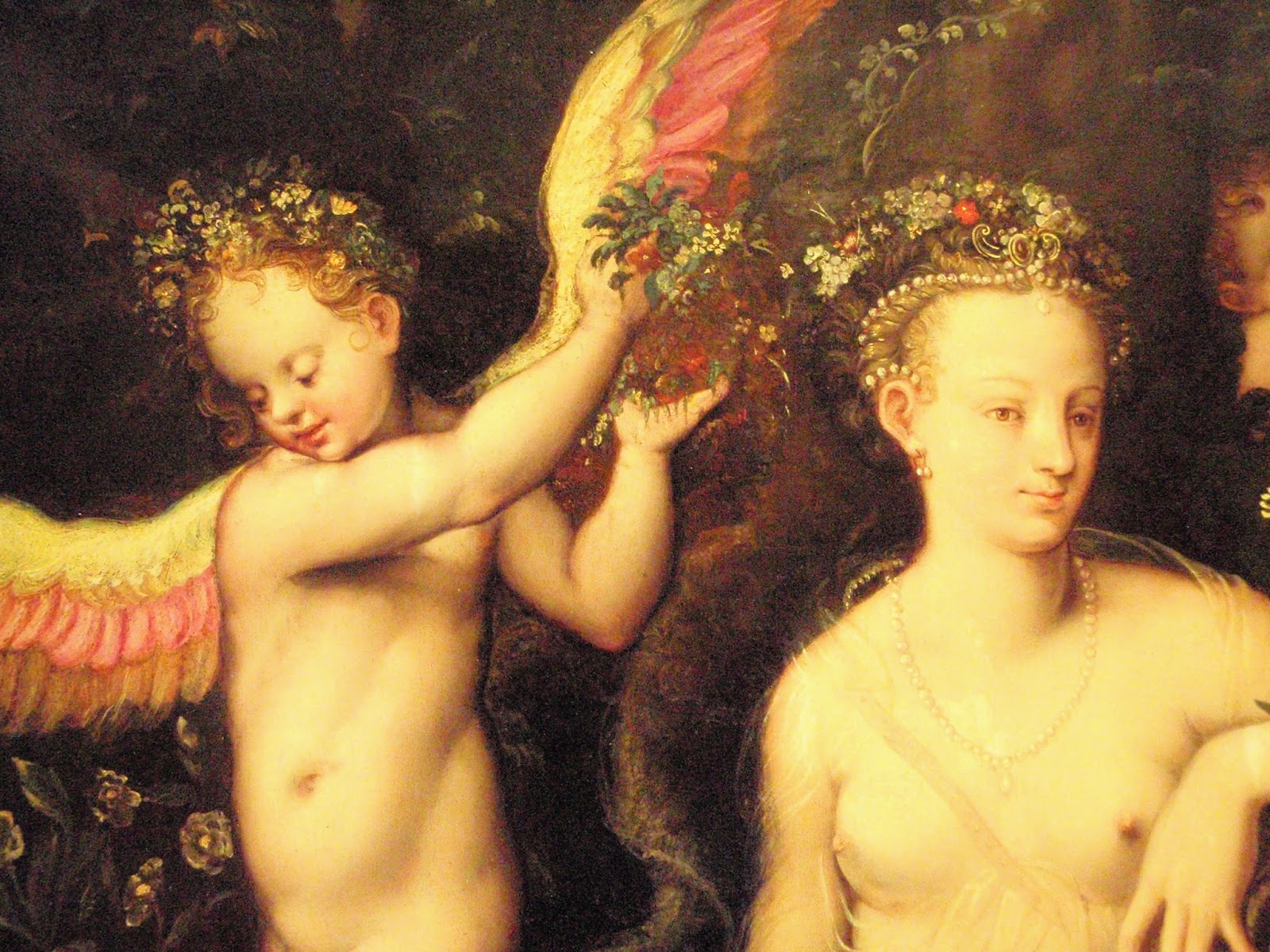
The performance was done concert-style, with the singers in evening dress and holding scores, and although one of the ways in which Sémélé resembles other baroque operas is the reliance on spectacle and stage magic, this delightful performance was all so fresh and lively you could feel the flowing waters and see the green forest vistas summoned by the vividly pictorial music. (Though I would still love to see a staging, maybe by someone like Mark Morris who could take advantage of the many dance/movement interludes.)
It's all quite sumptuous and extravagant, and was magnificently performed by the chorus, the orchestra, and the very strong line-up of vocalists: Grace Srinivasan (soprano), who on Thursday substituted for the indisposed Julianna Emanski as the Grand Priestess of Bacchus in the Prologue as well as singing her regularly scheduled role as Second Shepherdess; Ben Kazez (baritone) as the Grand Priest of Bacchus; Matthew Hill (tenor) as Apollon; Corbin Phillips (baritone) as Cadmus; Rebecca Myers Hoke (soprano) as Sémélé; Chelsea Morris (soprano) as Dorine, her maid; Steven Brennfleck (tenor) as Adraste, the warrior who thinks he's going to marry Sémélé until he realizes his rival is Jupiter; David Rugger (baritone) as Mercure (occasionally disguised as Arbate, in love with Dorine); Christopher Besch (bass) as Jupiter (occasionally disguised as Idas, mortal lover of Sémélé); Sara LeMesh (mezzo-soprano) as Junon; Ryan Strand (tenor) as the Shepherd; and Hannah De Priest (soprano) as First Shepherdess.

After the intermission there was noticeable attrition in the audience, which was unfortunate but inevitable when your week-night concert doesn't even start until 8:00 PM and lasts a bit over three hours. I wish ABS would join the growing number of organizations with more realistic start times. It was well after 11:00 PM when I arrived at the Civic Center BART station, only to find I had just missed a train and had to wait almost twenty minutes for the next one. That station has really gone downhill over the past year or two. There were people openly smoking drugs down on the platform, without a single BART officer in sight, and that is not the first time I've seen that down there. A successful concert brings with it a letdown as we re-enter the world, and this was more jarring than most, though perhaps it's rather the case that a reminder of the swelling ranks of human misery in our midst brought me closer in spirit to the descending years of the French monarchy.

(The photos are details of paintings at the Legion of Honor: the first is Thalia, Muse of Comedy by Jean-Marc Nattier; the second is Venus and Cupid by the School of Fontainebleau; the third and fourth are from Giovanni Battista Tiepolo's The Empire of Flora.)
11 August 2015
American Bach Soloists: Versailles & the Parisian Baroque
Aficionados of the baroque have frequent opportunities to hear major and minor works by German, Italian, and English composers, but (apart from the occasional piece by Lully or Rameau) fewer chances to hear their French compeers, so there was a grateful novelty about many of the works presented by American Bach Soloists this past weekend in the opening concerts of their 2015 summer Festival & Academy, which highlights the musicians centered on Versailles and Paris.

As we gathered in the lobby of the San Francisco Conservatory of Music on Friday night, a band of musicians on the third floor above us played Michel-Richard de Lalande's Concert de trompettes pour les festes sur le canal de Versailles, which reminded some of us of the fanfares at Bayreuth signaling the imminent start of the performance. At this first concert, ABS Artistic & Music Director Jeffrey Thomas led three substantial pieces for small orchestra. The opener was Les Élémens by Jean-Féry Rebel, which recreates musically the creation of the world – form arising from chaos – which makes it a very suitable opening number. Thomas started off by having the band play the themes that illustrated the four elements: air, fire, water, and earth. This was quite useful, though some in the audience found in unaccountably amusing. He then went on to talk about the wild opening, which is meant to illustrate primordial chaos. I think it would have been more effective to let the sound speak for itself; it's meant to be jarring and bizarre and would surely have shocked its first audience – it's still enough to startle us out of whatever preconceptions we might have had about the clarity and order of the French baroque. Far better to have the sound hit you than to have someone tell you, in effect, to brace yourself. That aside, I enjoyed hearing this music live (I had only heard a recording before this). As with much baroque music, dance forms are basic, and the world danced itself into being in a wide variety of rhythms and moods. There was a lovely twittering interlude for les rossignols (the nightingales) as well; the melodious birds had a movement to themselves.
That piece was followed by Suite II in D Major, Op 9 no 2 by Jacques Aubert le Vieux. Like many of the other composers featured in these programs, le Vieux was a performer at the French court (in his case, a violinist) and his compositions grew out of the talents around him and the tastes of Louis XIV. After the intermission came the Ouverture & Suite from Jean-Philippe Rameau's opera Naïs; this time the dance forms were actually intended to be danced to (again, catering to the Sun King's tastes; he was a dancer himself). The elegant concert hall at the San Francisco Conservatory of Music used to be a natatorium (swimming pool does not seem the right word), so I guess it was suitable that we were hearing music written about the water-nymph Naïs. The orchestra throughout was clear and lively and impeccably shaped.

The second concert, on Saturday night, had a number of more intimate chamber pieces, rather than the grander statements of the night before. Years ago I visited Versailles and was struck by how utterly displayed everything was; it was beautiful and even overwhelming, but not really a place of intimacy or eccentricity. This is to say that even in these chamber pieces there was a sense of being displayed to the public eye. The performers this time were faculty members of the ABS Academy; their names were grouped in a headnote to the program, and though it was not that difficult to figure out who was doing what, I would have liked to see the individual names by the individual pieces. Other than that the ABS program book was, as usual, a model of amplitude and elegance, full of interesting articles and attractive pictures.
The concert opened with a Suite in D Major by Marin Marais (the viola da gamba master made famous currently by the film Tous les Matins du Monde). He, too, was a performer as well as composer. That was followed by four Airs de Cour (three by Sébastien le Camus and one by Nicolas de la Grotte) sung by alto Judith Malafronte; then François-André Danican Philidor's Sinfonia I in G Minor; then André Campra's satirical cantata Les Femmes, sung by baritone William Sharp, about a man tired of love and women who leaves them all behind to become a hermit (or so he says). Then came the intermission, and after that a riposte to the Campra by Quirinus van Blankenburg, an organist outraged by what I have to say was the fairly gentle satire of Les Femmes into producing L'Apologie des Femmes, in which a man (bass-baritone Max van Egmond) flees the horrors of the wilderness to enjoy the company of a delightful variety of women. It would be amusing to know what the women thought of both these characters.

The concert concluded with two instrumental pieces, the Sonata in A Major, Op 51, no 5 by Joseph Bodin de Boismortier and François Couperin's Troisième Ordre, "L'Impériale" – a cellphone went off during that piece, and I have to say I was dismayed by the number of attendees at this concert who were apparently students at the Academy who pulled out their phones at the slightest pause in the proceedings. The splendid players deserved more attention and respect; they were, in addition to the singers I have mentioned, Elizabeth Blumenstock on violin, Corey Jamason on harpsichord, Steven Lehning on viola da gamba, Robert Mealy on violin, Sandra Miller on flute, Debra Nagy on oboe, William Skeen on violoncello and viola da gamba, Kenneth Slowik on viola da gamba, and Dominic Teresi on bassoon.
The festival is continuing through this week; check here for a full schedule, including the rare opportunity to hear Marin Marais's opera Sémélé.

As we gathered in the lobby of the San Francisco Conservatory of Music on Friday night, a band of musicians on the third floor above us played Michel-Richard de Lalande's Concert de trompettes pour les festes sur le canal de Versailles, which reminded some of us of the fanfares at Bayreuth signaling the imminent start of the performance. At this first concert, ABS Artistic & Music Director Jeffrey Thomas led three substantial pieces for small orchestra. The opener was Les Élémens by Jean-Féry Rebel, which recreates musically the creation of the world – form arising from chaos – which makes it a very suitable opening number. Thomas started off by having the band play the themes that illustrated the four elements: air, fire, water, and earth. This was quite useful, though some in the audience found in unaccountably amusing. He then went on to talk about the wild opening, which is meant to illustrate primordial chaos. I think it would have been more effective to let the sound speak for itself; it's meant to be jarring and bizarre and would surely have shocked its first audience – it's still enough to startle us out of whatever preconceptions we might have had about the clarity and order of the French baroque. Far better to have the sound hit you than to have someone tell you, in effect, to brace yourself. That aside, I enjoyed hearing this music live (I had only heard a recording before this). As with much baroque music, dance forms are basic, and the world danced itself into being in a wide variety of rhythms and moods. There was a lovely twittering interlude for les rossignols (the nightingales) as well; the melodious birds had a movement to themselves.
That piece was followed by Suite II in D Major, Op 9 no 2 by Jacques Aubert le Vieux. Like many of the other composers featured in these programs, le Vieux was a performer at the French court (in his case, a violinist) and his compositions grew out of the talents around him and the tastes of Louis XIV. After the intermission came the Ouverture & Suite from Jean-Philippe Rameau's opera Naïs; this time the dance forms were actually intended to be danced to (again, catering to the Sun King's tastes; he was a dancer himself). The elegant concert hall at the San Francisco Conservatory of Music used to be a natatorium (swimming pool does not seem the right word), so I guess it was suitable that we were hearing music written about the water-nymph Naïs. The orchestra throughout was clear and lively and impeccably shaped.

The second concert, on Saturday night, had a number of more intimate chamber pieces, rather than the grander statements of the night before. Years ago I visited Versailles and was struck by how utterly displayed everything was; it was beautiful and even overwhelming, but not really a place of intimacy or eccentricity. This is to say that even in these chamber pieces there was a sense of being displayed to the public eye. The performers this time were faculty members of the ABS Academy; their names were grouped in a headnote to the program, and though it was not that difficult to figure out who was doing what, I would have liked to see the individual names by the individual pieces. Other than that the ABS program book was, as usual, a model of amplitude and elegance, full of interesting articles and attractive pictures.
The concert opened with a Suite in D Major by Marin Marais (the viola da gamba master made famous currently by the film Tous les Matins du Monde). He, too, was a performer as well as composer. That was followed by four Airs de Cour (three by Sébastien le Camus and one by Nicolas de la Grotte) sung by alto Judith Malafronte; then François-André Danican Philidor's Sinfonia I in G Minor; then André Campra's satirical cantata Les Femmes, sung by baritone William Sharp, about a man tired of love and women who leaves them all behind to become a hermit (or so he says). Then came the intermission, and after that a riposte to the Campra by Quirinus van Blankenburg, an organist outraged by what I have to say was the fairly gentle satire of Les Femmes into producing L'Apologie des Femmes, in which a man (bass-baritone Max van Egmond) flees the horrors of the wilderness to enjoy the company of a delightful variety of women. It would be amusing to know what the women thought of both these characters.

The concert concluded with two instrumental pieces, the Sonata in A Major, Op 51, no 5 by Joseph Bodin de Boismortier and François Couperin's Troisième Ordre, "L'Impériale" – a cellphone went off during that piece, and I have to say I was dismayed by the number of attendees at this concert who were apparently students at the Academy who pulled out their phones at the slightest pause in the proceedings. The splendid players deserved more attention and respect; they were, in addition to the singers I have mentioned, Elizabeth Blumenstock on violin, Corey Jamason on harpsichord, Steven Lehning on viola da gamba, Robert Mealy on violin, Sandra Miller on flute, Debra Nagy on oboe, William Skeen on violoncello and viola da gamba, Kenneth Slowik on viola da gamba, and Dominic Teresi on bassoon.
The festival is continuing through this week; check here for a full schedule, including the rare opportunity to hear Marin Marais's opera Sémélé.
27 January 2015
Happy, Happy, Happy We: American Bach Soloists goes pastoral

Last Saturday there was a basketball game at Cal, which made it tricky to get over to First Congregational Church to hear the American Bach Soloists. As a non-driver I am fortunately spared parking (as well as driving), but even walking through the crowds was a challenge, particularly since large portions of Sproul Plaza are torn up with construction. So it seemed like a refuge to arrive in First Congregational's spare yet warm space, for a rich and full program, led by Music Director Jeffrey Thomas. Things opened with a stately and elegant performance of Bach's Brandenburg Concerto No 4 in G, which highlights the spirited swirling and tootling (like a running brook) of violin and recorder, featuring Elizabeth Blumenstock on the former and Judith Linsenberg and Debra Nagy on the latter. The main event, though, was Handel's pastoral, Acis and Galatea. Not to diminish the contributions of the orchestra or the crisp chorus (particularly notable in the rousing ear-worm finale of the first half, Happy We), but the quartet of soloists was the outstanding attraction of the performance. Tenor Kyle Stegall and soprano Nola Richardson were the sweetest Acis and Galatea I have ever heard, both tall and beautiful and radiant of voice. Stegall had an endearing way of stretching his arms out in moments of enthusiasm. Tenor Zachary Wilder was the warm voice of reason as the shepherd Damon, so full of good advice for all. As with most pastorals, initially nothing happens except idyllic feelings of love, until an outside force shows up – in this case, the threatening giant Polyphemus, sung by the imposing baritone Mischa Bouvier. Smitten (as we probably all were) by the charms of Galatea, he disposes of Acis. He still doesn't get the girl. She preserves her Acis by turning him into a "gentle murmuring stream," – "thus I exert my power divine; be thou immortal: though thou art not mine" – and so the evening ends as it began, with music flowing like a purling stream, only now shadowed with loss. Terrific performance!
Next up for ABS is the St Matthew Passion, on 27 - 28 February and 1 - 2 March. You can check out the different venues and get more information here. ABS also has an annual festival/academy, which is one of the musical highlights of the local summer; this year it will be 7 - 16 August, on the enticing theme of Versailles and the Parisian Baroque. In conjunction with that, ABS is running a Kickstarter campaign to help the students of the larger instruments pay for their air transportation: you can check that out, and the various benefits offered, here.
Subscribe to:
Posts (Atom)