Showing posts with label BART sucks. Show all posts

15 August 2015

American Bach Soloists: Semele

When I checked over the schedule for this summer's American Bach Soloists Festival & Academy, one offering that stood out even among the promised abundance was the outside-of-Europe premiere of Sémélé, one of the operas by Marin Marais, a master of the viola da gamba who is better known for his chamber works. I must not have been the only one eager to hear this piece, since ABS had to add an additional performance. That is the performance I attended, on Thursday night. I hope someone who can do something about it is paying attention to this pent-up demand for French baroque opera.


As is often the case in these works, there was a lengthy (roughly thirty minute) prologue. This one involved an inaugural ceremony in honor of the new god, Bacchus – the first bacchanal. Love and wine are invoked. Apollo shows up to approve the proceedings in honor of his half-brother's ascension to the pantheon: a nice example of the Apollonian and the Dionysian joining together. The sun god then calls on the muses to tell everyone how Bacchus came about: in the manner of our comic-book movies, it's the origin story! And that makes up the rest of the opera, though at the end the libretto doesn't actually make it clear that Semele was pregnant when jealous Juno tricked her into making Jupiter reveal himself in his glory, thereby burning the mortal to a cinder and requiring Jupiter to rescue the infant god. Presumably the audience knew the story and could put the pieces together afterward, much as Jupiter did. There are other complications of a romantic nature, typical of dramatic works of this period.

Marais proved a master of evening-length theatricals as well as briefer instrumentals: there was a delightful variety in the score, which was crammed with dances and spectacular effects such as an invocation of the Underworld (a particularly powerful moment for the men of the splendid chorus) and a striking earthquake as Jupiter approaches in his destructive glory.


The performance was done concert-style, with the singers in evening dress and holding scores, and although one of the ways in which Sémélé resembles other baroque operas is the reliance on spectacle and stage magic, this delightful performance was all so fresh and lively you could feel the flowing waters and see the green forest vistas summoned by the vividly pictorial music. (Though I would still love to see a staging, maybe by someone like Mark Morris who could take advantage of the many dance/movement interludes.)

It's all quite sumptuous and extravagant, and was magnificently performed by the chorus, the orchestra, and the very strong line-up of vocalists: Grace Srinivasan (soprano), who on Thursday substituted for the indisposed Julianna Emanski as the Grand Priestess of Bacchus in the Prologue as well as singing her regularly scheduled role as Second Shepherdess; Ben Kazez (baritone) as the Grand Priest of Bacchus; Matthew Hill (tenor) as Apollon; Corbin Phillips (baritone) as Cadmus; Rebecca Myers Hoke (soprano) as Sémélé; Chelsea Morris (soprano) as Dorine, her maid; Steven Brennfleck (tenor) as Adraste, the warrior who thinks he's going to marry Sémélé until he realizes his rival is Jupiter; David Rugger (baritone) as Mercure (occasionally disguised as Arbate, in love with Dorine); Christopher Besch (bass) as Jupiter (occasionally disguised as Idas, mortal lover of Sémélé); Sara LeMesh (mezzo-soprano) as Junon; Ryan Strand (tenor) as the Shepherd; and Hannah De Priest (soprano) as First Shepherdess.


After the intermission there was noticeable attrition in the audience, which was unfortunate but inevitable when your week-night concert doesn't even start until 8:00 PM and lasts a bit over three hours. I wish ABS would join the growing number of organizations with more realistic start times. It was well after 11:00 PM when I arrived at the Civic Center BART station, only to find I had just missed a train and had to wait almost twenty minutes for the next one. That station has really gone downhill over the past year or two. There were people openly smoking drugs down on  the platform, without a single BART officer in sight, and that is not the first time I've seen that down there. A successful concert brings with it a letdown as we re-enter the world, and this was more jarring than most, though perhaps it's rather the case that a reminder of the swelling ranks of human misery in our midst brought me closer in spirit to the descending years of the French monarchy.


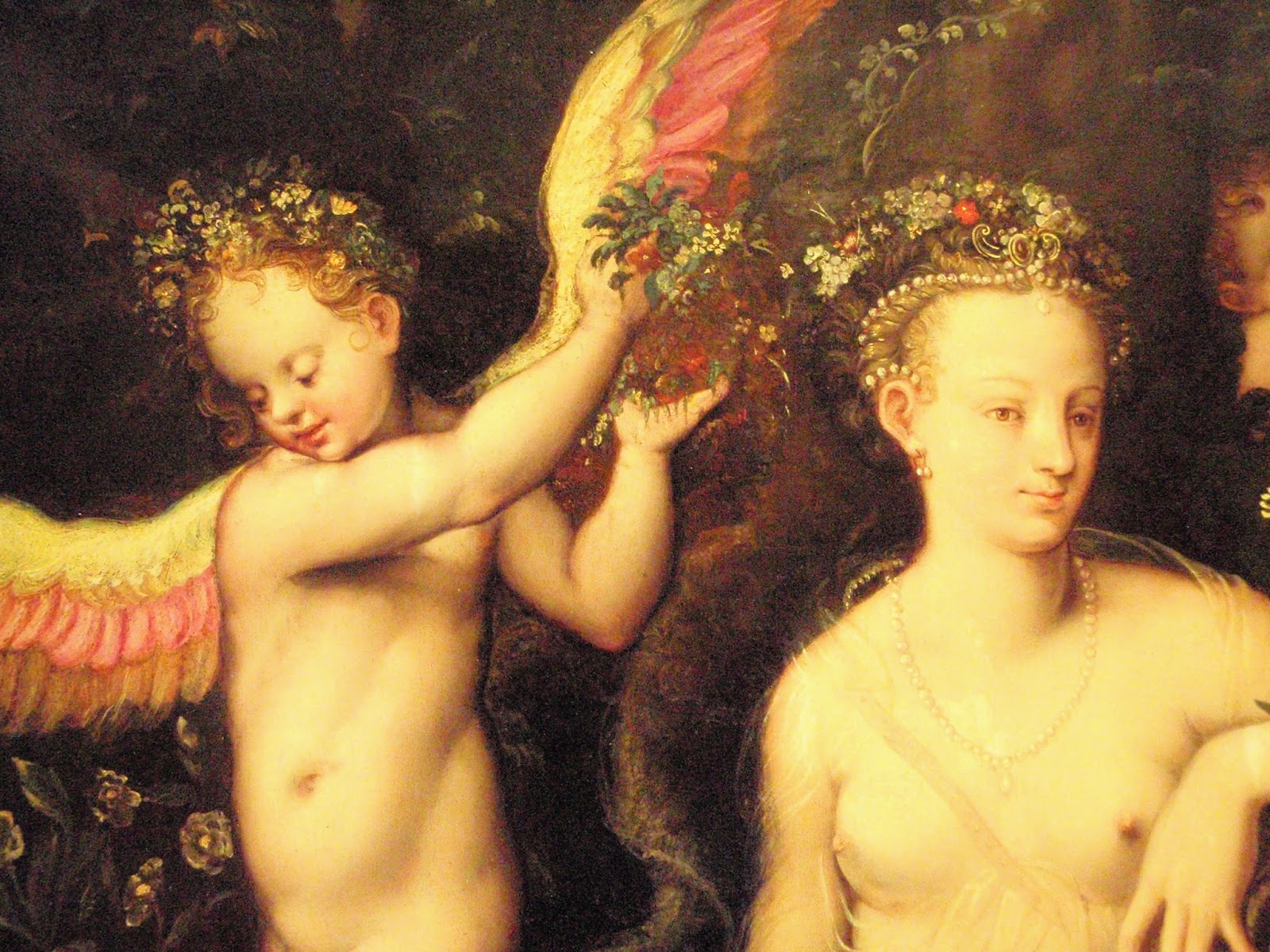
(The photos are details of paintings at the Legion of Honor: the first is Thalia, Muse of Comedy by Jean-Marc Nattier; the second is Venus and Cupid by the School of Fontainebleau; the third and fourth are from Giovanni Battista Tiepolo's The Empire of Flora.)

24 June 2015

fun stuff I may or may not get to: July 2015

BART Update
As I've been noting every month since April, BART had announced a track shut-down between Coliseum and Fruitvale, scheduled for several weekends a month from April to August. The good news is that they seem to have finished early. The I'm raising my eyebrow at you, BART news is that they didn't bother with more than a cursory announcement of that fact. You'd think they'd have something up on their website, if only to pat themselves on the back for finished ahead of schedule. Such an announcement would also be reassuring to people who have been thrown by BART's capricious way of suddenly announcing and then quietly changing the shut-down dates.

I did actually take the bus bridge one Sunday afternoon, because I had a ticket for a matinee I didn't want to miss. The bus bridge was, how shall I put this, surprisingly endurable? On both ends the buses were there waiting, and there seemed to be enough of them for the crowds, which was good because many people had no idea this was going on (and this was a month into the project) so ridership was probably close to normal Sunday levels. I don't know if I just got lucky with the buses – I definitely got lucky on the return trip, because if I'd reached the San Francisco station two minutes later I would have had to wait at least another twenty minutes for a train, though that is not really due to the shut-down problem and is more in the nature of just one of BART's regular problems, which is that they don't run enough trains. I also have to say: people move so slowly I cannot believe it. I'm not talking about elderly, very young, or disabled passengers, I mean adults who should be able to walk on an escalator or at least know enough not to block them. In the event of (God forbid!) some disaster striking, I am just going to shove people out of my way. Seriously. Or at least scream at them to speed up their strolling. Slow-moving is a particular problem in the many stations that have narrow staircases/escalators and not enough of them. Which is most of the stations.

In short: the bus bridge worked surprisingly well, but added enough time and trouble to the trip so that I would not want to deal with it late at night.

I think I was correct in guessing in my initial remarks on this situation that BART was going to be randomly announcing such track shut-downs for the next few years, because we have another one coming up, and since it involves the crucial area between the West Oakland station and the Transbay Tube, it is going to have an even bigger effect on riders. There will be buses between the 19th Street Station in Oakland and the Temporary Transbay Terminal in downtown San Francisco, but BART is presenting them as a last resort for desperate riders and is basically hoping you'll figure another way to do whatever you need to get done. The currently announced dates are the first weekend in August and all of Labor Day Weekend – but as repeatedly noted, and complained about, BART does have a history of changing their dates with little to no fanfare, so check their site as necessary and consider yourself warned.

As usual, July is a fairly quiet month for performances, but there are some fun things out there, particularly for opera fans.

Operatic
San Francisco Opera closes out the second half of its season with a few performances in July: one more of Berlioz's Les Troyens (1 July) and two more of Mozart's Nozze di Figaro (3 and 5 July; the 3 July performance is simulcast at Major Phone Company ballpark; the simulcast is free but you need to register).

San Francisco Opera's Merola Program for young artists starts up when the regular season ends; there is a concert (presumably of opera arias, though no specific program is given on the website) on 9 July at the Conservatory of Music and a repeat on 11 July (matinee) at Yerba Buena Gardens; then on 23 and 25 (matinee) Merola presents Puccini's Gianni Schicchi on a double-bill with Menotti's The Medium at Cowell Theater at Fort Mason (from a public transportation point of view, this is a difficult location; I'm not sure why they moved from the lovely auditorium at Everett Middle School that they have used the past few years). Click here for more Merola information.

At the other end of the month (and mostly into August), West Edge Opera holds its second summer festival, again presenting three operas – Monteverdi's Il Ritorno d'Ulisse in Patria, Berg's Lulu, and Laura Kaminsky's As One, a new chamber opera exploring the life of a transgender woman. Each is in a separate and intriguing location: Lulu is in the abandoned 16th Street train station in Oakland on 25 July, and 2 (matinee) and 8 August; Ulysses is in the American Steel Studios at 1960 Mandela Parkway in Oakland on 1, 7 and 9 (matinee) August; and As One is in the Oakland Metro on 26 (matinee) and 31 July and 8 August (matinee).

I have conflicting feelings about these venues. On the one hand, they sound potentially exciting and even glamorous in a sort of necrotic Norma Desmond way, with lots of site-specific possibilities. On the other hand, they are not public-transportation friendly (and please note that some of the dates coincide with BART's latest track shutdown, as noted above). I have walked to the Oakland Metro (near Jack London Square) from the 12th Street BART station; it's a bit of a schlep but do-able, though I would not scoff at anyone who did not feel comfortable walking it alone at night. For the other two operas, West Edge will provide a shuttle ($10 round-trip; free if you buy a "gold" ticket) to the West Oakland BART station (again: BART's latest shutdown will effect the 1 and 2 August performances, and it's possible West Edge doesn't even realize this yet). But honestly – and this is more the fault of our inadequate public transportation than of West Edge Opera  – the thought of waiting up to twenty minutes late at night at the West Oakland station really does not thrill me. What is West Edge's fault is their persistence in starting evening performances at 8:00, even as more tradition-bound organizations (like the San Francisco Opera) bow to reality and start performances at 7:30. I'd be a little more open to the wait if I thought it wouldn't be approaching midnight and the final possible train. There's also the horrifying thought of having to wait in a crowd of opera patrons while they gather themselves, slowly oh so slowly, to get on the shuttle. And then having to listen to their so-called "thoughts" on what they saw! I'm impatient enough already without dealing with that! Well, at least West Edge did add the shuttle option; when I checked their site a few months ago, there was no information about public transportation at all. Too bad there's only one matinee per opera, since that seems like the best time for this particular adventure.

Symphonic
As a lagniappe to the San Francisco Symphony's June Beethoven festival, and as part of its summer programming of popular concerts, you can hear Edwin Outwater conduct an all-Beethoven program – the Leonora Overture No 3, the First Symphony, and the Violin Concerto with soloist Liza Ferschtman – on 11 July. Outwater also conducts the other program that looks particularly interesting, when Awesome Principal Trumpet Mark Inouye and his jazz quartet join the Symphony for variations on some old favorites; that's on 9 July. Both those concerts start at 7:30 rather than 8:00, an innovation that I would welcome during the regular season.

Theatrical
Shotgun Players presents Caryl Churchill's Top Girls, directed by Delia MacDougall, from 2 July to 2 August.

San Francisco Playhouse presents Sondheim's Company, directed by Susi Damilano, from 7 July to 12 September.

No Nude Men revives William Marchant's 1955 comedy The Desk Set, directed by Stuart Bousel. Yes, this is the play that was made into a Tracy/Hepburn film, and it's about four women researchers who are losing their jobs to technological advances. Gee, can't imagine why they'd revive that now! The show runs from 9 to 25 July at the Exit Stage Left Theater.


26 May 2015

fun stuff I may or may not get to: June 2015

the BART reminder
Again, here's a reminder before you buy any tickets for upcoming events: BART is shutting off part of its tracks on certain weekends through August; since this will affect traffic as well as the rest of the BART system, you may want to check your plans against the latest shut-down dates, which are currently:

* Saturday and Sunday 6 - 7 June, all day;

* Saturday and Sunday 13 - 14 June, all day.

But be sure to check here for the latest information, since they've been switching the dates around, which is annoying.


Operatic
The big item at San Francisco Opera is of course Hector Berlioz's Les Troyens, conducted by Donald Runnicles and staged by David McVicar, with Anna Caterina Antonacci / Michaela Martens as Cassandra, Susan Graham as Dido, Bryan Hymel as Aeneas, Sasha Cooke as Anna, Brian Mulligan as Chorebus, Christian Van Horn as Narbal, and René Barbera as Iopas. But wait! as they used to say – there's more! You can also catch the world premiere of Marco Tutino's Two Women (based on the film starring Sophia Loren, which was based on Alberto Moravia's novel), with Nicola Luisotti conducting and Francesca Zambello directing; this also stars Anna Caterina Antonacci. The Opera is also presenting one of my favorites, Mozart's Le Nozze di Figaro, conducted by Patrick Summers, with a promising cast including Philippe Sly, Lisette Oropesa, Nadine Sierra, Kate Lindsey/Angela Brower, and Luca Pisaroni. Unfortunately it's the same production I've disliked (actually, loathed) in previous outings, but we can't have everything.

You can also go across the street to Davies Hall to hear some opera presented by the San Francisco Symphony. Charles Dutoit conducts a program including Ravel's one-act L'Heure Espagnole with the beauteous mezzo-soprano Isabel Leonard on 4 - 6 June (the rest of the program is Ravel's Alborado del gracioso and de Falla's Nights in the Garden of Spain). Later in the month, as part of their Beethoven festival, you can hear his only opera, Fidelio, led by Michael Tilson Thomas, with an excellent cast headed by Nina Stemme as Leonore and Brandon Jovanovich as Florestan. That's 25 - 26 and 28 June.

Symphonic
The San Francisco Symphony is dedicating most of its month to Beethoven. Michael Tilson Thomas conducts the performances unless otherwise noted. One highlight is sure to be the Missa Solemnis, with excellent soloists (Joélle Harvey, Sasha Cooke, Brandon Jovanovich, and Shenyang) along with our beloved SF Symphony Chorus. The performances will be semi-staged by James Darrah, who directed last year's stunning Peter Grimes at the Symphony as well as a brilliant Don Giovanni for the Merola Opera Program, so that's a good sign. You can experience that on 10 - 13 June. You can hear the Pastoral Symphony along with the Overture to the Creatures of Prometheus, the Piano Concerto No 4 with soloist Jonathan Biss, and the concert aria Ah, perfido! with soprano Karita Mattila on 17 and 19 June. You can hear the Fifth Symphony, the Sanctus from the Mass in C Major, and the Choral Fantasy and Piano Fantasy in G minor (with Biss as soloist again) on 18 June. And you can put all that together on 20 June in the Beethoven Marathon, a recreation of the famously overpacked concert that featured the premieres of the Fifth and Sixth Symphonies along with the Piano Concerto No 4 and the Choral Fantasy. On 30 June you can hear the Fifth Symphony, this time led by Edwin Outwater, along with Rachmaninoff's Piano Concerto No 2 with Garrick Ohlsson as soloist.


If you're not in the mood for Beethoven but you still want to hear an orchestra, preferably playing rarities, then check out the Bay Area Rainbow Symphony's 6 June concert at the San Francisco Conservatory of Music. Titled Portrait of the Artist as a Young Woman and led by Music Director Dawn Harms, the concert features music by three women composers: the Partita for Piano and Strings by Vitězslava Kaprálová, the Piano Concerto by Clara Wieck Schumann, and Serenade by composer, suffragette, and friend of Virginia Woolf – that's not a euphemism, she really was a friend of Woolf's – Dame Ethel Smyth. The piano soloist will be Sara Davis Buechner. Earlier that same day, Buechner will give a program called Crossing the Concourse: Sara Davis Buechner in Words and Music, in which she will (quoting from the press release) "illustrate her life story and transgender journey with short piano pieces, including one of her own compositions." You can find out more and get tickets to either or both performances here.

Theatrical
At Cutting Ball Theater the annual Risk Is This. . . series of new play readings continues; you can still catch Katharine Sherman's nightcap (31 May - 1 June); Andrew Saito's Whisper Fish (7 - 8 June); and Andrew Saito's Beauty Secrets (14 - 15 June). More information may be found here.

Shotgun Players has Heart-Shaped Nebula running through the 14th. On 8 and 9 June they present as part of their "Champagne Reading Series" Madeline George's The (Curious Case of the) Watson Intelligence. A few years ago Shotgun presented another play by George, Precious Little. I had mixed feelings about it, but there was enough there of interest so that I would be interested in seeing another of her plays. You can find out more here.

The American Conservatory Theater is opening a new venue on Market Street, not far from its home theater on Geary: the newly renovated Strand Theater. Like the Geary, the Strand was built in the early years of the twentieth century, but unlike the Geary it suffered a slow yet dramatic decline, ending up as a porn house (which I guess is another business model, like independent bookstores, hit hard by the Internet). It has been thoroughly renovated as a venue for smaller productions, with the hope that it will make a seedy section of Market Street a cultural center; it's opening on 3 June with Caryl Churchill's Love and Information, directed by Casey Stangl; check here for more information on the theater and the play.

Modern/New Music
Composer Terry Riley is turning 80 this year, and he's being celebrated musically:

Old First Concerts presents pianist Sarah Cahill on 19 June in A Piano Party for Terry Riley at 80, in which she will play new works in celebration of Riley's birthday by Samuel Carl Adams, Pauline Oliveros, Gyan Riley, Evan Ziporyn, Christine Southworth, Danny Clay, Dylan Mattingly, Luciano Chessa, Elena Ruehr, and Keeril Makan.

The Kronos Quartet presents a Terry Riley Festival at the SF Jazz Center from 26 - 28 June, with performances of Riley's music by the Kronos Quartet, Wu Man, Zakir Hussain, and others. There's a different program each night – the third night is Riley's vast string quartet Salome Dances for Peace. You can click here to see the first night but go here to the Jazz Center schedule to get to the others (and while you're there you can check out the other concerts going on there in June).

Pierre Boulez is also having a birthday year (his 90th), and he is being celebrated at Ojai at Berkeley (which is what used to be known as Ojai North). Presented by Cal Performances, this year's festival runs from 18 - 20 June. Steven Schick, this year's guest music director, has included lots of other great music, in addition to the Boulez. There are several concerts each day; check here for the full program.

The Center for New Music has its usual wide variety of possibilities; you can check the full schedule here, but some programs that jump out at me are: the Del Sol String Quartet playing Ken Ueno's Peradam on 4 June; Andrew Jamieson's Talking with Spirituals program, in which he improvises on the piano in response to traditional African-American spiritual, on 5 June; Ensemble San Francisco's Amor program, featuring new songs by Jose Gonzalez Granero sung by baritone Efraín Solís as well as music by Mark Ackerley, Osvaldo Golijov, Brahms, and Kodaly, on 11 June; and the Zofo piano duet playing music by Kurt Rohde and Terry Riley on 25 June.

Visual Arts
The DeYoung Museum is hosting JMW Turner: Painting Set Free, starting 20 June and running until 20 September. Like Les Troyens at the Opera, this is self-recommending.

29 April 2015

fun stuff I may or may not get to: May 2015

a reminder about BART

First a reminder before you buy any tickets for upcoming events: BART is shutting off part of its tracks on certain weekends through August; since this will affect traffic as well as the rest of the BART system, you may want to check your plans against the latest shut-down dates, which are currently:

* Saturday 2 May starting at 7:00 PM and all day Sunday 3 May;

* Saturday 9 May starting at 7:00 PM and all day Sunday 10 May; and

* Saturday 23 May starting at 6:00 AM and continuing to 8:00 AM Monday 25 May

But be sure to check here for the latest information, since they've been switching the dates around. Yes, those dates include Mother's Day and Memorial Day weekend. See here for what I wrote earlier about this whole situation.

And . . . already an update. Just today BART "announced" (that is, slipped a little note into a screen buried in their website) that in fact the trains will be running 2 - 3 May, but will be down all day 9 May as well as 10 May. No reason for the change is given. This is . . . aggravating. I had already made plans (or missed buying tickets) based on the previous schedule. And now that's all screwed up for me. Seriously: if you're going to mess up transportation for the entire Bay Area, stick to the dates you've already announced so people can make plans. I've said it before and no doubt will have to say it again: BART, when it comes to letting me down, you never let me down.


Visual Arts
The rebuilding of the San Francisco Museum of Modern Art means it's closed for another year or so, but they've been lending out parts of their collection and more than fifty artworks (paintings, sculptures, photographs, and videos) will be at the handsome Museum of the African Diaspora (MOAD) in a show called Portraits and Other Likenesses, starting 8 May and running through 11 October. Check here for more information.

You have until 10 May to catch the Asian Art Museum's exhibits on the Yoshiwara pleasure district and of ukiyo-e (woodblock prints). And you have until 31 May to see Botticelli to Braque: Masterpieces from the National Galleries of Scotland at the DeYoung Museum.

Early Music / Baroque Music
American Bach Soloists present music by Bach (the Concerto for Two Violins, the Orchestral Suite No 4, and Cantata 169, Gott soll allein, mein Herze haben), Vivaldi (Nisi Dominus), and Leonardo Leo (Concerto for Violoncello in A major), conducted by Jeffrey Thomas and featuring countertenor Ian Howell, Gretchen Claassen on violoncello, and Elizabeth Blumenstock and Cynthia Black on violin. That's 1 - 4 May in a different location on each day so check here for more information.

Operatic
Opera Parallèle presents the American premiere of Heart of Darkness, based on Conrad's story, with libretto by Tom Phillips and music by Tarik O'Regan, directed by Brian Staufenbiel and conducted by Nicole Paiement. The enticing cast includes Isaiah Bell, Philip Skinner, Thomas Glenn, Jonathan Smucker, Daniel Cilli, Michael Belle, Igor Vieira, Heidi Moss, and Shawnette Sulker; that's 1 - 3 May at Z Space.

At the Oakland East Bay Symphony, Michael Morgan conducts Bernstein's Candide with an excellent cast including Thomas Glenn, Shawnette Sulker, Robert Sims, Tami Dahbura, Hadleigh Adams, and Katy Stephan; that's 15 May at the Paramount.

West Edge Opera presents a semi-concert version of Verdi's I due Foscari on 3 May at Rossmoor in Walnut Creek and 4 May at Freight & Salvage in Berkeley.

The San Francisco Conservatory of Music presents Britten's Albert Herring, with a student cast and orchestra conducted by Curt Pajer and directed by Heather Mathews, on 6 and 8 May

Theatrical
Cutting Ball presents the world premiere of Mount Misery by Resident Playwright Andrew Saito, directed by Rob Melrose. It's about the strange intersections in time and space of Donald Rumsfeld and Frederick Douglass. I've really liked what I've seen so far of Saito's work, so this is an exciting prospect. It plays 8 May to 7 June.

Also at Cutting Ball: the Hidden Classics Reading Series closes out its season with Heiner Mueller's Hamletmachine, directed by Rem Myers. That's on 17 May. And the annual Risk Is This. . . . series of new-play readings begins this month, with Mark Jackson's Who Is Heiner Mueller or the End of History (17 - 18 May), Christopher Chen's Caught (24 - 25 May), Katharine Sherman's nightcap (31 May - 1 June); Andrew Saito's Whisper Fish (7 - 8 June); and Andrew Saito's Beauty Secrets (14 - 15 June). More information on all of those plays may be found here.

Cal Performances presents the Handspring Puppet Company in Ubu and the Truth Commission, conceived and directed by South African artist William Kentridge and written by Jane Taylor, with puppets by Adrian Kohler. That's 1 - 3 May at Zellerbach Playhouse (not Zellerbach Hall, but the smaller theater beside it).

Custom Made Theater presents Grey Gardens, with book by Doug Wright, lyrics by Michael Korie, and music by Scott Frankel, directed by Stuart Bousel. It's based on the famous documentary, which some people find fabulous campy fun and I found extremely disturbing. Either one of those reactions might be a recommendation. That's 22 May to 21 June.

Shotgun Players presents Heart Shaped Nebula by Marisela Treviño Orta, directed by Desdemona Chiang, from 21 May to 14 June.

Berkeley Rep presents One Man, Two Guvnors by Richard Bean, directed by David Ivers. It's an updated version of Goldoni's The Servant of Two Masters, and plays from 8 May to 21 June.

ACT presents Sondheim's A Little Night Music from 20 May to 14 June.

Modern/New Music
At the San Francisco Symphony, for one night only (16 May), Michael Tilson Thomas leads the band in two works by John Cage: The Seasons and Renga. Tim Robbins is the speaker, and baritones Patrick Dupré Quigley and Christopher Dylan Herbert also take part. Clyde Scott is the video designer for Renga.

Symphonic
At the San Francisco Symphony, Esa-Pekka Salonen conducts Stravinsky's Firebird, Ravel's Mother Goose Suite, and his own Nyx on 30 April and 1 - 3 May.

Even if you can't make it to these concerts, check out this interesting interview with Salonen at A Beast in a Jungle.

Also at the San Francisco Symphony, Michael Tilson Thomas leads the orchestra in the Bartók Concerto for Orchestra, Mozart's Sinfonia concertante for Violin and Viola (featuring violinist Alexander Barantschik and violist Jonathan Vinocour), and a new work by Samuel Adams – so new that if it has a name, it has not yet been revealed. That's on 20 - 23 May, though the 20th is a morning open rehearsal and the 21st is up at Green Music Center in Sonoma. Then Charles Dutoit leads them in the Ravel orchestration of Mussorgsky's Pictures at an Exhibition, Stravinsky's Jeu de cartes, and the Elgar Cello Concerto with soloist Gautier Capuçon on 27 - 31 May.

New Century Chamber Orchestra plays Stravinsky's Pulcinella Suite, Schubert's Death and the Maiden Quartet (arranged for chamber orchestra by Mahler), and Murmurations, a new work by Derek Bermel. That's 28 - 31 May, in different locations each day, so check here for more information.

Chamber Music
San Francisco Performances presents the Brentano Quartet in works by Haydn and Debussy; they will also be joined by composer Vijay Iyer on piano for the west coast premiere of his Time, Place, Action. That's 10 May at the SF Jazz Center.

Cal Performances presents violinist Christian Tetzlaff and pianist Lars Vogt in a program of Brahms and Webern on 10 May.

Earplay closes out its season on 18 May with music by Dohee Lee, Bruce Bennett, Peter Josheff, Wayne Peterson, Carla Lucero, Nicholas Tzortzis, and Lou Harrison, at the ODC Theater.

Piano
San Francisco Performances presents Stephen Hough in music by Debussy and Chopin on 12 May at the SF Jazz Center.

Dance
San Francisco Ballet closes out its season with Helgi Tomasson's Romeo and Juliet, set to Prokofiev's score, from 1 to 10 May.

Choral
Volti presents Pandora's Gift, a short vocal/movement work with music by Mark Winges and libretto by Denise Newman. Robert Geary conducts and Erika Chong Schuch stages the work. That's 16 - 17 May at Z Space.

The San Francisco Symphony Chorus presents its annual concert on 17 May; Ragnar Bohlin leads them in Stravinsky's Mass, Poulenc's Figure humaine, and the Killmayer arrangement of Orff's Carmina Burana. The concert also features members of the Symphony, the Pacific Boychoir, soprano Joanna Taber, tenor Jonathan Thomas, and baritone Michael Taylor. I expressed some skepticism to a friend of mine in the chorus about Carmina Burana (I enjoy it, but don't feel much need to hear it again). He informed me that the Poulenc and Stravinsky would be well worth hearing. I dutifully bought a ticket.

Sven Edward Olbash leads the Lacuna Arts Chorale in works by C Hubert Parry and C V Stanford on 15 May at St Mark's Lutheran and 17 May at St Luke's Episcopal (both churches are in San Francisco).

at the Jazz Center
Quite a few interesting vocalists at the SF Jazz Center in May: Esperanza Spalding is doing a run early in the month, but it's sold out, though you could check with the box office for returns; the Carolina Chocolate Drops are playing 14 - 17 May; Lavay Smith & Her Red-Hot Skillet Lickers are playing 21 - 24 May; and Laurie Anderson is playing 28 - 31 May.

Cinematic
The San Francisco Silent Film Festival holds its twentieth anniversary festival from 28 May to 1 June at the Castro Theater. It opens Thursday evening with the silent version of All Quiet on the Western Front, with live musical accompaniment by the Monte Alto Motion Picture Orchestra (the festival has really wonderful live music for almost all its presentations) and closes the next Monday with Ben Hur: A Tale of the Christ, and you can keep your Chuck Heston, for me the only Judah Ben-Hur is Ramon Novarro. In between those two films are a wide-ranging display of the joyful variety of silent films, from classics such as Murnau's The Last Laugh (one of my all-time favorite films) and Flesh and the Devil (if you want to know why many consider Greta Garbo the most beautiful woman ever to step in front of the motion-picture camera, see this film) to rarities such as the Chinese Cave of the Spider Women and the newly discovered Sherlock Holmes with William Gillette. You can find a full schedule here and you can buy either tickets for individual shows or a festival pass that gets you into everything.


29 March 2015

fun stuff I may or may not get to: April 2015

a warning about BART
So once again I have to start off a monthly preview with a long-range warning about BART: on certain weekends starting in April and continuing through August, they will not be running trains between the Fruitvale and Oakland Coliseum stations. They will instead have a "bus bridge" between the two, and are predicting delays of up to an hour – also, they won't be keeping to any schedules or timed transfers. (If past experience is any guideline, the delays will be longer and service even more inefficient than predicted.) The biggest effect will obviously be on those who take the Fremont or the Dublin/Pleasanton lines, but undoubtedly delays will ripple throughout the system and since BART is basically suggesting you just drive on those weekends, traffic will be that much worse (the weekends, by the way, include Easter Sunday and all of Memorial Day weekend – enjoy the holidays, everyone!). And though the buses will be free to BART riders, presumably once you reach Coliseum by bus you then need to re-enter the system and pay an additional fare to get where you're going after that. Oh, BART: your dedication to making every trip as irksome as possible is truly overwhelming. When it comes to letting me down, you never let me down.

Even setting aside the inconvenience and waste of time involved, I can't be the only one who is given pause at the thought of standing out at Fruitvale for up to an hour late at night waiting for a bus. So I now have to figure out what to do about several concerts for which I've already bought tickets, and I guess I'll just have to give up several other performances I was hoping to go to. You may find the list of dates here, and even if you've seen the list somewhere before you may want to check it again, since as I just noticed when I went to get the link the dates have been revised since the original announcement about a week ago, which makes me wonder how thought-through this thing is.

The reason for the shut-down is to replace the track between the two stations. Sure, maintenance is crucial (and clearly they've been neglecting it for years), but even if I take their word for it (because, you know, BART has been so trustworthy!) that they need to stop operations for 11 or 12 weekends to make the fix . . . well, I find it hard to believe that the track between Fruitvale and Oakland Coliseum is the only one that needs replacing. Are we going to have to deal with this sort of thing sneaking up on us randomly for the next decade?

I'm just not willing to cut this incompetently managed system any slack. It's typical of my feelings about them that several years ago, when I was at the Berkeley station waiting for a train late at night after a concert, and I heard the station agent on the loudspeaker saying, "To the young man urinating on the platform: please do not do that" my first thought was not how gross the guy was being but that if BART would re-open its already inadequate bathrooms maybe he wouldn't need to piss on the platform – I mean, I doubt he was doing it for kicks. (After 9/11 the bathrooms were closed in several stations "for security reasons" because the terrorists; those stations all tended to be in areas with a high concentration of homeless people, which I'm sure was a complete coincidence. I should point out that in this case the platform pisser was not a homeless guy but probably a student at Cal, who looked as if he were going to the city with friends to go clubbing.)

Even the way BART slipped this news out shows how inept they are: None of the regular BART riders I have spoken to about this had heard anything about it. I, who ride BART almost every day, have heard no announcements and seen no messages in the stations; nothing has been sent to Clipper Card holders. . . . Who knows when I would have heard about this if I hadn't chanced upon an article on SFGate.com one recent morning – but when I went back an hour later the article was off their main page. There's just a discreet little link off to the side on the BART website to reassure me that I didn't just hallucinate the whole thing. Honestly: you cannot repeat information like this too often, because people just don't pay attention. Case in point: the SFGate article clearly mentioned that the closures were planned around the Oakland A's homestands, yet at least three comments of the maybe two dozen I read complained that this would affect people going to A's games at the Coliseum – even though, you know, it was right there in the article that the dates were picked so that it wouldn't affect those people. Of course, when the A's are away, the Giants usually are playing at home in San Francisco, so I guess if you're a Giants fan who lives in the East Bay, you're boned.

What really breaks what's left of my heart about this is that I truly believe in public transportation. I don't drive and rely on BART, but even more than that, I believe it's necessary for the environment that public transportation be made as desirable and convenient as possible – and even more than that, I believe it's crucial for us as a society to learn how to share public spaces together. Car culture is sick for more than the environmental reasons. I used to vote automatically in favor of any public-transportation measure. Now I automatically vote against anything that will give more money to BART, at least until transit strikes are banned and they get their spending under control (to make it clear: this is not an anti-union dog-whistle; I've discussed my feelings about the BART unions before so I won't repeat them, but I'm also talking about the incompetent management and the general amount they waste on things like, random example, overheating the cars when everyone who's riding is dressed for outdoors anyway). Voting against more funds for BART may seem like shooting myself in the foot, but what am I getting out of my increased fees and taxes? BART has shown itself an incompetent manager of public money; they get more and more and we've been getting less and less. I'll define what I mean by the "improved service" I'd like to see: (1) full-length trains (and I mean ten cars, which I rarely see even at rush hours, and I ride three of the four BART lines regularly) that (2) come more often (it's ridiculous to wait 20 minutes or more for a train). Oh, there are other things that should be dealt with – the poor station design, the inadequate train announcements, and so forth – but really: full-length trains, and more often. But BART can't even get that much right.

Anyway: exercise caution when buying weekend tickets, if you are BART-dependent, and even if you're not make sure you know the dates and leave yourself plenty of driving time.

Theatrical
Shotgun Players presents a reading of Adrienne Kennedy's The Ohio State Murders, 27 - 28 April, starting at 7:00 each night.

This may make it look as if there are slim theatrical pickings for April, but many of the shows listed last month are continuing into this month, so check those out as well.

Operatic
The Lamplighters present an attractive rarity: The Grand Duke, the last collaboration between WS Gilbert and Arthur Sullivan, for four performances only: 25 - 26 April at the Yerba Buena Center in San Francisco, 30 April in Mountain View, and 2 May in Walnut Creek.

Soloists from San Francisco Opera's Adler program will join Philharmonia Baroque in a production of Rossini's La cambiale di matrimonio (The Marriage Contract), along with some Mozart numbers. That's 15 and 17 - 19 April in their usual various locations.

The San Francisco Symphony presents John Eliot Gardiner and the English Baroque Soloists in Monteverdi's L'Orfeo on 27 April. Sadly it's in Davies Hall, which is about as far as you can get from an intimate Renaissance court theater, but you can't have everything.

The San Francisco Conservatory of Music presents Donizetti's L'Elisir d'amore, fully staged (by Jose Maria Condemi) and with a full orchestra (conducted by Scott Sandmeier), on 2 and 4 April.

Strings
San Francisco Performances presents violinist Hilary Hahn and pianist Corey Smythe in a program of works by Cage, Lang, Bach, Auerbach, and Schumann on 18 April.

Piano
San Francisco Performances presents Garrick Ohlsson in an all-Scriabin program on 6 April (this concert was rescheduled from 14 March) and Dubravka Tomsic in a program of Haydn, Beethoven, and Chopin on 19 April.

Dance
San Francisco Performances presents the Paul Taylor Dance Company in three different programs, 15 - 18 April at the Yerba Buena Center.

Cal Performances presents the annual visit of the Alvin Ailey American Dance Theater, with three different programs from 21 to 26 April.

The Shostakovich Trilogy, choreographed by Alexei Ratmansky, returns to San Francisco Ballet from 8 - 19 April; their other offering this month is a mixed bill of Caprice by Helgi Tomasson, the world premiere of Swimmer by Yuri Possokhov, and Balanchine's Four Temperaments, and that runs 10 - 21 April.

Choral
Cappella SF, led by Ragnar Bohlin, returns on 11 April with a program of "vocal music written in an orchestral style" with composers ranging from Gabrieli and Bach to contemporary composers like David Conte and Elliott Encarnación (who also sings tenor in the group). That's at the Mission Dolores Basilica (right next to Mission Dolores itself, an easy walk from the 16th Street BART station).

Early/Baroque Music
Cal Performances presents the Tallis Scholars on 10 - 11 April, in a different program each night.

Modern/Contemporary Music
The California Institute of Integral Studies presents the complete string quartets of John Zorn, played by the JACK Quartet (with soprano Tony Arnold). That's 30 April at the Palace of Fine Arts (seems like an odd venue to me – not that easy to get to; I've been to the Palace of Fine Arts but never for a concert so I don't know how suitable the hall is there).

Cal Performances presents the eco ensemble, conducted by David Milnes, playing works by Bedrossian, Leroux, and Campion on 25 April.

The San Francisco Conservatory of Music's baroque ensemble ventures into new music with Elinor Armer's Leonardo's Riddle, featuring Adam Cockerham on archlute. That's on 19 April, in the afternoon.

At the Center for New Music, the Plath Project concert I mentioned last month is now scheduled for 26 April.

Old First Concerts presents the Wooden Fish Ensemble in a celebration of the 70th birthday of Belgian composer Boudewijn Buckinx. The works by Buckinx include The Floating World, a large-scale piano piece written for Thomas Schultz, a founding member of Wooden Fish, as well as works by Hyo-shin Na in honor of Buckinx. That's on 12 April. On 24 April, they present the Friction Quartet playing the John Adams String Quartet along with world premieres by Max Stoffregen and Eric Tran.

Vocalists
Cal Performances presents tenor Ian Bostridge and pianist Wenwen Du in a program exploring the music and poetry of World War I. That's on 12 April. This looks like a highlight for this month!

Symphonic
Pablo Heras-Casado leads the San Francisco Symphony in a couple of programs: the first features Joshua Bell playing the Tchaikovsky Violin Concerto along with Schoenberg's Chamber Symphony No 1 and John Adams's Chamber Symphony, and you can catch that on 9 - 12 April; he's then leading a program of the Haydn 44, the Mozart Piano Concerto 9 with Igor Levit, Debussy's Prelude to the Afternoon of a Faun and the Stravinsky Symphony in Three Movement on 18 - 19 April. Esa-Pekka Salonen conducts Ravel's Mother Goose Suite, Stravinsky's Firebird, and his own Nyx on 30 April and 1 - 3 May.

Joana Carneiro leads the Berkeley Symphony in a thoughtful coupling of Mozart's Requiem with Choruses from the Death of Klinghoffer by John Adams; that's on 30 April.

21 February 2014

ubiquity of Ubu-osity

Last Sunday I saw Cutting Ball's production of Alfred Jarry's Ubu Roi, directed by Yury Urnov, in a new translation by Cutting Ball Artistic Director Rob Melrose. When the play premiered in Paris in 1896 there were riots in the audience, and the play immediately became a touchstone of modernism and a milestone in theatrical history. Oddly, though that kind of thing is right up my alley I had never seen or even read the play before. I'm always fascinated by these lacunae among aficionados; life is crammed with incident, most of it irrelevant to what we're really interested in, and time grows scarce, and you can't get to everything, and admitting that is admitting your mortality. Anyway I walked into the theater with only the vaguest idea of what I was going to see, and though apparently some adjustments have been made from the original version I can't speak to what exactly they are, though I can say that this production is brilliantly entertaining, with the sort of simple, even subversive directness that can only be produced by the highest sophistication.

The story itself is a variant of Macbeth; Father Ubu and his ambitious wife Mother Ubu join forces to take over the kingdom of Poland (the play of course predates Hitler, but for us it's as impossible not to hear an echo of the Third Reich in this plot as it is not to remember the Shoah during The Merchant of Venice). Along the way there are also refracted references to Julius Caesar, Hamlet, Richard III, and a bit of Romeo & Juliet, and maybe more, but though such things provide structure and ironic connections to theatrical history you could enjoy the play even without having heard the name "Shakespeare" ever before in your life; it's a slapstick tragedy that looks very much like the daily newsfeed. Few things fade faster than yesterday's shocking art; at this distance, though one can only admire the willingness of the Parisian audiences to be ridiculously outraged, what was absurd and obscene provocation to them looks like realism to us. The play has value beyond its historical interest and its once-shocking content.

The constantly repeated obscenities, for instance (generally versions of "shit"; I think there wasn't a single "fuck" uttered in the two-hour run time, which makes sense because devouring and therefore defecation are what you might call the all-consuming motive of the Ubus) sound depressingly like everyday conversations to us (I hear this sort of thing on the commuter trains and the sidewalks of the Financial District all the time); you have to want very badly to be shocked to find shit shit shit shocking, rather than a sad example of how we sound to each other these days – such accuracy forms its own scabrous satire on how we live now.

The setting for this production is a modern-style kitchen, all gleaming stainless steel and shiny utensils, which is a really brilliant concept, since it makes the setting both stylishly up-to-the-minute and primal: there is a basic hunger portrayed in these characters, who ignore or attack officially admired institutions of church and state and live in a world of abrupt, self-centered and self-serving actions breaking through the feeble veneer of civilized life. Ubu's opponents are sometimes portrayed using tomatoes or baby carrots, which is funny in the way of Chaplin's dance with the dinner rolls in The Gold Rush but also terrifying: Ubu looms over these little objects, slicing and smashing and devouring them. There's a honey bear that is put to threatening use, at one point last Sunday reducing two of the actors as well as the audience to helpless laughter. Spatulas become swords, the company forms itself into a horse, everything metamorphoses into something else. Clever use is made of music, lots of klezmer but also bits of Mozart and, in one memorable mimed battle, Barber's Adagio for Strings.

Ubu's opponent, the Czar of Russia, first appears shirtless and fishing; he is often shirtless and sporting, in the manner of Vladimir Putin, just one of the unobtrusive ways this production links the world of Ubu to the world around us. There is also the son of the King he killed, who (the son) is portrayed as a posturing, queeny youth, which was genuinely funny but also somewhat shocking to modern sensibilities, since we like to pretend that such caricatures have no basis in reality (I guess the shock of having to laugh at stereotypes is the current equivalent of an earlier age's shock at obscenity, just as people who these days casually say fuck would never use a racist epithet). Ubu is concerned almost entirely with how to get more money out of his world without having to spend any, even on the army he needs to defend what he has already grabbed. They might as well call him Mr 1%; his unprincipled and selfish greed is the guiding light for current American capitalism.

David Sinaiko, a Cutting Ball stalwart, brings his manic edge to Father Ubu, and Ponder Goddard is the hilariously scheming Mother Ubu. William Boynton, Nathaniel Justiniano, Andrew Quick, and Marilet Martinez bring the other parts to life. There is some audience involvement, of a painless and even enjoyable sort; when Mother Ubu towards the end tries to persuade her angry, stunned husband that she is an apparition, come to tell him that she has in fact never wronged him, some members of the audience get to read the "apparition's" lines to him (I was one of them – it's fun being an actor! but I was a little surprised that the other readers were so halting and stiff). Some of the audience members, depending on their proximity to the action, are given plastic ponchos to wear when the egg-tossing and tomato-smashing starts.

The last scene is done mostly on video, with stage directions read out loud as we see the Ubus wander out into the seedy surrounding neighborhood. It's an interesting way of transitioning us out of the theatrical world into the real but oddly similar world. It makes us conscious of theatrical artifice, and of how much it is a major element in the world around us, and our perceptions of that world.  As I left the theater I heard sirens and the rumor flying around the streets was that there had been a shooting in front of the Westfield Mall, just a block or two away from the Cutting Ball. This meant that the Powell Street BART station was closed, but of course the lazy, useless, overpaid BART employees didn't actually tell anyone that, and it wasn't until I got down on the dangerously crowded platform that I realized something was wrong. There were no announcements as to what was going on, and the electronic signs just flashed the usual boilerplate messages. I soon realized that I needed to get out of there and walk to another station. I stopped along the way to buy some chocolates, since I was quite hungry by then. And though I did spare a thought to the man who had been shot and his still-unapprehended would-be killer, I mostly cursed the inconvenience caused me by the greedy, incompetent BART employees who couldn't be bothered to get off their fat asses to tell people not to enter the station. Ubu's world is our world.

The show has been extended through 9 March. Go see it if you can. More information and tickets may be had here.

24 September 2013

fun stuff I may or may not get to: October 2013

First, a word of warning: as of this time, the BART labor situation is still unsettled. Even for those who don't rely exclusively on public transportation, a strike will roil and snarl Bay Area traffic horribly, and so in the continuing absence of a signed contract I would exercise extreme caution in making plans or buying expensive tickets for any events after 10 October, when the current sixty-day "cooling off" period expires, a period which appears to have been mostly wasted. My understanding is that if BART shuts down again due to a strike, there is little to nothing that anyone (such as the governor) can do. I am normally very pro-union, and hate the long-term trend in America of lavishing benefits on the few at the top by squeezing the rest of us, but I have no sympathy for the notoriously lazy and unhelpful BART employees, who give unions a bad name. They are already grotesquely overcompensated, and increases to their bloated salaries and benefits will be coming out of fare hikes and tax increases on people who do not make nearly as much – a further squeeze on people who can't afford it. I do not consider opposing the BART unions anti-worker, since I also consider BART management grossly overcompensated. It would be nice if any excess money in the system were used to improve their lousy service, but that doesn't seem to be a concern of any party involved.

While I'm talking about BART, here's a reminder that due to earthquake retrofitting on the transbay tube for the next year or so, trains after 10:00 PM Tuesdays through Thursdays will be delayed by up to twenty minutes. This means that, for all practical purposes, if you attend an event on those days that starts at the conventional 8:00 PM, your transbay trip is most likely going to be seriously delayed (twenty minutes counts as a serious delay when you have to get up to go to work the next day).

Over at the War Memorial, San Francisco Opera has a few October performances of Boito's Mefistofele (2 October) and the world premiere run of Picker's Dolores Claiborne (1 and 4 October). Bicentennial birthday boy Verdi is represented by his wonderful Falstaff, the only opera that actually improves on a Shakespearean source (granted the source is the weak Merry Wives of Windsor), opening 8 October, with Bryn Terfel in the title role and Nicola Luisotti conducting; and the other bicentennial birthday boy, Richard Wagner, is represented by The Flying Dutchman, opening 22 October, with Greer Grimsley in the title role and Patrick Summers conducting. There is also a one-off performance of Verdi's Requiem on 25 October, with Luisotti conducting and soloists Leah Crocetto, Jamie Barton, Michael Fabiano, and Vitalij Kowaljow.

There's also a lot going on across the street at the San Francisco Symphony, starting with Pablo Heras-Casado conducting a mini-festival of mostly Mendelssohn and Adès: 3 October (evening) Adèhimself joins baritone John Brancy and members of the Symphony in chamber music by Debussy, Ravel, and Adès; then on 3 (matinee) - 6 October Leila Josefowicz joins them as soloist in Stravinsky's Violin Concerto, along with works by Lully and Adès, and Mendelssohn's Scottish Symphony; 10 - 12 October, in addition to works by Mendelssohn, soprano Audrey Luna, mezzo-soprano Chrlotte Hellekant, and baritone Rodney Gilfrey will perform scenes from Adès's The Tempest. Later in the month Edwin Outwater conducts works by Ligeti, Dvorak, Lutoslawski, and Prokofiev (Piano Concerto 3, with soloist Simon Trpceski), 24 - 26 October. There are also solo concerts by Andras Schiff (Bach Partitas, 6 October, and both the Goldberg and Diabelli Variations, 13 October) and Yuja Wang (Prokofiev, Chopin, and Stravinsky, 15 October), among other things. Get more details and check out the other scheduled concerts here.

For more in the symphonic vein, there's Wagner, Rachmaninoff, and a world premiere by Edmund Campion at the Berkeley Symphony on 3 October, with Joana Carneiro conducting. UPDATE: for medical reasons Carneiro is unable to travel, so Gerard Schwarz will now conduct this program.

Countertenor David Daniels and soprano Carolyn Sampson join Philharmonia Baroque in a program called Pergolesi in Naples, though it also features arias from Handel's Giulio Cesare and Rodelinda and a concerto grosso by Durante. The Pergolesi works are his famous and beautiful Stabat Mater and the sinfonia from his opera L'Olimpiade. That's 2, 4-6 October, in their usual variety of venues, though note that the San Francisco performances are at the Jazz Center due to Herbst's closure for retrofitting.

Curious Flights closes its inaugural season with a program called Transatlantic Crossings (collaborations between Bay Area and UK musicians and composers), featuring new or newish works by Dylan Mattingly, Larry London, and Edwin Roxburgh. I missed CF's second concert, a Britten tribute, since I was having a cornea scrape, which is exactly what it sounds like (I've been having a superfun year!), but I was at their first concert, the pleasures of which made me want to attend the others. This one is 18 October at the SF Conservatory of Music.

Also at the Conservatory of Music, BluePrint new music ensemble, led by Nicole Paiement, plays David Del Tredici (Dracula), Stephen Hartke (Meanwhile: Music for Imaginary Puppet Plays), Tobias Picker (selected songs), and John Cage (Living Room Music), on 5 October. At the other end of the chronological line, you can hear the Conservatory's baroque ensemble in vocal music of Monteverdi, 24 October.

If you're looking for further adventures in new music, check out the schedule of the Center for New Music. A couple of events that jump out at me are pianists Sarah Cahill and Adam Tendler on 19 October and vocalist Ken Ueno with Tim Feeney on percussion and electronics on 31 October. I have not yet been to this venue, which is conveniently located right by the Powell Street BART stop, but I hear great things about it.

Another interesting new music event is composer/vocalist Lisa Bielawa's Airfield Broadcast, which involves hundreds of performers spread over Crissy Field, so that (at least this is my understanding) as you move around you will have different musical/spatial experiences, each unique to that particular moment and situation. That's 26 - 27 October, and you can find out more here.

San Francisco Performances opens its season this month; they are co-sponsors of the Andras Schiff concerts listed above under the Symphony, and they have the Juilliard String Quartet playing Beethoven, Schubert, and a new work by Jesse Jones on 27 October. Their season opener on 18 October features the exciting young singers Isabel Leonard and Alek Shrader, both of whom have appeared in solo recitals presented by SFP, but it is a season opener and a benefit and tickets are priced accordingly.

Cutting Ball opens its season with Sidewinders by Basil Kreimendahl, directed by M. Graham Smith, 18 October to 17 November at the EXIT on Taylor. Shotgun Players continues its season with Strangers, Babies, by Linda McLean, directed by Jon Tracy, 15 October to 17 November at the Ashby Stage. Both these plays are new and I don't know much about them, but both these theaters have good track records, so dive in.

Speaking of diving in, there is the usual abundance of possibilities over at Cal Performances; highlights include Keith Jarrett, Gary Peacock, and Jack DeJohnette on 4 October, mezzo-soprano Kelley O'Connor and soprano Jessica Rivera on 13 October, mezzo-soprano Stephanie Blythe with Les Violons du Roy on 20 October, and Musicians from Marlboro on 26 October; find out more about those programs and check out the other possibilities here.

17 June 2012

from vision to inheritance


After Attila on Tuesday I reached the BART platform just as my train was pulling in – and, unusually for that hour, it was a full-length train (they do need full-length trains on that line late at night, they just rarely run them; it’s all part of BART’s project to make commuting as expensive and unpleasant as possible). So I was pretty pleased with my BART luck and wondered how long it would last. Not long, was the answer: early Thursday morning a fire in west Oakland shut down the transbay tube. There I was, stranded in the east bay, with an expensive ticket to an excellent seat for that night’s performance of the John Adams/Alice Goodman/Peter Sellars opera Nixon in China, which I have wanted to see on stage since its premiere in Houston twenty-five years ago. People chuckle at my need to get to the theater early, but in the back of my mind I’m always thinking What if BART stalls? What if something happens? You know what it’s like when you realize your paranoia is justified? That's how I felt. (Which is not a bad frame of mind in which to contemplate the ambiguities of Richard Nixon, actually.)

Anyway, I attempted to keep my panicking to a minimum (not sure I succeeded) and with help from V I made it to Civic Center in plenty of time (even for me) for that night’s performance, the second of the run. I love this opera and have heard both recordings dozens (maybe hundreds?) of times. But I have never seen it in any form, having missed the broadcast of the original production as well as the Met livecast from last year. I’m going to start off with something negative, because I pretty much only have the one thing (and it’s not a fault of the production, but a preference of the composer, for reasons I do not understand): the amplification, though not as bad as it might be, led to some strange occasionally disembodied and flattened voices, and I sometimes felt the cast was singing against rather than with the orchestra. Everything else about the production – design, staging, lighting, costumes, cast, orchestra – is just completely awesome. (Tickets available here.)

Initially I did have some hesitation about Maria Kanyova’s Pat Nixon, who seemed a bit too much like a society woman – in fact, I realized after a few minutes that she was playing her as if she were Nancy Reagan. The actual Pat Nixon had a recessive, fragile quality that in the cultural context of her time was often read as a regressive banality, an active rejection of the counterculture and the feminist movement. (Now she seems a much more ambiguous and sadly gentle figure.) Kanyova’s portrayal certainly worked well, and it’s possible my opinion is colored by remembering the actual historical figure, at least as she appeared in the media of the time, but I think ideally the gentleness of the character would have been brought out a little more.

Confronted with this re-creation, those of us who remember not just the opera’s premiere but Nixon’s actual visit to China can’t help but reflect on the passing of time, of course. (The passing of time is also very much on the minds of the opera's protagonists: the aging and increasingly infirm Mao, a leader from a previous generation, reflects that "revolution is a boy's game" and the Nixons reflect on life during World War II, Pat at home and Richard in the Pacific Theater . . . "that was the time I should have died" he sings.) It’s strange to think that Nixon (who instituted wage-and-price controls, started the EPA, and funded the arts, along with many other less salutary actions) would be pilloried as a leftist these days by his own party. But then he always sought out vilification as justification for self-pity. He was a figure of deep Shakespearean shadows and conflicts; since then the presidential parade has mostly illustrated the banality of evil, and the advancing derangements of illegitimate empire. And Mao’s reputation as a political philosopher has sunk rapidly as the facts around the Cultural Revolution (and his whole repressive rule of China) become clearer. Both countries now are united in enriching their entrenched elites at the expense of the general population, particularly the working poor. It’s strange to look back on a time when the two countries were thought to represent such divergent paths.

Goodman’s superb libretto (allusive, elusive, evocative, poetic) concentrates on the days of the encounter, though it does hint at the darker qualities and other days of the protagonists: Nixon’s paranoia (“rats begin to chew the sheets”), Mao’s serene indifference to the suffering of others. Mme Mao’s murderous, controlling rage is deftly pointed out in “I am the wife of Mao Tse-tung,” her instantly celebrated aria that ends Act 2, in which ambiguous phrasing illuminates the character and indeed China’s situation. (During one intermission I heard a ninety-year-old woman exclaim, "This is the most intense opera I've seen! It's the whole history of China!") In the aria's first lines (“I am the wife of Mao Tse-tung / Who raised the weak above the strong”) it’s ambiguous who is being modified by the second clause: is she saying that Mao raised the weak above the strong? or is she claiming that glory? or is the implication that she is doing it through him? Ambiguity makes clear her urge to power. In the third and fourth lines (“When I appear the people hang / Upon my words. . . “) Adams sets the third line twice so that you don’t miss the threat hidden in the line break: when I appear the people hang. A few lines down (“And when I walked my feet were bound / On revolution.. . .”) the pause as the line breaks is significant again, a reminder of the oppressive conditions that led to the urge for a revolutionary break with the past – it wasn't just the colonial exploitation of China that caused rebellion, it was the traditional culture of China as well (early on, Mao tells us “We cried ‘Long Live the Ancestors!’ / Once, ‘It’s Long Live the Living!’ now”).

An interesting thing about finally seeing this work staged is noticing the increasing presence of Mme Mao during Act 2, as she guides the ballet and its audience and finally explodes in her fierce aria. Hye Jung Lee is astounding in the role; a tiny, intense young woman, her rich voice soars through her showstopper number without any strain or harshness; there’s a warm sultry undercurrent to her voice that reminds you that Chiang Ch’ing was a showgirl before she became Mme Mao.

The second-act ballet, a version of Red Brigade of Women, has always been one of my favorite parts of the opera. I know it’s supposed to be kitschy and clichéd, but it’s also thrilling and effective, with its mash-up of James Bond saxophones and sweeping Wagnerian strings: there’s a reason propaganda and Hollywood films take the form they take. I would maybe have toned down a bit the slobbering of the Kissinger character (Patrick Carfizzi), but it's suitable to the tone; this anti-imperialist story seems like a very pointed entertainment directed at the visiting Americans. After the Houston premiere I read several reviews that were completely baffled by the goings-on in the ballet, particularly when the Nixons, moved by the plight of the abused young peasant woman, insert themselves into the action. I was surprised that anyone was surprised. As soon as I heard about it I thought it was a brilliant idea: the China summit was itself an act of theater; Mao and Nixon and company were all playing roles that were reported (and their images created) according to set patterns: there’s theater, and politics that is enacted as theater, and “reality” that may or may not be real, and we’re watching all this recreated on stage – part of the idea’s brilliance was that it was so obvious to point out these ambiguities by blurring the sometimes arbitrary line between what is seen as theater and what is seen as real. (Short version: hadn’t any of these people seen Hamlet?)

I shouldn’t slight the men: Brian Mulligan is commanding as Nixon, dominating the stage immediately with his excited and even boyish delivery of his introductory aria (“News has a kind of mystery”), which expresses not only Nixon’s self-conscious view of himself as a world-historical figure, but his sense of how his image is being perceived by the public through the filter created by the media (with which Nixon had a well-known obsession). The President, though trying to embody a conservative view of America emphasizing self-reliance and continuity and contented success, smiles nervously, trying to win the approval of these placid and implacable older revolutionaries with their riddling and ambiguous remarks. Simon O’Neill captures the vigor and ambition of the physically fading Mao, his stentorian vocal lines part of his self-presentation as the new and improved Confucius. Chen-Ye Yuan is a Chou En-lai of reserve and depth. The entire cast is praiseworthy. Really, the whole production is all so well done, with so many nice touches! For example, the way the opening chorus (“Soldiers of heaven hold the sky”) takes place behind a scrim until “the people are the heroes now,” when the scrim rises and for the first time we can see the people clearly; or the lovely way Pat Nixon extends both arms out to her sides and slowly pivots as she sings her visionary Act 2 aria (“This is prophetic”).

One daring structural feature of the opera is the third act; it’s a tribute to what Adams, Goodman, and Sellars achieved that despite its lack of the big set-pieces of the first two acts and despite coming at the end of a long evening (the performance lasts three and a half hours) and despite coming after Mme Mao's searing barn-burner of an aria, it seems like the perfect ending, the right change in tone and mood and focus. We move away from the banquet halls and official tours and theatrical presentations and we hear fragmentary thoughts, and conversations, spoken or murmured but perhaps not meant to be heard. Nixon, the representative of officially optimistic America, dwells on his days in the Pacific Theater during the Second World War, thinking of death. Nixon and Pat dreamily dance, and so do Mao Tse-tung and his wife. Chou En-lai looks back in time and has no answers. His final words end the opera: “Outside this room the chill of grace / Lies heavy on the morning grass.” It’s one of those seemingly casual observations of the natural world, precise yet universal, typical of traditional Chinese poetry, evoking ambiguous and endlessly troubling, or calming, implications. (I wonder if I’m reading too much into the lines to hear an echoing reference to Whitman’s ultimately American leaves of grass, uniting both cultures in a single image?) The lines are both optimistic (the grace and the fresh grass) and cautionary (grace is chilly, and lies heavy; and there’s the usual “morning” / “mourning” homonym). The music is strangely calm and low as it ends.

This opera plays (and connects) with operatic history and conventions throughout just as much as with what we might call "history history." (The toasts echo the traditional drinking songs, there's a Queen-of-the-Night-style aria of rage and revenge, the three Chinese women translators recall the Queen of the Night's trio of attendants, there's a ballet, the personal and political intersect in a Verdian manner, the airplane-landing music in Act 1 evokes the pompous grandeur of the entry of the gods into Valhalla, Act 1 ends with one of those tumultuous scenes familiar from Rossini and company of everyone singing different things at once. . . .) It still reads and is perceived as "new", yet if you saw Turandot in 1950 you would be seeing something closer in time to its premiere than we are to the premiere of Nixon in China. The world has moved on since then, for better and worse. It’s an odd coincidence that this season opened and closed with operas on “contemporary” American history: first the puerile inanities of Heart of a Soldier and then the triumphant Nixon in China, a work both theatrically exciting and powerfully subtle. (I'm hoping the decline in depth and quality and the rise in unthinking militaristic jingoism from Nixon in China to Heart of a Soldier is merely a coincidence and not a sign of American cultural decline.) The music of Nixon in China clearly springs from the minimalist movement, but is already moving beyond it; though Adams’s music has become even richer since, this score still sounds fresh; you don’t listen to it thinking, oh, yeah, remember when everyone used all those arpeggios?; instead, you think I am going to have this music in my mind for weeks now. I’m happy to have it there.