Showing posts with label DeYoung. Show all posts
21 August 2015
Friday photo 2015/34
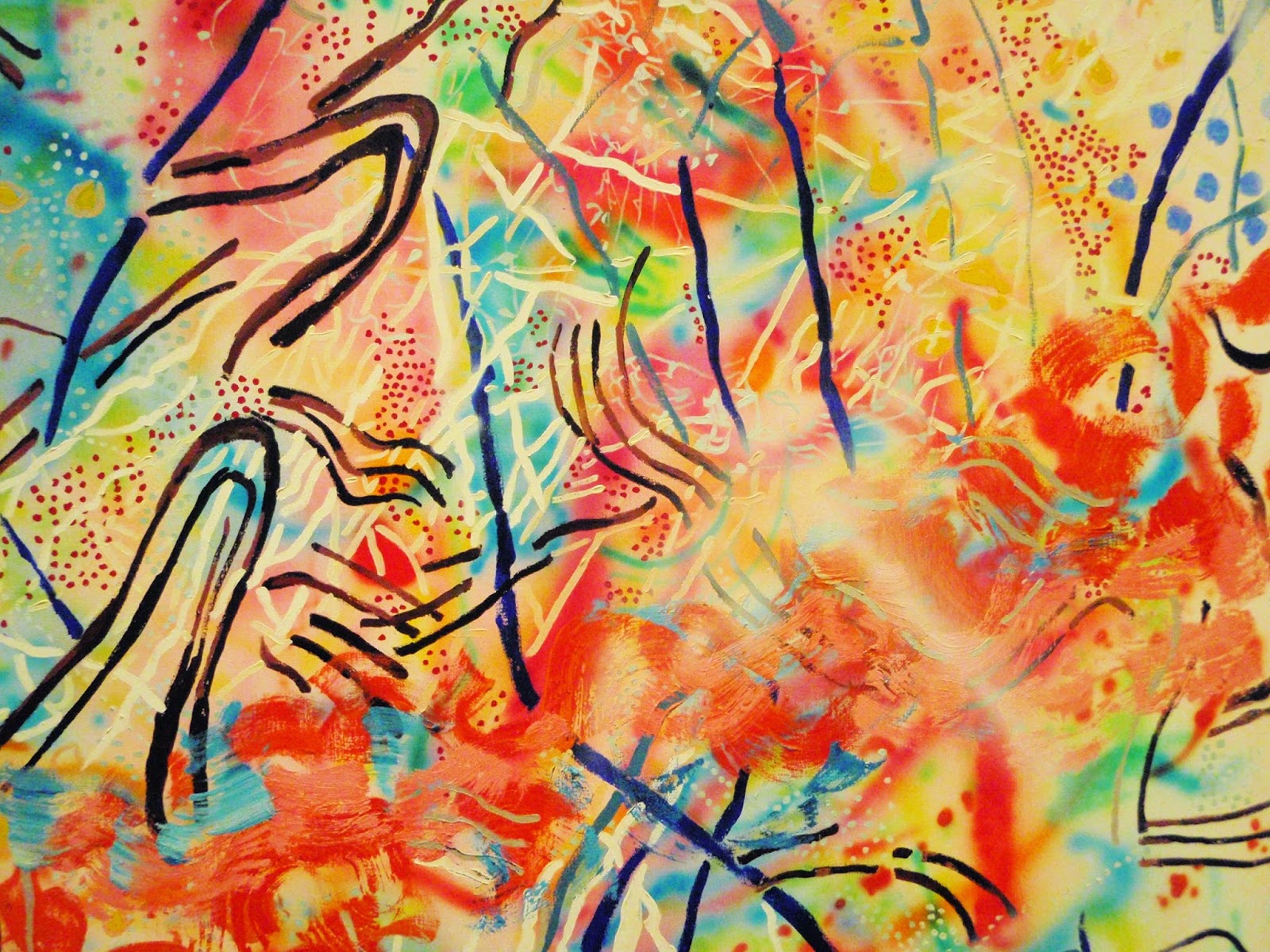
adjusted detail of The Tired Boxer, a bronze by Douglas Tilden, from the de Young Museum, San Francisco, August 2015
15 October 2014
28 September 2014
Modernism from the Meyerhoff Collection at the DeYoung
I guess the National Gallery of Art is undergoing some renovations, because there have been two local exhibits featuring parts of their vast collection: an Impressionist show that closed this summer at the Legion of Honor, and then over at the de Young museum modernist works from the Robert & Jane Meyerhoff Collection. Contrary to the usual practice in special exhibitions, photography was allowed in both; I assume this is because they come from a government-run museum. All of the photos of paintings below are only details and sections of the works; if you want to see the whole thing, the National Gallery allows you to search their catalogue on-line. The show is at the de Young until 12 October.
The entry way. All of the other photos are of paintings.
This is from Ad Reinhardt's Untitled (Yellow and White) of 1950. It's very forthrightly yellow, though I think it's meant as sort of a zebra painting, as in: is it black with white stripes, or white with black stripes? There are two shades of yellow there, though perhaps that's more a matter of how thickly textured the paint is.
The four below are all from Hans Hofmann's Autumn Gold of 1957. You can see the whole thing here. The paint textures are really rich in this one; it's good to see it in person.
Here's a whole painting: Frank Stella's Flin Flon IV of 1969. The exhibit is nicely arranged, with lots of space around the paintings, many of which are quite large.
Across from the Stella is an enclosed room which holds Barnett Newman's Stations of the Cross: Lema Sabachthani, a suite of fifteen paintings that correspond to the fourteen traditional stations of the cross (I don't remember what the fifteenth painting in this series represents). Lema Sabachthani is a shortened version of one of the sayings of Jesus on the cross: Eli, Eli, lama sabachthani? which means, My God, my God, why hast thou forsaken me? The phrase is found in Matthew 27:46 and also in Mark 15:34 (which gives Eloi, Eloi instead of Eli, Eli). The omission of the reference to God may explain why this Jewish artist chose a traditionally Catholic subject: the paintings are meditations on spiritual struggle in an abandoned world. They benefit from being seen together and in isolation, creating an atmosphere similar to that of the Rothko Chapel in Houston.
Below is a detail of the first station:
The one below gives you some sense (I hope) of the atmosphere the paintings create. Each canvas is well over six feet tall and about five feet wide.
Below is a detail from British artist Howard Hodgkin's Souvenirs of 1980-1984:
Below is a close-up section of Agnes Martin's Untitled #2 of 1981. I really loved this one so I had to include it here but none of the photos I took do justice to the subtlety of the colors or the textures. There are horizontal stripes of very pale red, kind of a beige-white, and very pale blue. I find her work very meditative; it rewards close contemplation. (That's another Martin painting I'm looking at in my avatar above.)
Eric Fischl's Saigon Minnesota of 1985 is a very large, unsettling work. It seems at first like some sort of family gathering in a suburb. But it's on four panels of different sizes, which look oddly cobbled together, so that there is no smooth surface. It's obviously summer, given the bathing suits and popsicles, but the very bright colors have an acrid edge.
Then you notice details like the man at the top and center of the work, who is missing an arm. Is Saigon a reference to the Vietnam War? Is the man a wounded veteran, who has brought the war home to Minnesota? In a note posted near the painting, Fischl says that the title came to him as he was working on the painting and noticed that some of the people were "[taking] on an Asian appearance while he painted. At the same time, the national press was reporting on an alleged child-abuse scandal in a small Minnesota town."
You wouldn't necessarily think "child-abuse scandal!" when you saw the painting, but there is something at least potentially disquieting going on in many of the poses. Even the characters who look like young people enjoying their summer take on an oddity in these surroundings.
The longer you look, the more fraught and ambiguous seem the relations among these people.
Across from the Fischl is Agualine of 1980 by Nancy Graves. I really loved this strong, vibrant, joyous work. Click here to see the whole thing and read some more information about the painting.
Philip Guston's Courtroom was in his controversial exhibit of 1970, when he puzzled and alarmed his public by returning to figurative painting.
23 January 2012
Venetian Masters at the DeYoung
Back before they rebuilt the DeYoung Museum but after they realized they needed to, there was some talk about relocating the museum from Golden Gate Park downtown, closer to other museums like the Museum of Modern Art, the Jewish Contemporary Museum, the Cartoon Art Museum, and the Museum of the African Diaspora, where it would be more accessible to the rest of the Bay Area and help form sort of a "museum district." I thought this was a great idea, but nothing came of it (oh, the unseen backstage intrigues that shape our existences!), and the DeYoung remains a long trek out of the way for most Bay Area residents.
I’ve never regretted the museum’s location more than during its magnificent current show, Masters of Venice: Renaissance Painters of Passion and Power, a jaw-dropping assortment of Mantegnas, Giorgiones, Titians, Tintorettos, and Veroneses (along with assorted others) on loan from the Kunsthistorisches Museum in Vienna. If the DeYoung were as accessible as SFMoMA, I’d be visiting this collection once or twice a week, the way I did with the Stein collection this summer. If you have any interest in Italian Renaissance painting, Venetian art, Old Masters, pictures of pretty naked people, or just great art in general, you really need to see this show. I’m hoping to go back again before it closes February 12.
On my first visit I was in the gift shop buying the very attractive and inexpensive catalogue and some prints and postcards, and a young saleswoman proudly pointed out that the DeYoung is the only venue for this show. I asked why that was. She told me that the galleries in Vienna were being redone. I already knew that, so I explained that what I meant was Why here? I didn’t want to come right out and say, “Why here, instead of a more prestigious venue like the Metropolitan or the National Gallery?” She didn’t know why. Another of those unseen backstage intrigues, I guess.
Whatever the reason, I’m grateful. It’s hard to describe how stunned and excited I was to turn a corner and see, in all its glorious jeweler’s precision, Mantegna’s St Sebastian, something I’ve known in reproduction most of my life. And here was the actual, irreplaceable thing! (Also: I don’t usually associate Mantegna with Venetian art, though he was active in Padua, which is close to Venice and was part of the Venetian republic at that time. But he comes down pretty clearly on the side of line as form rather than color as form, which is what the Venetian painters were famous for (to put it in terms of their contemporary art theory, he favored disegno over colore).)
And then to turn another corner and come across the enigmatic poetry of Giorgione, with his melting lucid landscapes and the calmly assertive looks of his many-meaninged figures, then to the bold Titians with their glowing nude women (and his later canvases, where the increasingly vivid brushwork almost takes over as the subject of the picture, in the modern way), and then to the Mannerist elongations of Palma Vecchio’s Bathing Nymphs, and the lambent rows of what a wall label amusingly and accurately describes as “beautiful anonymous blonde women,” and then to the vivid Tintorettos and the lush Veroneses . . . the DeYoung has become, temporarily at least, one of the great museums.
There are a few interesting labels discussing the changes due to the use of oil paints from tempera (richer, thicker colors) and canvas rather than wood (a different surface texture). Frescoes were less significant in Venice as well, due to the general dampness of the climate, which is nice for us since panels can travel and frescoes can’t (though frankly I can’t believe some of these paintings were available for loan – the St Sebastian, Giorgione’s Three Philosophers, Titian’s Danae – these, and others in the show, are some of the great images of Renaissance art).
Some of the assertions on the wall labels seem dubious, like the one about Tintoretto’s Susanna and the Elders (I’m quoting the version in the catalogue): “Men often displayed paintings of this kind in bedrooms, to remind their wives about proper married behavior.” Really? Susanna was a virtuous young wife, spied upon in her bath by two lecherous old men, pillars of the community. In an early example of sexual harassment, they threatened to claim she was an adulteress unless she actually became one with them. She refused and they accused. She was about to be stoned to death based on their calumnies when the prophet Daniel, then a boy, rose up and insisted on questioning the two old men separately (CSI: Ancient Israel!). Their contradictory answers exposed their falsehood, and the crowd stoned them to death, instead of the virtuous Susanna. If you know this story, and I assume any Renaissance Venetian who would own a Tintoretto would, it seems a lot more like a warning about proper married behavior for husbands. Tintoretto’s lushly decorative version may lack the psychological intensity of Artemisia Gentileschi’s versions, but it’s perfectly clear that his naked woman is pure of heart and his crouching old voyeurs are not.
I can only hope that some day the Kunsthistorisches Museum decides to redo their Pieter Brueghel galleries, with the Bay Area once again the beneficiary. If that happened I really would trek out to the DeYoung once or twice a week, no matter how awful the bus rides.
03 October 2011
Picasso in the park
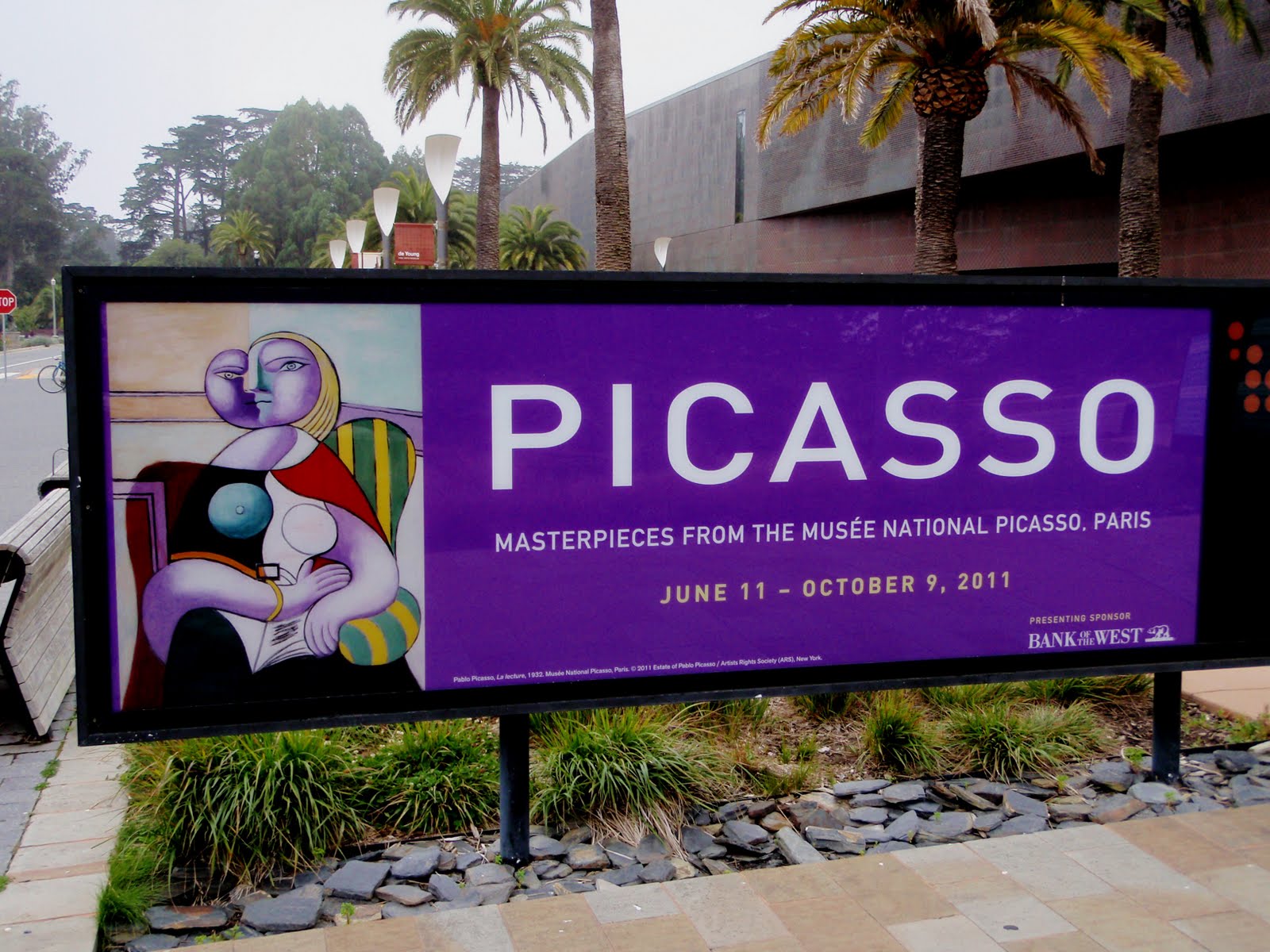
The show has been there a while but I was so absorbed in the Stein collection at SFMoMA that there wasn't room in my world for another exhibit, even one centering on an artist as central to the Steins as Picasso. It turned out to be an interesting complement to the SFMoMA show. Seen in the context of the Stein collection, Picasso seemed to be absorbing and reacting to the influences around him: Japanese prints, African masks, and most particularly the Matisses, whose striking and indelibly wild colors seemed to be pushing Picasso in the opposite direction, towards the monochromatic blue period paintings or towards the subdued browns and grays of cubism.
What the DeYoung exhibit brought out is how incredibly inventive, original, and influential Picasso was. He seemed like his own artistic universe. There must be a dozen pictures each in the show with titles like Head of a Woman, Woman with Hat, Artist and Model, yet each picture is different, often vividly different, from the others. There are pictures hanging next to each other of the same subject, yet one will be done with a classical authority and the other with all the abandonment of modernist distortion.
The curators did a really beautiful job hanging the show, by the way. Though the rooms can get fairly crowded (which is why I went on a weekday), the paintings themselves have well-judged space between them, hanging high enough so that they can be seen from across the room but not so high that you can't inspect them closely once the crowd opens up.
I got back on the #5 Fulton bus but hopped off as soon as I was close enough to a BART station. That turned out to be in Civic Center, where there was an interlude of brilliant sunshine and warmth between the fog of Golden Gate Park and the fog in San Leandro. Several skateboarders were taking turns going up a portable plywood ramp, and I was reminded of the energy and expressive physical contortions of the Picasso paintings I had just seen.
Subscribe to:
Posts (Atom)