22 July 2024

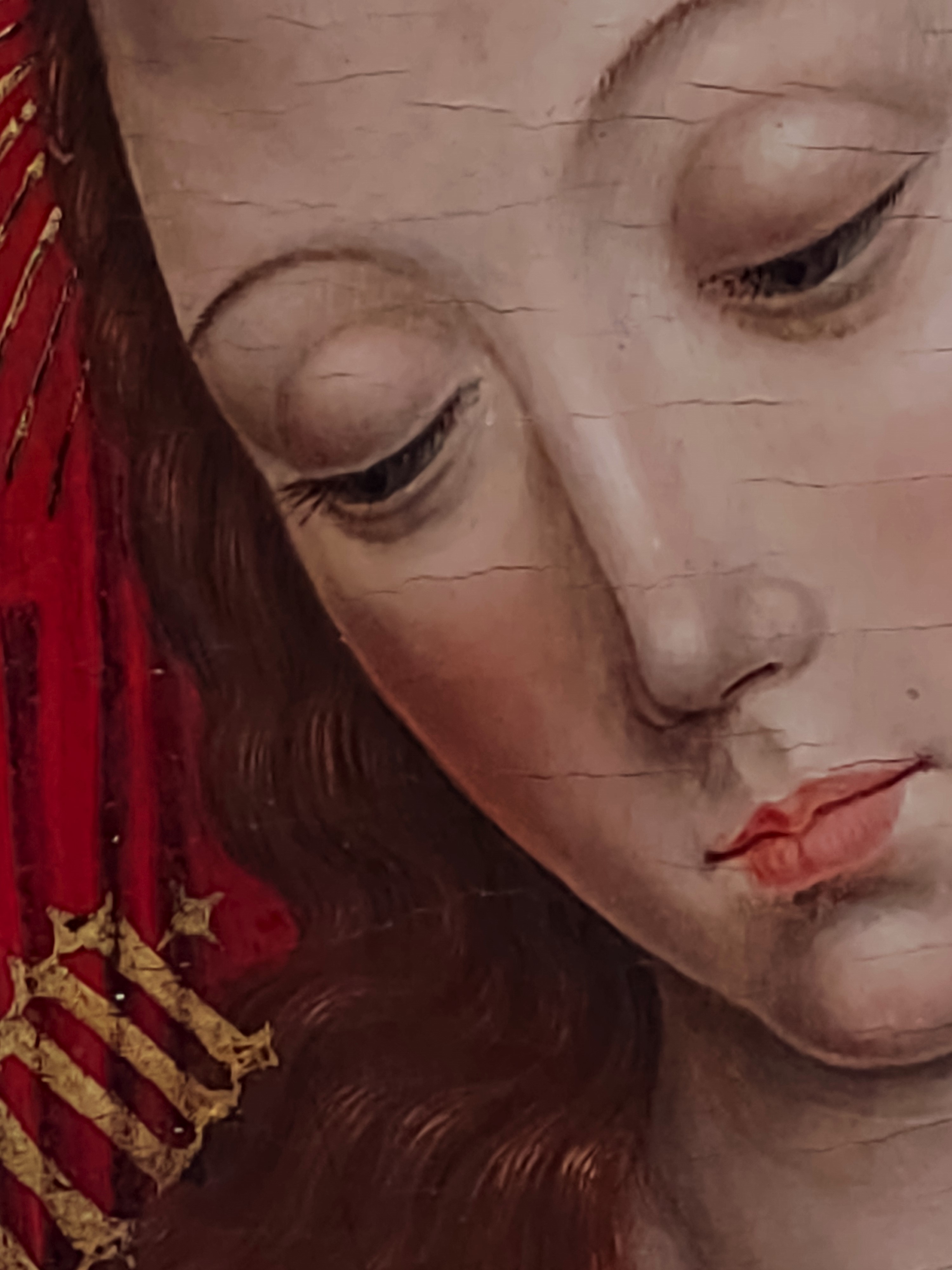
Museum Monday 2024/30


detail of The Annunciation by the Master of the Retable of the Reyes Católicos, at the Legion of Honor in San Francisco

19 July 2024

17 July 2024

Poem of the Week 2024/29

Salt and Vinegar

I consumed the salt and vinegar crisps
in a single gulp.
The packet ballooned with volume
to greet me; a twin
of my stomach, but darker –
when I finished
it wasn't as empty as my stomach once had been,
my hand stretched further into it
like a glove
and came up with shards, jagged
in the depths, the world's splintered residue.

– Amit Chaudhuri

Crisps are the very descriptive British term for potato chips. Salt & vinegar is a flavor inspired by the traditional malt vinegar used on the chips (French fries) in fish & chips (so many differing potato words!). I've had salt & vinegar crisps. They're actually kind of disgusting, with a highly processed, very salty, & somewhat acrid taste. But I can understand the craving for them, for this specialized artificial bloom of flavor, this attempted recreation of a homey comfort. Perhaps that is why the hungry poet consumed rather than ate them: they are very much a consumer product, as opposed to "food" in the sense of, say, an apple or pear. And if you like, you could read this poem not only as a description of a common experience – feeling very hungry, grabbing some junk food that will fill but not quite satisfy you – but also as a darkly humorous critique of how a capitalist society packages our needs in a way that leaves us needing more.

The poet is describing a familiar sight here: the bag, inflated like a balloon, that ends up holding many fewer potato chips than you think, or than you think you need. It's sort of a great bladder, filled with air, that deflates easily. He compares it to his stomach, also a sort of bag filled with items resembling food. One twin (the stomach) fills as the other (the bag) empties. The two are linked, the man's innards & the bag's crisps. Why is the bag the darker twin? Is it because his stomach can become full, & even too full, & the bag never has quite enough? Is it because a stomach can feel contented but the bag of crisps is calculated never quite to satisfy? He's eaten all the potato chips, but he still wants more. His hand goes further & further into the bag – like a glove, he says. First the bag is like his stomach, now it's like a hand covering. His snack keeps metamorphosing into bodily parts or body coverings. It's a bit eerie, a touch surreal.

Another familiar sight is the little bits of potato chip clinging to the inside of the bag, despite your best efforts to hoover up all available contents. It's a minor thing, of course, but acquires significance in  the poem: all the poet can come up with are bits that he describes in words conveying brokenness, a dangerous sharpness, rejected leftovers, something destroyed, broken, fragmented: shards, jagged / in the depths, the world's splintered residue. It's a  bit comic to describe little bits of flavored greasy potato chips clinging inside a bag in such evocative terms. But it replicates what most of us feel when we're eating a snack & it's run out before we want it to: it's not really a big deal, the people gulping down crisps are mostly not people facing serious hunger, we know we should be eating something healthier but we gave in to a craving: but it's still annoying in a way that seems, in the moment, important. And we can recognize the comedy in our reaction & still feel it as a reflection of our general disappointment in life. There's an underlying critique here, as I mentioned, of a consumer capitalism that comes close to satisfying our desires while still leaving us craving more. (I think it's not a coincidence that the crisps are in a tart flavor that is a chemical re-creation of a traditional dish; is this an attempt to sell us some profitable evocation of a national nostalgia?.) But beyond that, the poem is a weirdly comic & even unsettling look at the way our deeper hungers are never quite satisfied by the world.

I took this poem from Sweet Shop: New and Selected Poems, 1985 - 2023 by Amit Chaudhuri.

15 July 2024

10 July 2024

Poem of the Week 2024/28

Return

After a few centuries
we prodigals came home in August.

London lowered her skies.
The fatted calf withdrew
into sullen pasties.
People in pubs backed off.
We had lived among swine.

Only the small country churches
opened their dim doors to us
like ancient aunts.
Half blind, they mistook us
for their lost congregations.

– Virginia Hamilton Adair

Adair was an American poet, but whatever autobiographical incidents crystallized into this poem about a return to London don't really matter to us, its readers, & probably didn't matter much to her, either, as the very first line, with its capacious time frame of centuries, lets us know that this is not a literal travelogue.

There's a comic slant to the juxtaposition of the grand centuries with the very specific month of August. Why that month? It's a standard time for vacations, though this trip, with its centuries & the Biblical weight of prodigals, doesn't seem like an ordinary vacation. August is full-on summer, & your feelings about that time of year will vary depending on how you feel about heat, humidity, sweat, & flies. Despite the heat, it's the month that starts to signal the approach of autumn & then winter, a standard poetic trope for old age & death: grasses dying out, a breeze that's cooler than expected, brown leaves starting to fall on the sidewalks & roads more frequently; darkness is starting to fall a littler earlier each day. It's the month of things getting late, of the end approaching.

Prodigals in the second line is likely to put the reader in mind the strange parable of the Prodigal Son (found in Saint Luke, 15: 11 - 32), in which, to give it a slightly nonstandard (but I suspect common) reading, the dutiful younger son is taken for granted while the older, the Prodigal, goes out into the world, burns up the money he cajoled out of his father by living the high life, & then returns, repentant through poverty, to that father, who celebrates his return by fêting him with a fattened calf. The dutiful among us are going to find this deeply unfair & even troubling. Meanwhile, there's glamor & excitement to the Prodigal's life, even in his misery: he's burning the candle of his inheritance at both ends & winds up in a picturesque plight as a herder of that unclean animal, the swine: this isn't a grinding, scrimping poverty, a careful making-do-with; it's as romantic in its way as his wild parties.

What makes the poet prodigal? We never quite find out, nor do we find out who accompanies her (it's we who come back). Since she is an American, there is a suggestion that England is in some way, if only language, the "Mother Country"; anyone who writes poetry in the English language, even those with no genetic link to the island, is bound to see the language-source as, in some sense, a home. Is it simply her Americanness that makes the poet a prodigal, her country's separation from its original colonizers, the assumed wealth & carelessness of her country, or maybe just a feeling that one has strayed, done wrong carelessly with & in one's life, & needs to return to one's source?

London's greeting is not quite that of the father in the Biblical parable: the skies (the heavens, if you will), are lowered. Literal storm clouds? A more metaphorical reluctance in the greeting for the returned ones? The mention of the fatted calf confirms for the reader that the switch flipped by prodigal was correct: the poem is playing off the parable. But the effect, starting with the verb lowered in the first line of the stanza, is clearly going to be more subdued, less dramatically colored than the Biblical story. There is no Father here, rejoicing in his son's return; instead, rather than being slaughtered to feast the returned Prodigal, the Fatted Calf withdraws itself on its own volition, & fills its assigned role duly & dully in the form of sullen (dark, glum, moody, morose; anything but welcoming) pasties. A pasty is a traditional British meat pie, the sort of "heritage food" you would order while visiting a foreign place, in order to convince yourself you were having an "authentic" experience. The locals know this, & produce them for the tourist trade. This may be part of the sullenness; there's no indication that the pub pasties are tasty. And contrary to the stereotype of the welcoming pub crowd, here the returned Prodigals are given the cold shoulder – even more than that, they are actively avoided. They are tainted rather than made romantic by their degrading time among the unclean pigs. They are back,  but still outsiders, perpetually. The contrast with the parable underlines that this is a world without the guiding if perhaps puzzling & paradoxical ancestral faith that led the Father in the parable to welcome back his erring son.

In the final stanza, the poet has moved from one standard tourist attraction, London & its pubs, to another, the old churches dotting the countryside. And here the prodigals are welcomed, though not quite with full comprehension: the churches are small, their entrances are dim, they are like older relatives who, half-blind, can't quite remember who you are: yet they let you in anyway, giving some sort of welcome, at least more of one than the prodigals received in the grander venues of the capital. Again there is a sense that the past's faith-based ways & assumptions have mostly vanished, just like the congregations the churches have lost (has the faith died out? is it just that customs have changed, & regular church-going is no longer the signifier of respectability? have the churches, content in their old ways, failed to react wisely to the modern world?).

Is the title of this poem a noun, indicating the fact of a trip back to some sort of originating place, or is it a verb, an injunction urging us to go back to such a place? The Prodigal was certainly in a bad place when he decided to return, & we can assume that the poet, a self-proclaimed Prodigal, is also in some sort of place of need (perhaps emotional more than physical). In a modern world devoid of its long-time religious & related social customs, & in an ambiguous, disappointed way typical of adult life, the returned prodigal finally finds welcome, of a sort. It may not be enough, but it's what she gets.

I took this poem from Ants on the Melon: A Collection of Poems by Virginia Hamilton Adair.

08 July 2024

Museum Monday 2024/28


detail of Saint Sebastian, an etching by Odoardo Fialetti after Tintoretto, seen at the National Gallery of Art in Washington, DC as part of Venetian Prints in the Time of Tintoretto, an adjunct to their 2019 special exhibit Tintoretto: Artist of Renaissance Venice

03 July 2024

Poem of the Week 2024/27

Not marble, nor the gilded monuments
Of princes, shall outlive this pow'rful rhyme,
But you shall shine more bright in these contents
Than unswept stone, besmeared with sluttish time.
When wasteful war shall statues overturn,
And broils root out the work of masonry,
Nor Mar's his fire nor war's quick fire shall burn
The living record of your memory.
'Gainst death and all oblivious enmity
Shall you pace forth; your praise shall still find room
Even in the eyes of all posterity
That wear this world out to the ending doom.
    So, till the judgment that yourself arise,
    You live in this, and dwell in lovers' eyes.

– William Shakespeare

Given Shakespeare's long-time status as a world-wide cultural monument, & the widespread use of the English language as, if not a first, then a nearly universal second language, & the fame of this particular sonnet, it's easy for us to miss how breathtakingly arrogant & even delusional it is.

England at the time was, of course, even smaller than it is today, as Scotland was still a separate country & the Irish were barely under British control. Located on the edge of the Eurasian landmass, cut off by the sea from the rest of Europe, under constant threat from the superior strength of Catholic Spain & France, centuries behind the intellectual & cultural developments of a hotspot like the Italian city-states, not so far away in time from a series of bloody internal wars over succession & facing more of the same as their aging Queen (resplendent though she was) was clearly going to die without producing an heir, emerging from a series of back-&-forth switches between Catholic & Protestant religions, with a growing minority of Dissenters & Puritans, speakers of a language generally unknown outside the realm . . . . England was at this time a marginal & chaotic place, & English literature was pretty much being invented at this time. So for a poet to claim that his rhyme (in a form borrowed from the more sophisticated literature of Italy) would last through Judgment Day is, even for a poet, audacious.

The idea that poets grant eternal fame through their verse is rooted in the classical tradition, but, as noted above, England was not exactly the center of the classical revival. Yet Shakespeare does not acknowledge the marginal status of his language or his country: he simply claims the territory, with an assurance & magnificence that have helped to make his prophecy come true. And he saw clearly not only the power of officially acknowledged poetry but also the scruffier precincts of dramatic poetry: as Hamlet says of the traveling players, they are "the abstract and brief chronicles of the time: after your death you were better have a bad epitaph than their ill report while you live".

The poet stakes his claim in the very first line: not the golden but the gilded monuments are cited, suggesting that the princes have a veneer of glory but nothing substantial beneath that. Once the princes are safely under the marble, who's paying attention to them? The stone is unswept, smeared  & dirty with the passage of time (sluttish here suggests slovenly or slatternly, not sexually promiscuous – though that more modern definition isn't really inappropriate; there are lots of princes & rulers, & Time promiscuously gathers them all in, without too much distinction).

The second quatrain moves beyond the general forward movement & neglect of Time to the specific example of War, deliberately trying to root out – as every gardener knows, that means to destroy utterly – the memorials & memory of the previous regimes. The mention of overturning statues must be a recollection of the smashing of images that followed Henry VIII's break with the Catholic church & the subsequent imposition of a Protestant church on England: the references to war & the destruction of monuments are not hypothetical possibilities here, but actual events in living memory in a state perpetually besieged by internal & external forces.

In the third quatrain & the concluding couplet, Shakespeare moves beyond the forgetfulness caused by Time's regular passing & the active destruction of war into a grandly eschatological view: he is positioning himself (more accurately, his words) against death & ultimately the end of the world & the Last Judgment (this was a world that believed, though perhaps only on an official level, that Christ would return to judge the living & the dead); he asserts that his lines will last until the very end, the destruction & transfiguration, of the known world.

But of course it isn't accurate to say that poetry (particularly in the days when printing was fairly new & not inevitable for a writer, who, in the early modern world, often circulated their works in manuscript among their friends) outlives the depredations of Time & political or religious attempts to wipe it out: we have only to look at the huge gaps in what is left of even the most celebrated authors of Greece & Rome, or the chancy survival in a single manuscript of such now-celebrated works at Beowulf or Sir Gawain & the Green Knight, to realize how great a role chance plays in the survival of even the greatest works, particularly from the time before printing became widespread.

Is there some fear of loss lying, however deeply submerged, behind the bravado of this poem's assertions? Counterbalancing the confident assertion of the poet's power in this sonnet is a parallel track: he is addressing a lover. How much of the poem's forceful assertion is the poet's effort to persuade the lover (& perhaps himself) that he is worth paying attention to? From this perspective, his insistence can seem perhaps a bit overdone, in an effort to persuade this other person, who may or may not be responsive: I am giving you eternal life through my words, he insists; you will become an epitome for future lovers. The poet dismisses the chance of princes against Time's indifference & destruction, but does so while pleading for his lover to love him back, or at least pay some attention to his words. An indifferent lover can be harsher than princes or Time.

The ironic thing is that, against the odds – England's dicey state, Shakespeare's ambiguous status as poet & player (& therefore not a serious, powerful man), the tenuous state of the English language & literature – his words did come true. These lines will indeed last as long as English is read, which will, most likely, be until the world blows up in some way. The lover he addresses has indeed achieved immortality through his words, & lives in the eyes of, if not lovers, then lovers of poetry. But no one knows who exactly the lover is. There is much speculation on the identity of the "Dark Lady of the Sonnets" as well as that of the young man some of them are addressed to, but nothing is certain. There's nothing in this poem that even tells us whether it's addressed to the lady or the youth. The unnamed "lover", who may or may not even have been a specific person (Shakespeare might have been addressing some idealized but non-existent lover), has been transubstantiated into an eternally dazzling (but anonymous) image of The Loved Object.

There are many editions of Shakespeare's sonnets, of course, but I use the Signet Classic edition. This is Sonnet 55.
01 July 2024

Museum Monday 2024/27


detail of Ferdinand Pettrich's The Dying Tecumseh, on view at the Smithsonian National Portrait Gallery in Washington DC