and the upward glance,
past the tall faceless buildings
to the faceless stars
07 October 2011

06 October 2011
05 October 2011
04 October 2011
Haiku 2011/277
the warm south beckons
cheery cheesy travel sites
it's all for the birds
*******
the warm south beckons
clear blue waves hiss back, then crash
perpetually
cheery cheesy travel sites
it's all for the birds
*******
the warm south beckons
clear blue waves hiss back, then crash
perpetually
03 October 2011
Picasso in the park
 I took a day off work recently and trekked out to Golden Gate Park to see Picasso: Masterpieces from the Musee National Picasso in Paris, which is at the DeYoung Museum until 10 October (according to the website) or 9 October (according to the sign near the museum entrance).
The show has been there a while but I was so absorbed in the Stein collection at SFMoMA that there wasn't room in my world for another exhibit, even one centering on an artist as central to the Steins as Picasso. It turned out to be an interesting complement to the SFMoMA show. Seen in the context of the Stein collection, Picasso seemed to be absorbing and reacting to the influences around him: Japanese prints, African masks, and most particularly the Matisses, whose striking and indelibly wild colors seemed to be pushing Picasso in the opposite direction, towards the monochromatic blue period paintings or towards the subdued browns and grays of cubism.
What the DeYoung exhibit brought out is how incredibly inventive, original, and influential Picasso was. He seemed like his own artistic universe. There must be a dozen pictures each in the show with titles like Head of a Woman, Woman with Hat, Artist and Model, yet each picture is different, often vividly different, from the others. There are pictures hanging next to each other of the same subject, yet one will be done with a classical authority and the other with all the abandonment of modernist distortion.
The curators did a really beautiful job hanging the show, by the way. Though the rooms can get fairly crowded (which is why I went on a weekday), the paintings themselves have well-judged space between them, hanging high enough so that they can be seen from across the room but not so high that you can't inspect them closely once the crowd opens up.
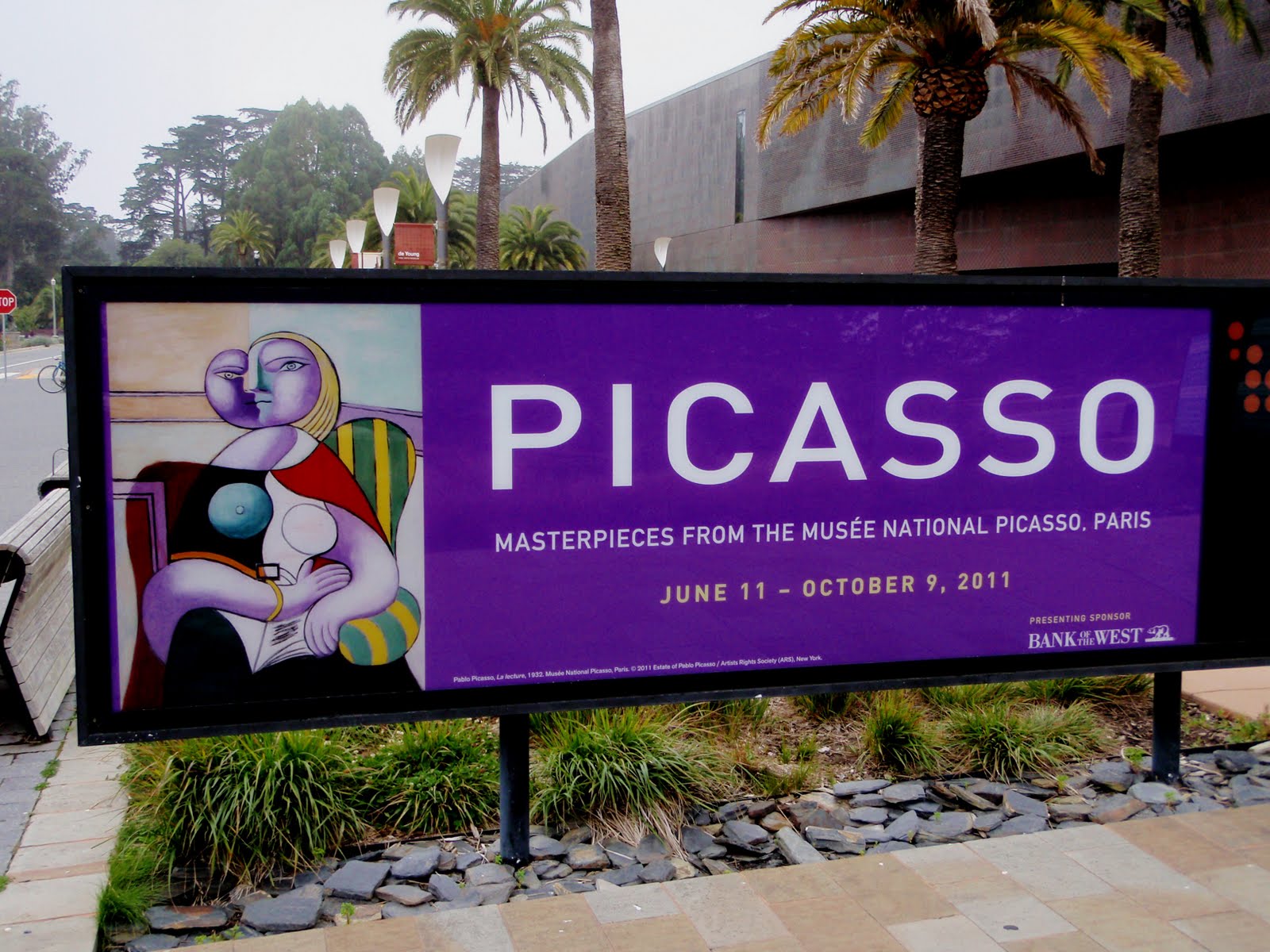 The pictures range from his very early days to the very end. There are pictures that reminded me of New Yorker covers and pictures that reminded me of classical frescoes and pictures that reminded me of mid-1950s hotel-room harlequin paintings. The show is in one sense smaller than I thought (I had the impression, from where I don't know, that there would be about ten more rooms) but its effect is aesthetically and emotionally much larger and frankly kind of overwhelming.
 Picasso is indelibly associated with Paris, especially in its avant-garde glory days in the early twentieth century, but he's of course very Spanish, and I was reminded again of how crucial Spain has been to shaping modern art and culture, though it tends to get overlooked a bit. Right by the DeYoung in Golden Gate Park are some reminders of the Spanish cultural influence; above, that's Junipero Serra, founder of the California missions, who covered the state with Spanish placenames; and that's a bust of Cervantes below. The two almost but not quite face each other across the parkway.
 There was an informative booklet available surveying Picasso's career, which I read during lunch in the cafeteria while waiting for my timed entrance to the show. It connects the works with cultural and biographical facts, which is interesting but also irrelevant; if Picasso (in Bullfight: Death of the Torero from 1933) did intend to show himself as the bull and his wife as the wounded horse and his mistress as "the effeminate matador," then that particular emotional complexity may be part of where the picture is coming from, but it doesn't explain the picture for me, a foreign viewer looking on long after the deaths of all involved, in any useful way. The emotions of the picture are there to be unpacked by the viewer and can be deduced without reducing them to biography. I think most artists are actually more immersed in the technical matters of their art.
 After viewing the show I took the elevator up the bronze tower for the panoramic view of the city, which was beautiful in the fog. But the elevators are rather small and the wait is long and I realized I was kind of trapped up there and I should have just left after seeing the Picasso show.
 I'll have more chances to check out the view from the tower, since I'm sure I'll be trekking out to the DeYoung several times for their upcoming show of paintings from Renaissance Venice.
I got back on the #5 Fulton bus but hopped off as soon as I was close enough to a BART station. That turned out to be in Civic Center, where there was an interlude of brilliant sunshine and warmth between the fog of Golden Gate Park and the fog in San Leandro. Several skateboarders were taking turns going up a portable plywood ramp, and I was reminded of the energy and expressive physical contortions of the Picasso paintings I had just seen.


02 October 2011
drink to me only with thine eyes
The John Pascoe production of Donizetti’s Lucrezia Borgia, staged as a vehicle for Renee Fleming, was so thoroughly trashed when it played in Washington a few years ago and again Friday before last when it opened here (in this work’s first appearance at San Francisco Opera) that last Monday I went into its second performance with very low expectations, which may have been a good thing because I found myself enjoying the evening thoroughly.
This is not to say that the production or the opera itself is particularly good, though approached in the right way it is entertaining and very effective. I’m the first person to sneer coldly at people who discuss all opera as if it’s silly inane camp (“but of course the music,” they always simper condescendingly, “is simply gorgeous!”), but if I were a lawyer arguing that case I’d do my best to have Lucrezia ruled inadmissible as evidence. You may well spend a lot of time trying to piece together the haphazard plot, but this is I think the wrong approach. What we have here is not Lulu; it is not even Lucia. What I realized during an early scene in which a suddenly unmasked Lucrezia is confronted with four or five men who take turns announcing which of their relatives she has murdered, while La Lucrezia makes an anguished but exculpatory little backward sweep of her hand, as if to say, “Well, yes, I did poison all those people – but what else was I to do?!?” – what I realized then is that what we have here is a Joan Crawford movie.
I need to point out that I was not one of those jackasses who feel the need to laugh at something other people are taking seriously, in order to show how superior they are to it (and to those taking it seriously). I need to point this out because I despise people who impose their reactions on others during a performance, or who feel the need to assert their superiority to something they’re enjoying (I have no guilty pleasures, at least aesthetically), and I realize I’m coming about as close as I can imagine coming to saying an opera is best enjoyed as camp. It’s just that I realized that if I approached this the way I would something like Le Nozze di Figaro, or some similarly deep and, you know, coherent work, then I would miss the very different pleasures provided.
So I sat silently and in perfect attendance, as did those around me, and perhaps I would have enjoyed myself less if the audience had been more annoying, or if the opera had started at 8:00 rather than 7:30, as I was pretty much done by Act 3: the experience of live theater is so fragile and fraught with peril! – much like life in Renaissance Italy, as portrayed in Lucrezia Borgia. I’m used to such a portrayal in Shakespeare, but it seemed a slightly odd approach for an Italian to take to an era in his country's history that is one of the glories of this world. I kept thinking of Shakespeare because watching Lucrezia was a bit like watching Two Gentlemen of Verona, in that there are situations that are quite enjoyable and satisfactory, unless you know some of the later plays in which similar situations are elevated far beyond the earlier work; I kept thinking of Verdi, in particular Un Ballo in Maschera, and how much more effectively he had treated some similar situations (or something like Macbeth, in which both Shakespeare and Verdi achieved something deep and unified, as Donizetti didn't with his heroine).
As for following the plot, the opera gods forbid that five minutes of stage time be taken from the inevitable drinking song or the chorus’s umpteenth repetition of such relevant sentiments as “Venice is awfully nice!” or “We like to party!” in order to clarify such questions as why young soldier Gennaro (tenor Michael Fabiano) was raised by a fisherman instead of his mother Lucrezia, why he has never been told that she is his mother, why she never tells him she is his mother when she runs across him in Venice (allowing him instead to proclaim himself in love with her, and not in a brunch-and-corsage-on-the-second-Sunday-in-May way, either), or – and this is the question that nagged at me the most – why she simply doesn’t tell her husband Duke Alfonso (Vitalij Kowaljow) that Gennaro is not her lover but her son, when such information could save Gennaro’s life, which seems to be her general goal. Yes, I can assume it’s a shocking or shameful secret, but what’s the point (other than providing a smashing final curtain, of course) of announcing it only when it is most obviously way too late?
You see that making sense of the plot is not the way to go here. You talk about tabloid operas – this is the mother of them all, steeped in gossip so sordid and scandalous it was whispered down the generations. Lucrezia Borgia is like Salome without the philosophical underpinnings. You can feel Donizetti straining to fit this wild, shocking Romantic-movement fantasia into the theatrical restrictions of the early nineteenth-century Italian stage, and not quite succeeding. It’s all about what is most vivid and sensational and depraved from moment to moment, and if that means a certain overall incoherence, or a lack of such niceties as plausible characterization, then so be it.
It’s all about the moment, and isn’t that where live theater exists, only in the vanishing moment? But I don’t want to make it sound like a philosophical exercise, or too aesthetic and rarefied, as if you were reading Mallarme or holding an opal up to the sun to watch it flash its dazzling colors; what watching Lucrezia is like is standing in the supermarket check-out line and reading contradictory tabloid headlines about the same star (the most relevant star in this case would be Angelina Jolie) and realizing that in that universe there is no contradiction.
The heroine is both a powerful, vindictive woman and a heart-broken mother; there are intimations of betrayal and lurid crimes of all sort; the plot is convoluted and elliptical to the point of incomprehensibility; and of course it’s all very noir, not only in style, but quite literally – whether a scene takes place in a secret dungeon or in a public square during what was later, to my great surprise, announced as “broad daylight,” the stage is plunged in unrelenting night – I might as well enter into the extravagant spirit of the thing and call it Cimmerian gloom. I assume this is a deliberate, if slightly puzzling, artistic choice, and not an attempt by the Opera company to cut down on its no-doubt expensive utility bills, but it sure doesn’t help when you’re trying to figure out which interchangeable minor courtier is doing what to another interchangeable minor courtier.
But, again, legibility is not the point. Given this approach, it was easy to enjoy the show without worrying too much about why the courtiers were occasionally elaborately choreographed and why they sometimes moved like regular human beings; or why people kept giving the Nazi salute (I don’t care if this salute was customary in Renaissance Italy; if you put it on stage in 21st-century America, it reads as a Hitler reference); or why – well, why bother listing? I stopped dwelling on such things. I even consented to pretend that the leather-clad jailer desultorily whipping a thin nervous dancer as the dungeon scene opened was the height (or depth) of titillating depravity, even though the newspaper that morning had far more explicit photos and descriptions from the previous weekend’s Folsom Street Fair (a major San Francisco tourist attraction), complete with a report from a nice middle-aged lady visitor that she hadn’t seen much like this up in Eugene, Oregon. The signifiers of depravity have their iconic functions.
The homoeroticism was not limited to leather-clad jailers. In Act 3 Gennaro, after spending the first two acts falling in love or at least horniness at first sight with beautiful women (even if they turned out to be his mother), was suddenly smooching in the piazza with his compatriot Maffio Orsini (mezzo Elizabeth DeShong). Usually this sort of shoe-horned same-sexiness irritates me, because you can tell the directors feel smug about how “honest” they are (when what they’re really doing is messing up the psychological relationships among the characters) and how “bold” they are (when instead they are simplistically reducing all relationships among men to purely sexual ones). But I entered into the anything-goes spirit of sensationalism so fully that when I realized that Orsini was not Gennaro’s pageboy, as I had initially thought (DeShong is quite short and youthful-looking, and her part kept reminding me of Oscar in Ballo, hence my pageboy assumption), I was mostly disappointed that the sulfurous whiff of pedophilia wasn’t adding to the heady tabloid brew.
I also loved the much-mocked costumes, which I found sumptuous, lurid, and slightly ridiculous, and therefore perfectly suited to the staging. It makes sense in the terms of this production that Lucrezia would visit her husband’s dungeon wearing a glam chiffon-and-shimmer ballgown in russet and green-gold, with her hair done up in a Dairy Queen swirl which was slightly off-center, no doubt to express inner anguish. In the grand finale, she bursts into the party room like the Red Death, wearing black tights and an elegantly cut (or hammered) silver breastplate, her hair now done in a severe and punitive shag, looking totally ready for Joan of Arc night at the dance club. She enters with sword grandly drawn, which may seem quite literally like overkill, as she has already poisoned the drinks of everyone in the room, but it is undeniably a kick-ass entry, and who am I to deny a diva her accessories in the name of some dramatic or logical principles that clearly had been set aside when the curtain first ascended?
Meanwhile Gennaro is rocking a pair of tights with broad vertical stripes in muted and blended shades of green – nothing too bright or primary, which is good because such shades really don’t work for the portrayal of overripe decadence, which is why I feel designers of Salome should reach for olive-green and purple and not crimson – topped by a golden pec-baring tunic perfectly suited for watching the tenor’s chest rise and fall as his last aria pours forth in the sweet anguish of death. I don’t usually react this way to costumes, but in this case I really had some sartorial envy: I thought, My God, if I were a Renaissance mercenary who smooched boys in the alley and fell in love with his own Mom, that is exactly what I would want to wear! My own costume of black pants and long-sleeved black T-shirt (long sleeves: the secret of elegance, or at least presentability!) seemed in comparison like a utilitarian failure to truly live.
I have no idea how the costumes read farther back in the barn that is the War Memorial Opera House. As I said, the lighting was notably dim throughout.
This was all a reminder that the pleasures of the opera house are not only musical. As for the actual musical pleasures . . . well, that was a mixed bag, though Donizetti had certainly supplied some promising raw materials. I have seen Carol Vanness carry roles that weren’t really suited to her through sheer force of personality; if Fleming didn't quite achieve that, seeming more disengaged, more a visiting celebrity than an engine of the story, well . . . as I mentioned earlier: Joan Crawford. Under the circumstances it didn’t seem entirely unsuitable for her to stand there smiling vaguely amid the destruction. She is more engaged and convincing in some aspects of the part than others – she’s much better at the suffering mother than the tempestuous temptress. Vocally some parts were rougher than others, but then there were moments of astonishing beauty, in particular one long sustained anguished note as her Act 1 unmaskers accuse her to her son, which may have been one of the most memorable purely vocal moments I’ve experienced recently in the opera house.
Clearly Fleming was the selling-point of the evening (quite literally; she’s been ubiquitous in the Opera’s marketing materials, and we were urged to subscribe before her appearances sold out), but on the whole the other singers provided more consistent pleasures; in particular Michael Fabiano made an excellent debut as Gennaro, with a strong and flexible voice that was always pleasing, and Vitalij Kowaljow was a thunderous and authoritative Alfonso.
As I said, I enjoyed my evening thoroughly, though I understand why the performances have gotten mixed and often negative reactions. The audience the night I went seemed generally quite enthusiastic, culminating in the now perhaps inevitable standing ovation. But when it came to that – well, so soon after we all stood for the SF Symphony’s epic and blazing Mahler 3, it just didn’t seem right to me to give the same tribute to the lurid pleasures of Lucrezia Borgia. But I’m not going to pretend I didn’t enjoy it all quite a lot, and I’m not going to sneer at what I genuinely enjoyed.
This is not to say that the production or the opera itself is particularly good, though approached in the right way it is entertaining and very effective. I’m the first person to sneer coldly at people who discuss all opera as if it’s silly inane camp (“but of course the music,” they always simper condescendingly, “is simply gorgeous!”), but if I were a lawyer arguing that case I’d do my best to have Lucrezia ruled inadmissible as evidence. You may well spend a lot of time trying to piece together the haphazard plot, but this is I think the wrong approach. What we have here is not Lulu; it is not even Lucia. What I realized during an early scene in which a suddenly unmasked Lucrezia is confronted with four or five men who take turns announcing which of their relatives she has murdered, while La Lucrezia makes an anguished but exculpatory little backward sweep of her hand, as if to say, “Well, yes, I did poison all those people – but what else was I to do?!?” – what I realized then is that what we have here is a Joan Crawford movie.
I need to point out that I was not one of those jackasses who feel the need to laugh at something other people are taking seriously, in order to show how superior they are to it (and to those taking it seriously). I need to point this out because I despise people who impose their reactions on others during a performance, or who feel the need to assert their superiority to something they’re enjoying (I have no guilty pleasures, at least aesthetically), and I realize I’m coming about as close as I can imagine coming to saying an opera is best enjoyed as camp. It’s just that I realized that if I approached this the way I would something like Le Nozze di Figaro, or some similarly deep and, you know, coherent work, then I would miss the very different pleasures provided.
So I sat silently and in perfect attendance, as did those around me, and perhaps I would have enjoyed myself less if the audience had been more annoying, or if the opera had started at 8:00 rather than 7:30, as I was pretty much done by Act 3: the experience of live theater is so fragile and fraught with peril! – much like life in Renaissance Italy, as portrayed in Lucrezia Borgia. I’m used to such a portrayal in Shakespeare, but it seemed a slightly odd approach for an Italian to take to an era in his country's history that is one of the glories of this world. I kept thinking of Shakespeare because watching Lucrezia was a bit like watching Two Gentlemen of Verona, in that there are situations that are quite enjoyable and satisfactory, unless you know some of the later plays in which similar situations are elevated far beyond the earlier work; I kept thinking of Verdi, in particular Un Ballo in Maschera, and how much more effectively he had treated some similar situations (or something like Macbeth, in which both Shakespeare and Verdi achieved something deep and unified, as Donizetti didn't with his heroine).
As for following the plot, the opera gods forbid that five minutes of stage time be taken from the inevitable drinking song or the chorus’s umpteenth repetition of such relevant sentiments as “Venice is awfully nice!” or “We like to party!” in order to clarify such questions as why young soldier Gennaro (tenor Michael Fabiano) was raised by a fisherman instead of his mother Lucrezia, why he has never been told that she is his mother, why she never tells him she is his mother when she runs across him in Venice (allowing him instead to proclaim himself in love with her, and not in a brunch-and-corsage-on-the-second-Sunday-in-May way, either), or – and this is the question that nagged at me the most – why she simply doesn’t tell her husband Duke Alfonso (Vitalij Kowaljow) that Gennaro is not her lover but her son, when such information could save Gennaro’s life, which seems to be her general goal. Yes, I can assume it’s a shocking or shameful secret, but what’s the point (other than providing a smashing final curtain, of course) of announcing it only when it is most obviously way too late?
You see that making sense of the plot is not the way to go here. You talk about tabloid operas – this is the mother of them all, steeped in gossip so sordid and scandalous it was whispered down the generations. Lucrezia Borgia is like Salome without the philosophical underpinnings. You can feel Donizetti straining to fit this wild, shocking Romantic-movement fantasia into the theatrical restrictions of the early nineteenth-century Italian stage, and not quite succeeding. It’s all about what is most vivid and sensational and depraved from moment to moment, and if that means a certain overall incoherence, or a lack of such niceties as plausible characterization, then so be it.
It’s all about the moment, and isn’t that where live theater exists, only in the vanishing moment? But I don’t want to make it sound like a philosophical exercise, or too aesthetic and rarefied, as if you were reading Mallarme or holding an opal up to the sun to watch it flash its dazzling colors; what watching Lucrezia is like is standing in the supermarket check-out line and reading contradictory tabloid headlines about the same star (the most relevant star in this case would be Angelina Jolie) and realizing that in that universe there is no contradiction.
The heroine is both a powerful, vindictive woman and a heart-broken mother; there are intimations of betrayal and lurid crimes of all sort; the plot is convoluted and elliptical to the point of incomprehensibility; and of course it’s all very noir, not only in style, but quite literally – whether a scene takes place in a secret dungeon or in a public square during what was later, to my great surprise, announced as “broad daylight,” the stage is plunged in unrelenting night – I might as well enter into the extravagant spirit of the thing and call it Cimmerian gloom. I assume this is a deliberate, if slightly puzzling, artistic choice, and not an attempt by the Opera company to cut down on its no-doubt expensive utility bills, but it sure doesn’t help when you’re trying to figure out which interchangeable minor courtier is doing what to another interchangeable minor courtier.
But, again, legibility is not the point. Given this approach, it was easy to enjoy the show without worrying too much about why the courtiers were occasionally elaborately choreographed and why they sometimes moved like regular human beings; or why people kept giving the Nazi salute (I don’t care if this salute was customary in Renaissance Italy; if you put it on stage in 21st-century America, it reads as a Hitler reference); or why – well, why bother listing? I stopped dwelling on such things. I even consented to pretend that the leather-clad jailer desultorily whipping a thin nervous dancer as the dungeon scene opened was the height (or depth) of titillating depravity, even though the newspaper that morning had far more explicit photos and descriptions from the previous weekend’s Folsom Street Fair (a major San Francisco tourist attraction), complete with a report from a nice middle-aged lady visitor that she hadn’t seen much like this up in Eugene, Oregon. The signifiers of depravity have their iconic functions.
The homoeroticism was not limited to leather-clad jailers. In Act 3 Gennaro, after spending the first two acts falling in love or at least horniness at first sight with beautiful women (even if they turned out to be his mother), was suddenly smooching in the piazza with his compatriot Maffio Orsini (mezzo Elizabeth DeShong). Usually this sort of shoe-horned same-sexiness irritates me, because you can tell the directors feel smug about how “honest” they are (when what they’re really doing is messing up the psychological relationships among the characters) and how “bold” they are (when instead they are simplistically reducing all relationships among men to purely sexual ones). But I entered into the anything-goes spirit of sensationalism so fully that when I realized that Orsini was not Gennaro’s pageboy, as I had initially thought (DeShong is quite short and youthful-looking, and her part kept reminding me of Oscar in Ballo, hence my pageboy assumption), I was mostly disappointed that the sulfurous whiff of pedophilia wasn’t adding to the heady tabloid brew.
I also loved the much-mocked costumes, which I found sumptuous, lurid, and slightly ridiculous, and therefore perfectly suited to the staging. It makes sense in the terms of this production that Lucrezia would visit her husband’s dungeon wearing a glam chiffon-and-shimmer ballgown in russet and green-gold, with her hair done up in a Dairy Queen swirl which was slightly off-center, no doubt to express inner anguish. In the grand finale, she bursts into the party room like the Red Death, wearing black tights and an elegantly cut (or hammered) silver breastplate, her hair now done in a severe and punitive shag, looking totally ready for Joan of Arc night at the dance club. She enters with sword grandly drawn, which may seem quite literally like overkill, as she has already poisoned the drinks of everyone in the room, but it is undeniably a kick-ass entry, and who am I to deny a diva her accessories in the name of some dramatic or logical principles that clearly had been set aside when the curtain first ascended?
Meanwhile Gennaro is rocking a pair of tights with broad vertical stripes in muted and blended shades of green – nothing too bright or primary, which is good because such shades really don’t work for the portrayal of overripe decadence, which is why I feel designers of Salome should reach for olive-green and purple and not crimson – topped by a golden pec-baring tunic perfectly suited for watching the tenor’s chest rise and fall as his last aria pours forth in the sweet anguish of death. I don’t usually react this way to costumes, but in this case I really had some sartorial envy: I thought, My God, if I were a Renaissance mercenary who smooched boys in the alley and fell in love with his own Mom, that is exactly what I would want to wear! My own costume of black pants and long-sleeved black T-shirt (long sleeves: the secret of elegance, or at least presentability!) seemed in comparison like a utilitarian failure to truly live.
I have no idea how the costumes read farther back in the barn that is the War Memorial Opera House. As I said, the lighting was notably dim throughout.
This was all a reminder that the pleasures of the opera house are not only musical. As for the actual musical pleasures . . . well, that was a mixed bag, though Donizetti had certainly supplied some promising raw materials. I have seen Carol Vanness carry roles that weren’t really suited to her through sheer force of personality; if Fleming didn't quite achieve that, seeming more disengaged, more a visiting celebrity than an engine of the story, well . . . as I mentioned earlier: Joan Crawford. Under the circumstances it didn’t seem entirely unsuitable for her to stand there smiling vaguely amid the destruction. She is more engaged and convincing in some aspects of the part than others – she’s much better at the suffering mother than the tempestuous temptress. Vocally some parts were rougher than others, but then there were moments of astonishing beauty, in particular one long sustained anguished note as her Act 1 unmaskers accuse her to her son, which may have been one of the most memorable purely vocal moments I’ve experienced recently in the opera house.
Clearly Fleming was the selling-point of the evening (quite literally; she’s been ubiquitous in the Opera’s marketing materials, and we were urged to subscribe before her appearances sold out), but on the whole the other singers provided more consistent pleasures; in particular Michael Fabiano made an excellent debut as Gennaro, with a strong and flexible voice that was always pleasing, and Vitalij Kowaljow was a thunderous and authoritative Alfonso.
As I said, I enjoyed my evening thoroughly, though I understand why the performances have gotten mixed and often negative reactions. The audience the night I went seemed generally quite enthusiastic, culminating in the now perhaps inevitable standing ovation. But when it came to that – well, so soon after we all stood for the SF Symphony’s epic and blazing Mahler 3, it just didn’t seem right to me to give the same tribute to the lurid pleasures of Lucrezia Borgia. But I’m not going to pretend I didn’t enjoy it all quite a lot, and I’m not going to sneer at what I genuinely enjoyed.
01 October 2011
fun stuff I may or may not get to: October 2011
According to an e-mail from Theatre of Yugen, one of the names for autumn in Japan is Geijutsu-no-Aki, meaning "the season of art." Here are some artful suggestions for October, the most beautiful month of the year ("season of mists and mellow fruitfulness" -- see, its beauty is acknowledged worldwide). Enjoy these, even if you feel every season is the season of art, or simply go somewhere to contemplate the fragile beauty of the autumn leaves and so forth:
I'll continue with Theatre of Yugen, and its Asian-fusion theater: the season-opening SORYA! A Minor Miracle! Part 1 runs 2-24 October (Part 2 is coming in the spring).
The ACT MFA Program presents Aphra Behn's The Rover from 19 October to 5 November, at the Hastings Studio Theater, 77 Geary Street, San Francisco.
The Olympians Festival (contemporary visions and revisions of classical Greek mythology) takes place all month at the Exit Theater, 156 Eddy Street, in San Francisco; check out the complete schedule here.
Cutting Ball Theater opens its season with Pelleas & Melisande -- the original Maeterlinck play, that is, not Debussy's more famous opera -- in a new translation by Rob Melrose, who also directs. 21 October through 27 November.
Cal Performances has a lot going on this month, including composer and pianist Thomas Ades joining the Calder Quartet in works by himself, Liszt, and Stravinsky (2 October); the Kronos Quartet in an all-Steve Reich concert (9 October, but at 7:00 instead of the usual Sunday matinee); Valery Gergiev leading the Mariinsky Orchestra in all six Tchaikovsky symphonies in a three-concert series (14-16 October); Desdemona, an extrapolation/interpretation of the relationship between Desdemona and her African nurse (who taught her the Willow Song), put together by Peter Sellars and Toni Morrison, and featuring Rokia Traore (26-29 October); and countertenor Philippe Jaroussky joins Apollo's Fire in a performance of music by Handel and Vivaldi (30 October).
The San Francisco Contemporary Music Players open their season Monday 3 October at Herbst Theater, with Josh Levine's Transparency (Part 1), Varese's Octandre, and John Luther Adams's Clouds of Forgetting, Clouds of Unknowing. This program looks exciting enough so that I am actually thinking of going, despite its absurdly worker-unfriendly start-time of 8:00.
Pianist Lara Downes, currently an Artist in Residence at the Mondavi Center in Davis, has an upcoming release party/concert featuring 13 Ways of Looking at the Goldberg, a new set of Goldberg variations featuring thirteen contemporary composers, including Higdon, Foss, Bolcom, del Tredici, and others; 14 October at 8:00, at Salle Pianos, 1632 Market Street in San Francisco.
Magnificat presents Charpentier's Orphee, 14-16 October, in various locations.
San Francisco Performances opens its season this month, with lots of great stuff including Stephanie Blythe (13 October) and Simon Keenlyside (27 October).
At the San Francisco Symphony, James Conlon conducts the Verdi Requiem with soloists Sondra Radvanovsky, Dolora Zajick, Frank Lopardo, and Ain Anger (19-22 October) and Alan Gilbert leads Renaud Capucon and the orchestra in Dutilleux's L'Arbre des Songes, along with the Haydn 99 and the Beethoven 8 (27-29 October; the 27th is a Thursday matinee).
Nicole Paiement's Blueprint series at the San Francisco Conservatory of Music presents John Harbison's song cycle North and South, along with a preview of Ensemble Parallele's upcoming chamber opera version of his Great Gatsby, plus a Violin Concertino by Kurt Rohde, featuring violinist Axel Strauss, and Erwin Schulhoff's Concerto for piano and small orchestra, with pianist Keisuke Nakagoshi, on 22 October.
Philharmonia Baroque presents Vivica Genaux in a program of arias written for Farinelli, 27-30 October, in various locations, as is their wont.
At the Legion of Honor, the exhibit Pissarro's People, featuring, as you might guess, paintings by Camille Pissarro of people, opens 22 October and runs through 22 January 2012.
At the DeYoung, the exhibit Masters of Venice, featuring Renaissance paintings now in the Kunsthistorisches Museum in Vienna, opens 29 October and runs through 12 February 2012.
At the Asian Art Museum, which has a silly new logo that looks like an arrow plummeting downward, the exhibit Maharaja: The Splendor of India's Royal Courts opens 21 October and runs through 8 April 2012.
I'll continue with Theatre of Yugen, and its Asian-fusion theater: the season-opening SORYA! A Minor Miracle! Part 1 runs 2-24 October (Part 2 is coming in the spring).
The ACT MFA Program presents Aphra Behn's The Rover from 19 October to 5 November, at the Hastings Studio Theater, 77 Geary Street, San Francisco.
The Olympians Festival (contemporary visions and revisions of classical Greek mythology) takes place all month at the Exit Theater, 156 Eddy Street, in San Francisco; check out the complete schedule here.
Cutting Ball Theater opens its season with Pelleas & Melisande -- the original Maeterlinck play, that is, not Debussy's more famous opera -- in a new translation by Rob Melrose, who also directs. 21 October through 27 November.
Cal Performances has a lot going on this month, including composer and pianist Thomas Ades joining the Calder Quartet in works by himself, Liszt, and Stravinsky (2 October); the Kronos Quartet in an all-Steve Reich concert (9 October, but at 7:00 instead of the usual Sunday matinee); Valery Gergiev leading the Mariinsky Orchestra in all six Tchaikovsky symphonies in a three-concert series (14-16 October); Desdemona, an extrapolation/interpretation of the relationship between Desdemona and her African nurse (who taught her the Willow Song), put together by Peter Sellars and Toni Morrison, and featuring Rokia Traore (26-29 October); and countertenor Philippe Jaroussky joins Apollo's Fire in a performance of music by Handel and Vivaldi (30 October).
The San Francisco Contemporary Music Players open their season Monday 3 October at Herbst Theater, with Josh Levine's Transparency (Part 1), Varese's Octandre, and John Luther Adams's Clouds of Forgetting, Clouds of Unknowing. This program looks exciting enough so that I am actually thinking of going, despite its absurdly worker-unfriendly start-time of 8:00.
Pianist Lara Downes, currently an Artist in Residence at the Mondavi Center in Davis, has an upcoming release party/concert featuring 13 Ways of Looking at the Goldberg, a new set of Goldberg variations featuring thirteen contemporary composers, including Higdon, Foss, Bolcom, del Tredici, and others; 14 October at 8:00, at Salle Pianos, 1632 Market Street in San Francisco.
Magnificat presents Charpentier's Orphee, 14-16 October, in various locations.
San Francisco Performances opens its season this month, with lots of great stuff including Stephanie Blythe (13 October) and Simon Keenlyside (27 October).
At the San Francisco Symphony, James Conlon conducts the Verdi Requiem with soloists Sondra Radvanovsky, Dolora Zajick, Frank Lopardo, and Ain Anger (19-22 October) and Alan Gilbert leads Renaud Capucon and the orchestra in Dutilleux's L'Arbre des Songes, along with the Haydn 99 and the Beethoven 8 (27-29 October; the 27th is a Thursday matinee).
Nicole Paiement's Blueprint series at the San Francisco Conservatory of Music presents John Harbison's song cycle North and South, along with a preview of Ensemble Parallele's upcoming chamber opera version of his Great Gatsby, plus a Violin Concertino by Kurt Rohde, featuring violinist Axel Strauss, and Erwin Schulhoff's Concerto for piano and small orchestra, with pianist Keisuke Nakagoshi, on 22 October.
Philharmonia Baroque presents Vivica Genaux in a program of arias written for Farinelli, 27-30 October, in various locations, as is their wont.
At the Legion of Honor, the exhibit Pissarro's People, featuring, as you might guess, paintings by Camille Pissarro of people, opens 22 October and runs through 22 January 2012.
At the DeYoung, the exhibit Masters of Venice, featuring Renaissance paintings now in the Kunsthistorisches Museum in Vienna, opens 29 October and runs through 12 February 2012.
At the Asian Art Museum, which has a silly new logo that looks like an arrow plummeting downward, the exhibit Maharaja: The Splendor of India's Royal Courts opens 21 October and runs through 8 April 2012.
Subscribe to:
Posts (Atom)