06 July 2015
Love & Information & the vague feeling "Is that all there is?"
On a recent Tuesday I went to the Strand Theater, newly renovated and redeemed from its porn house past by the American Conservatory Theater, to see their inaugural production, Caryl Churchill's Love and Information, directed by Casey Stangl. ACT did a beautiful job with the theater, which is now some kind of Platonic ideal of the small "black box" theater. They must have stripped it completely inside, because there is little to remind you that the theater was built in 1917. The lobby is clean and bright and stripped down with a streamlined and eternally modern chrome-and-glass look, with a large electronic board in the lobby. It seems designed to appeal to the nearby tech workers, allegedly all youthful and rich and masters of the future, that arts groups so fervently hope will become hooked on live performance.
The interior of the theater and the marquee are a lively red. Large trees wave outside on Market Street. The low evening sun brightens the little café in the lobby. The theater is conveniently located just steps from the Civic Center BART station. But the dignified and friendly doorman is a reminder that the surrounding area is still a bit dicey, despite such continued efforts at social uplift as the nearby Twitter headquarters and the fancy markets and indeed the renovated Strand Theater itself. When I arrived the doorman was talking to someone so, in an effort not to interrupt him, I started to go for the other glass door. He politely stopped me and opened the door he was standing in front of for me. Clearly an eye is being kept on who comes in and out. (I'm not necessarily complaining about that, by the way.)
I did not have anything at the café, but the theater-goers who did seemed to be enjoying themselves. Considering the care shown in the renovation, I was surprised at the bathrooms (well – the men's room; I have no idea about the women's room), which seemed inadequate even for a theater with only 283 seats. The seats themselves are not exactly outrageously comfortable but I was pleased to see that they all had their own armrests (so no need for a land-grab struggle with your neighbor) as well as a sliver of space between each seat. The rows were also banked enough to give good sightlines throughout the house. Clearly thought had been put into the arrangements.
As I was waiting for the play to begin I took a couple of photographs of the inside of the theater and the lone usher walked over and gently but firmly told me that photography was not allowed inside the theater. I did not point out the number of people using cellphone cameras and simply apologized, as I thought the photography ban applied only during performances. Nope, none at all: "It's just like the Geary Theater," she said. But I rarely go to the Geary anymore. ACT does a number of plays each season I'd like to see, but then I look at their schedule, and they have maybe one workweek 7:00 start time for the entire run, and then I look at their prices, and my jaw drops and a cold Brechtian sense of harsh economic reality sets in – honestly, I get six plays at Shotgun for just a bit more than the cost of one orchestra seat at ACT, and (again, honestly) I've had better times at Shotgun. High prices and 8:00 start times during the work week – that's why I think of ACT as "theater for the Peninsula but in San Francisco."
But I was curious to see the new Strand, and I had a special e-mail offer from ACT: to commemorate the new Strand Theater, tickets for certain performances of Love & Information would be priced $19.17 to mark the year it was built. That, plus a 7:30 start time, sounded good to me. And (once again: honestly) if I'd paid more than that (I think regular tickets are around $90) I would not have been happy with my evening, as the play itself struck me as mostly OK and not much more.
We get a series of brief scenes, moments really, that flash by, leaving you to draw connections and make inferences. But that probably makes it sound more interesting than it was, as each of the brief scenes, despite the skill and charm of the actors, each playing multiple roles, struck too many familiar notes with me – in fact, some of them I swear I had heard before. Nothing too ambiguous or suggestive or surreal happens; mostly we get little vignettes that seem like the highlighted moments of "realistic" "social issue" dramas that would be really boring at full length. Apparently Churchill's script consists only of the lines of dialogue, without speakers assigned, so that the company has to decide who is speaking what and even who is who. This would require an exploration during rehearsals that may make the play seem, to those involved in the process, daring and suggestive in a way that it is not for someone just sitting in the auditorium for one night.
I would not say I was bored during the one hour and forty minute run time (no intermission, thank God), but I also was not particularly engaged. It may be a twist that the old former lovers reminiscing about their days together are both men, or that the two using dream interpretation as a justification for their adulterous affair are both women, but the scenes themselves aren't up to much beyond the mildly interesting, and same-sex couples barely register as a novelty these days. I mean, I was glad to see them, and the use of a multi-racial cast, but that's the world around us and it would be pretty sad at this point if the theater didn't reflect that.
The marketing of the play implied that it would reflect how tech/social media were changing our personal relationships, and I can understand why they would play up that angle considering who now has money around here, but fortunately only a few scenes really depend on (please note that I did not say "examine") tech/social media – and, again, that is just the world around us, and nothing was said on that front that wasn't already familiar. "Information" is used in a much broader sense, and can mean things like the convenient dream interpretation I mentioned earlier, or gossip about mutual friends, or a remark that betrays romantic interest, or even a rash on a young man's body that gives his girlfriend pause: how do we get information, and how do we act when we get it? A few scenes make the point that fear can also be a valuable piece of emotional information that we might be wise to act on. But again I'm afraid I'm making this all sound more interesting than it was to experience. Churchill's script seemed mostly banal to me. One of the tech-related scenes showed a middle-aged employee bursting into the office of his young boss to berate him for firing him via e-mail. This is a scenario we've seen often, maybe too often, the whole "you are young and do not know how to behave with decency" thing, and nothing much was added here except a sense that they weren't quite getting it right: these things are done now in a way that prevents disgruntled workers from bursting into the manager's office (assuming that the office itself hasn't been replaced with one of those horrible Panopticon "open offices."). A number of the scenes have this air of something conventional but not quite right (like the one of a white woman office worker sitting having a conversation with a slightly crazed black male streetperson: I have worked in the Financial District for years and have seen plenty of both types of person and they just do not interact in this way).
In another tech-related scene, a man, maybe around thirty, goes to visit his father at his remote country house. The son of course is constantly using his phone, because that's what those young people are like these days!, only out where his father dwells there is no reception. In fact the father seems to live a life of almost monastic austerity (which people rarely do without a guiding philosophy, but if there was one we weren't given it, which was probably just as well since I can easily imagine it). So when it turns out there's no cellphone reception, no TV, no radio, the son asks his father what he does when he needs a weather forecast. I didn't hear his response because the woman two seats down from me announced loudly and smugly, "You look out the window!" But in the great tradition of audience remarks that interrupt a performance, she was both boringly obvious and completely incorrect: looking out the window will tell you what the weather is like outside the window. It will not necessarily tell you what the forecast is.
I did like some things in the play, especially a recurring bit with a silent older woman, looking depressed and brow-beaten, beyond the reach of those around her, that is, those who actually bothered to notice her and try to reach her. But the whole thing felt like a path we've walked down many times, ending at a place that is no great shakes. I might as well stop here. I would like to repeat that the actors – Joel Bernard, Anthony Fusco, Cindy Goldfield, Dan Hiatt, Joe Holt, Rafael Jordan, Christina Liang, Sharon Lockwood, Leo Marks, Dominique Salerno, Mia Tagano, and Shona Tucker – were all skillful and appealing, and I felt that the humdrum qualities of the evening were due to Churchill and not the performers. The theater itself is an attractive and welcome addition to the area, and I hope to be back there soon for something more interesting. The run continues until 9 August.
31 January 2012
“But Doctor – I am Grimaldi!”
I’m just too clumsy myself to find pratfalls funny. I once staggered through several rooms of my house with an old dining room table, carefully maneuvering it around narrow doors and trying not to scrape my hardwood floors, until I reached a door too narrow to angle the table through – and it was only then, after several frustrating attempts and some damage to the paint and the walls, that I realized the legs could be unscrewed and removed. And even now, years later, the gouge marks in the kitchen door bear witness to my difficulties negotiating the obvious. And if someone has spilled water on the break room floor at work and not bothered wiping it up because apparently I do not work with adults, then I’m sure to be the one who’s going to slip and land on his ass while badly banging his knee – in fact, it’s going to happen more than once (not in the same day, at least), and the second time is going to be even better because I’m going to be carrying a cup of water which will drench my shirt and pants as I tumble down. But I think even if I hadn't felt the pain I would still not understand people who laugh when other people fall.
A few years back I went to see Goldoni’s The Servant of Two Masters, performed in Italian and in traditional commedia dell'arte style. I loved the sense of theatrical history that comes with seeing something that an eighteenth-century audience could have seen (except for the electric lights and things like that, of course), and I love the visuals of commedia (Jacques Callot! Jean-Antoine Watteau!), but as the three-hour play progressed I realized . . . funny? Not so much. Yet clowns and circuses do fascinate me visually, metaphorically, theatrically, historically, and psychologically, and nothing perks up a movie like a bitter, vengeful, and possibly alcoholic clown (and Rigoletto is one of my all-time favorite operas), but when it comes to laughs . . . I look elsewhere.
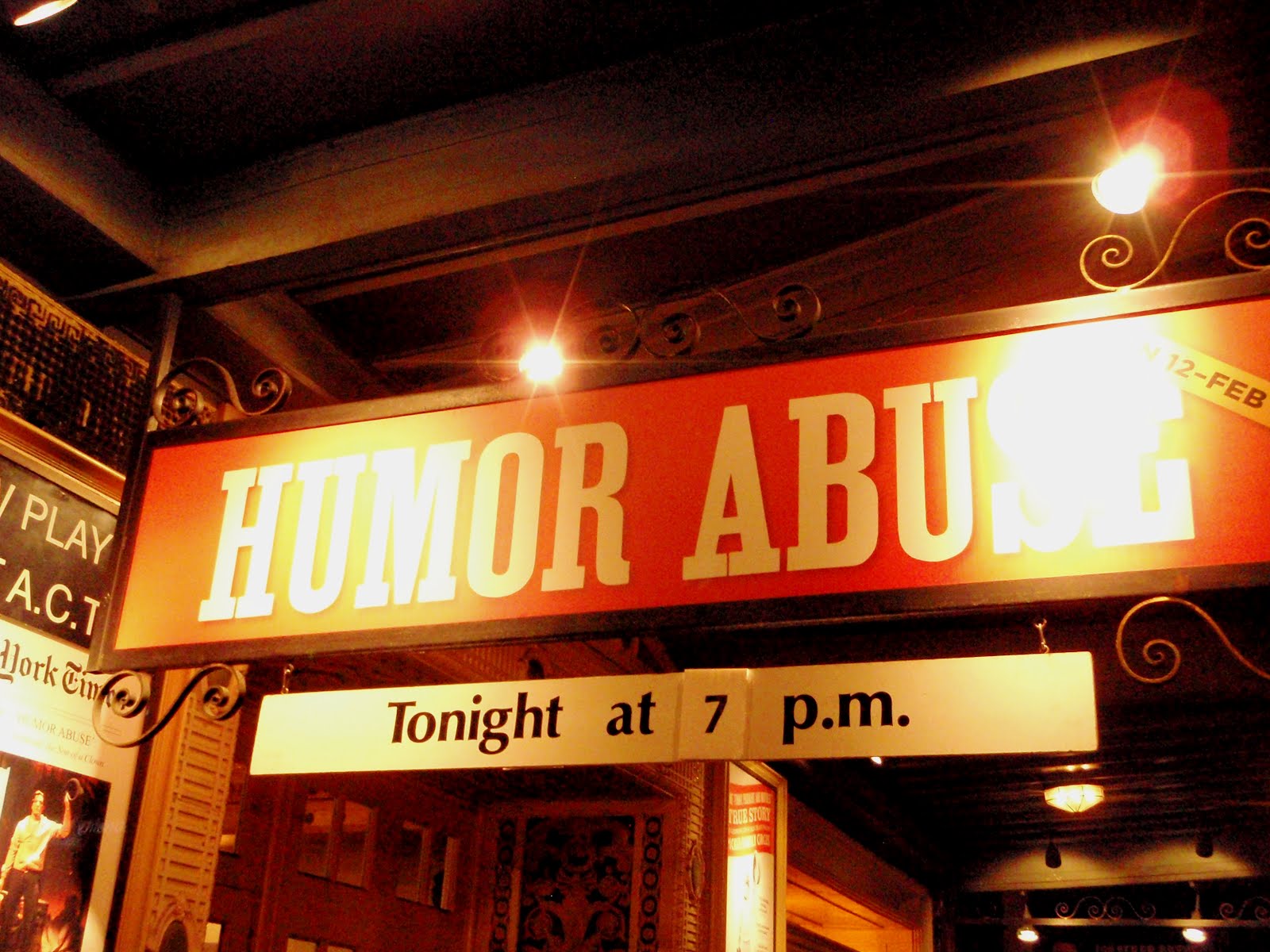
I first heard of Lorenzo Pisoni when he performed at ACT several seasons ago in the lead role of The Gamester, an eighteenth-century tale about a young man with two loves: a beautiful young woman and gambling. The thing about addiction stories is that they are by their nature inherently undramatic: the addiction always wins; that’s what makes it an addiction. But Pisoni was dazzling in the role, bringing unexpected aspects of his part to light, and staying true to both sides of the complex character. After that memorable turn I was eager to see him perform again. So off I went last week to Humor Abuse at ACT, his one-man show about growing up in his father’s circus (co-created and directed by Erica Schmidt).
The announced running time of the show was “approximately 80 minutes” but the night I went it was twenty minutes longer than that. I don’t know why, or if that was unusual. I never really felt that the pace was off or lagging. Pisoni commands the stage single-handedly and easily, with great charm and confidence. I find it fascinating that someone as handsome as Lorenzo Pisoni would regularly stick a big red nose and chalk-white make-up on his face. I think he should do a show about that.
Though the clowning routines were not really the reason I went or the main reason I enjoyed the show (as should be obvious from what I wrote above), I will say right off that I did laugh at them, which is a tribute to Pisoni's skills, even though he claims that his father was the funny one. There is a part with falling sandbags barely missing him as he wanders from place to place on the stage that, while breathtaking, really rattled my nerves.
There is a long rueful routine about the complexities of carrying some suitcases up a flight of stairs which made me laugh because it’s a whole philosophy of life: it’s the sort of thing Keaton would do that would make you understand why he appealed so much to Samuel Beckett. There’s another extended routine, also a study in the frustrations resulting from the simplest actions, in which Pisoni wears swim goggles, an old-fashioned one-piece bathing suit, and flippers, and tries to climb up a ladder so he can dive into a tiny pail of water.
It’s his great skill as an actor that really sells these routines, adding some poetry to their elegant mechanics. At the beginning of the show he gave us some ground rules, announcing that we could eat candy (assuming we had brought some, I guess) and applaud whenever we liked, or “just sit in silent judgment,” a line which gave me my biggest laugh of the evening because that is the sort of thing I find hilarious (because that is the sort of thing I do).
He starts off with a brief history of clowning and his family’s involvement in clowning, both of which spring from commedia dell'arte (his great-grandfather, an Italian immigrant, had joined a commedia troupe). He turns himself into Pantalone and Arlecchino with astonishing speed and thoroughness (maybe he should do a one-man version of The Servant of Two Masters – I'd be up for that), and as Arlecchino he tells a really filthy joke, and then tells us that his father told him that joke when he was seven. So he very skillfully ties his family story in with the theatrical history, though I could have done with a little more background on his parents’ troupe, The Pickle Family Circus. Many of the audience members clearly already knew the background and were there for a nostalgic tumble through a shared past (I saw a number of people wearing Pickle Family Circus t-shirts or jackets, and there was the laughter of sentimental recollection at some of the projected photographs of Pisoni pere et fils), but I really had only vaguely heard of them.
Given the time (the 1970s) and the place (the Bay Area), I assumed there was a countercultural element to the Pickle Family Circus, even before we were told that his father drew clowning inspiration from shamans, medicine men, and the Monkey King. And apparently it really was a family-run circus, though there must also have been other performers involved, but it’s not clear exactly who or how many they were. The set gives a nice sense of what the circus must have looked like, with cut-up rusty coffee cans lined up holding the footlights, and a backdrop duplicating the old circus curtain, with its paintings of local landmarks like the Golden Gate Bridge.
Pisoni’s father seems to have been a charismatic but also difficult man, whose problems with alcohol led to the break-up of his marriage and the circus. He kept performing elsewhere (I wasn’t really clear where – he doesn’t seem like a Barnum & Bailey type and I'm not sure where else a clown would go for work). Lorenzo, not yet a teenager, continued touring with the Pickle Family Circus, taking over his father’s routines. He seems to have been a lonely boy who didn’t realize how lonely he was, or how very young he must have looked as he tried to behave as he thought an adult should. His life reminded me several times of Buster Keaton’s life as a child touring the vaudeville circuit with his parents, while his father drank more and more heavily (which must be especially self-destructive for an acrobatic performer who relies so much on his body, his reflexes and timing). Pisoni traveled with the circus until he reached high-school age, with sporadic but affectionate contact with his father, who remarried and divorced again.
He realized that what he thought of as his father was really his father’s clown persona, Lorenzo Pickle, whose first name he shared and whose routines he inhabited for years. Larry Pisoni remained a mystery to him. It’s a fascinating, fleeting insight into the enigmas of identity, and one of several doublings in the show (he used to share space in the act with a life-size dummy of himself as a child, who made a reappearance in this show). Personally I would have preferred a little less of the clown routines and greater detail about his father and the rest of the family (there are just brief mentions of his mother and sister), and about circus life and its physical and mental toll. On the other hand, I respect the reluctance to impose his own theatrically shaped views of his family onto them. They are individuals with their own views of what happened. Perhaps it’s best to allow only glimpses of the darkness and strangeness and the ultimate unknowability of even those closest to us. The great silences around what we know and don’t know are part of the essential mystery of fathers and sons.
20 March 2010
Mothers of the Year, Classic-Style
It was a fascinating, absorbing, and frankly exhausting afternoon, even with a half-hour intermission with complimentary wine and hors d’oeuvres between the plays. (Those seats are kind of difficult to sit in for so long. Also: the woman behind me literally kicked me in the ass several times. Again I ask, what is wrong with you people? If your foot poked the person in front of you, wouldn’t you be extra careful next time you needed for some inexplicable reason to cross your legs, especially since he was so nice about it the first time? And that little pat on the shoulder doesn’t count. In fact it adds to the irritation. Sheesh.)
My other reason for favoring Seneca was that the Latin Medea had more of the requisite ferocity. I loved Paige as Lady Macbeth so I know she can handle Medea, but the performance of the Euripides version was too anguished, too sympathetic, too much the way a normal woman would be. But Medea is not a normal woman, something quite a few audience members didn’t seem to grasp. We need to fear her, and to recognize that her actions, however solidly motivated, are fearful. Other characters refer to her ferocity and cunning, and even in her mock meekness you have to sense that glint in the eye and steel in the voice that tells you that she is terrible, implacable, furious. Otherwise why would everyone who knows her be so wary of a powerless woman? Her rejection doesn’t leave her heart-broken, it leaves her enraged to the point of murdering her own children.
Medea hesitates to kill them, because she is not an inhuman monster, but killing her children is her plan all along, she never seriously falters in her plan, and she does it out of hatred. She’s not like Norma, whose more generous and natural impulses cause her to change her mind about killing her children and eventually lead her to accept love (and death) rather than revenge. And she’s not like Margaret Garner, the so-called American Medea, because Garner acted out of love, to protect her children from a life of slavery. Medea acts out of cruelty and hatred. Yet the feeling seemed to be that she was perfectly justified, and if anyone was to blame, it was Jason.
I was reminded of an interview with Fay Weldon that I read years ago, about her brilliant novel, The Life and Loves of a She-Devil: she said how odd she found it that people just accepted everything the protagonist did (as she destroys the husband who did her wrong, his mistress, and herself) instead of debating, as she thought they would, the point at which she went too far. (If this doesn’t make sense, it will if you read the novel, as you should, but at all costs avoid the crappy movie version with Meryl Streep and Roseanne, which omits about half of the book, the more interesting half.)
Perhaps this overly sympathetic portrayal was part of an attempt to differentiate the two Medeas, since their stories are essentially the same, though Seneca has many more long and elaborate speeches. The portrayal there, though still sympathetic to a degree, was of a more implacable woman. I found the Euripides performance fundamentally misconceived, but as noted quite a lot of the audience seemed to think murdering the children was just a particularly sassy comeback. (I did wonder if those audience members would have felt quite so comfortable about it if Medea had murdered two daughters instead of sons.)
Given this attitude, Jason, already a flawed and unheroic hero, had a losing battle for the audience’s favor, though Garth gave it his considerable best try. But when Jason points out to Medea that he’s given their children the great advantage of living in Greece, there was a lot of laughter, as if this were evidence of Jason’s smugness. But though there is some smugness there, it’s a valid point, as if an American were to make the same remark: yes, the country may be a mess, and tending downwards (do we finally have national health care yet?), but it’s a wealthier and more secure place to live than quite a few other places, and what’s silly and smug is pretending that doesn’t matter. When Medea justifies her earlier murders (of her younger brother, among others) by saying she did it out of love for Jason, I don't think we're supposed to accept that as an excuse. I think we're meant to take that as evidence that her emotions are selfish and uncontrolled. In other words, that the blame is hers for taking such actions, not primarily his for benefiting from them. If the audience is only taking one character's arguments seriously, it's missing the debate among irreconcilable and clashing points of view that is the essence of Greek tragedy.
I’d say the audience had a very naïve view of Medea, but the naivete may well be mine in taking the drama and the characters seriously. (But then, I’ve always felt that sophistication is really just another barrier between you and a genuine experience of theater; when you’re too busy sorting out which reaction will signify you as sophisticated, you can’t really have an honest reaction. Sophistication only exists in relation to other people.) It's not that these people weren't totally into Medea: one man told me he was pretty much a Medeahead, and was planning to watch the Lars von Trier version as sort of an after-party. Perhaps by now these stories have been so Freuded, Frazered, Junged, and Campbelled, so painted, performed, filmed, and sung, that we have reached a stage of Alexandrian decadence with them, where they have lost their primal strength and become exercises in style. What’s Hecuba to him, or he to Hecuba?
Seana McKenna as Phedre was fine, but after a while – the show was about two hours, with no intermission – I felt she needed a few more variations on the theme of how miserable her forbidden love for her stepson Hippolytus made her feel. This isn’t really McKenna’s fault, I think. The play has several strikes against it with a contemporary American audience: the subject matter, to start with. Far from shivering with the horrifying thrill of incest, we’re likely to think, meh . . . he’s not blood. It’s just a stepson, for Heaven’s sake! Haven’t we seen this dozens of times on Springer or even Oprah? What does forbidden love mean in our society, or more specifically, in our representations of society? We have a theater in which Albee can write a play about a man in love with a goat, and, though I found that play a huge disappointment, it is a serious play, and far from being shut down by the Vice Squad, it had a comfortable run entertaining the tourists on Broadway before heading out to a life of regional revivals. So I at least felt a little impatient with this woman mooning over her shocking love, and Racine didn’t do her (or us) any favors by moving any less-than-noble emotions to the wily servant Oenone (Roberta Maxwell), who in this version is the one who comes up with the scheme to slander Hippolytus, Potiphar’s-Wife-style.
You can hear at least one surviving recording, just a couple of minutes long, of Bernhardt as Phedre, which of course was one of her great triumphs. Even through the surface noise you can hear a combination of fever and formality. But she was coming from a theater that valued grand gestures and symphonic vocalism and that was still stylized in some of the ways in which Racine’s theater was stylized. We are very far from that.
I don’t regret seeing the play, because how many chances am I going to get? (Though I do have some regrets about the cost.) But I also can’t say I was thrilled by it, or discovered something I hadn’t already known or felt. The whole thing was disappointingly middle-of-the-road. The story, so basic yet so remote from anything we find tragic or shocking, and the formal, elevated style the play requires, called out for something extreme to wake us to whatever power they might still have over us: darken the stage, light the actors with spotlights or flashlights, strip the actors down and make their language standard contemporary prose. Or have the actors use highly stylized gestures, speak in rhyme and formal cadence, make the stage an explosion of expressive color. Put Hippolytus in a golden loincloth and Phedre in buskins and a towering crown. Go ahead and have a man play Phedre, in homage to the Greek tragic theater and to the camp attitude that many take to these works. Sure, there will be some inappropriate laughter, but there is now anyway (and camp versions of Greek tragedy can be both very funny and strangely powerful). To put it another way: go Noh, go Kabuki, or go home.
30 January 2010
fun stuff I may or may not get to: February
Cal Performances presents Ragnar Bohlin conducting the Swedish Radio Choir on February 28.
It’s a big month for choral concerts: Volti performs new music on February 26-28 and Magnificat performs old music on February 12-14.
The San Francisco Symphony presents Schubert’s Mass No. 2 with A Concord Symphony, Henry Brant’s orchestration of the Ives sonata.
Berkeley Opera presents Eugene Brancoveanu as Don Giovanni in its new venue, which has got to be an improvement over the Julia Morgan Theater.
ACT presents Brecht's The Caucasian Chalk Circle, in a new production directed by John Doyle, who did the recent Broadway revival of Sweeney Todd (you know the one: Patti Lupone plays the tuba!).
The San Francisco Ballet presents Program 2, a mixed program featuring works by Jerome Robbins, Christopher Wheeldon, and Paul Taylor, and Program 3, which is all Balanchine.
02 January 2010
fun stuff I may or may not get to: January
I always seem to have more concerts presented by San Francisco Performances in the second half of the season, so I’m only slightly surprised that I have five in January:
On January 10, Steven Isserlis and Kirill Gerstein play music for cello and piano by Britten, Schumann, and Rachmaninov.
On January 12, Nathan Gunn is accompanied by his wife Julie in Schubert’s Die schöne Müllerin.
On January 22, Richard Goode plays music by Bach, Haydn, and Schumann.
Morphoses/The Wheeldon Company appears Saturday and Sunday, January 23 and 24.
Violist David Aaron Carpenter plays music by York Bowen, Rebecca Clarke, Penderecki, Prokofiev, and Piazzola and January 24.
And on Sunday, January 31, there is a "Day of Exploration" of new music with Midori (schedule here).
Cutting Ball Theater has extended The Bald Soprano once again, until January 24. And their Hidden Classics Reading Series has a really interesting-looking program on Sunday, January 31: a Medea double-bill, featuring versions by Euripides and Seneca.
And speaking of the classics, ACT presents Timberlake Wertenbaker’s adaptation of Racine’s Phedre.
Ensemble Parallele presents a chamber-opera version of Berg’s Wozzeck on January 30 and 31.
George Benjamin is this year’s Phyllis C. Wattis Composer in Residence at the San Francisco Symphony, and is here for a couple of weeks of concerts.
And San Francisco Ballet opens with a revival of its new production of Swan Lake.
10 June 2008
the heart of the matter
I actually would have been OK with some judicious trimming, not so much because of the running time (though I’m as tired of pointing out the stupidity of starting a three-hour show at 8:00 on a work night as I always am the next day; no wonder audiences tend to be students and retirees, who can sit and enjoy their incest-murder-revenge dramas without thinking about the looming 8:00 a.m. cubicle the next morning) as because the comedy scenes . . well, they take the person of a doofus foolish suitor named Bergetto, and though Gregory Wallace performs him well –the acting throughout ranges from solid to excellent – the character is such a bizarre zany, so clueless and – can I just say mentally challenged? – that the longer he’s on stage the more inexplicable he becomes, so that when an attractive young woman (Philotis, but I’m going to keep plot summaries and character relationship diagrams to a minimum here, because you’d be better off spending the time it would take you to read the complicated summaries and explications in just reading the play) wants to marry him you can’t possibly figure out why. A little of this sort of character goes a long, long way; I’m faulting Ford, not the performance.
Much of his humor is of the robustly bawdy sort (“I like his codpiece!” announced the woman behind me, the more egregiously offensive one, in the Pepto-Bismal pink jacket, and here I might as well compliment the periodish costumes by Candice Donnelly, who no doubt would have done wonders with Pinkie behind me) so beloved of busty serving wenches at Renaissance Faires and English majors who want to play dirty without dirtying themselves. I will freely admit that I have an addiction to even the grossest sexual puns myself, a fault (if fault it can be called) which I attribute to a lifetime of reading Shakespeare, but can I just say without getting all Dr Bowdler here that I’m tired of the whole “bawdy humor” thing? It gets too coy and precious, and over-emphasized, when it should be obscene, and just one element among many. Seriously, rent some porn and yank it out of your system, and then maybe we could perform pre-Victorian works without the constant nudge-wink emphasis on all the naughty bits, and place a little more emphasis on the poetry and philosophy. But of course the audience chuckles at every hip thrust, in case anyone thinks they didn’t get it, and I just think of Polonius, who is for a jig or a tale of bawdry, or he sleeps.
I’d say that “of course” (of course, you should always beware of a statement that follows of course) ‘Tis Pity survives for its tragic scenes, but I’ve come across (or overheard) a surprising number of theater-goers who assume it’s a comedy (apparently on the theory that “whore,” being one of those above-mentioned bawdy terms, is inherently comic), so I guess we live in a world – and I ask you, what kind of world is this? – in which even veteran audience members don’t realize this is the tragic tale of Giovanni (Michael Hayden), his sister/lover Annabella (Rene Augesen), and her husband Soranzo (Michael Earle Fajardo). Most of the poetry and philosophy are supplied by the brother and sister, which is one of the elements that unites them against those around them. High praise to all three leads for capturing the quicksilver intensity of this triangle.
The blithering hags behind me mentioned (during the performance, of course; some insights just can’t wait) that it was very Shakespearean, which is true enough; there are Shakespearean echoes throughout, and though some, like the comic rundown of the suitors by the saucy maid, seem like standard theatrical devices that we only remember thanks to Shakespeare, some echoes are just too specific: watching the troubled philosophy student Giovanni grapple with his incestuous yearnings amid the comical parade of various unlikely suitors is like seeing Hamlet dropped into the wooing of Bianca.
So I was basically enjoying the performance very much, admiring the actors, particularly the three leads, and admiring the multi-level unit set, hung with strings of large iridescent glass beads and twists that lent a slightly tawdry yet dazzling air to the shifting scenes, yet feeling that somehow it wasn’t quite catching fire for me, when we came to the end. Everyone I’ve ever talked to who has read or seen this play always remembers one thing (maybe I should put in a spoiler alert here, just to be nice, though the point I’m about to make is that this memorable one thing doesn’t happen in this production): at the denouement, Giovanni enters with his sister’s heart, which he has cut out, impaled on his knife. In this production, though Giovanni kills the pregnant Annabella as required (and though the program notes made much of the literal and symbolic role of the heart in this play, and how the play was written shortly after Harvey’s discovery of the heart’s role in the circulatory system), they shied from the final tragic grotesquerie, and Giovanni’s pointed remarks about Annabella’s heart lost their literal meaning. In short, Ford and his play walk sublimely off a cliff, and director Carey Perloff and ACT declined to follow.
I can’t really blame them, even if it meant they didn't go quite as far out as the play demands. There was enough clueless laughter (which is different from nervous or unnerved laughter) during passionate or ironic moments to make me think a large portion of the audience would have just lost it if Giovanni had been walking around with his sister's heart on his dagger. Perloff said something I really liked in her “From the Artistic Director” letter in the program: “. . . ‘Tis Pity is one of those big meaty classics that are disappearing from the stages of the American theater, as both our economy and our attention spans constrict. As the American theater seems to move closer and closer to television realism, it is thrilling to reconnect with a classic work that is truly theatrical, poetic, ambitious, complex, and metaphoric. So we feel incredibly grateful to have the opportunity to explore one of the great plays of the 17th century [OK, here comes the part where she loses me] with one of the great audiences of the 21st.”
Look, I understand she needs to say that, but I’ve sat in too many local audiences to think that we have the great audiences that great theater deserves, or even that deserve great theater. The two women behind me, obviously regular theater-goers, are too typical of the breed: blithely chattering (despite being shushed several times), too oblivious to everything but the rusty clanking of their own brain-gears, too smugly pleased with their own status as theater-goers (yet identical in their reactions to any of the much-scorned television audience), too quick to offer opinions instead of to pay attention.
Years ago I read that Joseph Conrad said of his art, “Above all, I want to make you see.” I thought that was sort of obvious, but over the years I’ve realized that this is one of those remarks, like “Love thy neighbor,” whose simple surface conceals a maddening, endless and endlessly ambiguous imperative. Nothing is harder than just seeing what is happening accurately and, while maintaining concentration, withholding your own judgments until the end, when you can separate the wheat from the chaff. No wonder so many religions condemn the theater while stealing its best effects; both are in the business of making you above all things pay attention to the elusive underlying. This may seem like a heavy burden to lay onto, for example, Feydeau farces, but there are all sorts of degrees here, and the comic is as worthy and exalted as the tragic.
So I walked out feeling like Savonarola, disgusted at the unworthiness and frivolity around me, but what he burnt as vanities I wanted the crowds to worship as our closest simulacrum to truth, or at the very least to admire as some sort of justification for humanity’s continued existence. I applauded the actors as they deserved, and then hightailed it out of the profaned temple before I turned around to the babbling lumps behind me and said or did something I wouldn’t regret.
12 January 2008
you're the moon over Mae West's shoulder
The script is similar to those West wrote for her movies – she (called Margy LaMont this time around) is a good bad girl; a rich and innocent young man, ignorant of her background, falls in love with her down in Trinidad; when he takes her home to meet his parents, she realizes that his mother Clara is the ungrateful society lady she rescued in the first act from a misadventure in slumming. Margy eventually decides that her future happiness lies in marrying her old-time friend and lover, the recently retired Lieutenant Gregg, who knows all about her life and keeps proposing anyway, and moving with him to Australia, an ending which satisfies everyone except the love-struck young man, who will get over it.
The play is actually similar to most of Oscar Wilde’s plays; like them, it is basically an ironic melodrama about class boundaries leavened with sexually subversive epigrams. I don’t want to oversell the comparison; I’m not saying West could have written anything like The Importance of Being Earnest (though even Wilde only managed that once), and she never wrote anything like Salome (though I would love to have seen her version). And her play is a lot looser than, say, An Ideal Husband, which is a disadvantage or an advantage, depending on how you feel about plot machinery. Her play has plenty of vaudeville moments, and the first half ends with a very entertaining and very extraneous series of song and dance numbers (Robert Brewer as the lovestruck young man had a particularly nice voice, sounding at times remarkably like an actual 1920s Irish tenor – I guess I’m thinking of the John McCormack sound).
The Aurora is one of those tiny theaters (four rows in a U-shape around the open stage) that like to claim there are no bad seats, but I had one, at the right-hand tip of the U, behind the stage couch. For quite a bit of the play I was looking over the actors' shoulders or observing their necks. I would have just accepted this as my bad luck, but I saw a woman buy a discount ticket at the box office half an hour before the show started, and her seat was much better than mine. You’d think that buying in advance at full price would give you the better seat. Apparently I have a lot to learn about the ways of the theater.
Seating discontent aside, this was an enjoyable evening (oh, all right, I’ll give in and say it – I really enjoyed the Sex, thanks so much, the money is in the box office), though I couldn’t help feeling that if this had actually been a film from the 1930s, the class drama would have been more sharply delineated – there’s something antiquated and formal about the dress, movement, and speech of the upper classes in those films that is alien to our society, and difficult to convey with modern actors in a stripped-down set. I wish the Aurora had trusted the material a little more and relied less on its curiosity value and period charm. They opened and closed the show with unnecessary historical background – a sketch of the usual jazz age pizzazz, some shocked contemporary reviews, the eventual arrest for obscenity after packing the house for months. I’m not sure why they thought this fairly straightforward, enjoyable play needed all that – they wouldn’t have done the same for Lady Windermere’s Fan.
The attempt to recreate the atmosphere around the original play may also have been the reason for the production’s major miscalculation, which I’m guessing was the fault of Tom Ross, the director: having Delia MacDougall, the actress playing Margy, imitate Mae West. There are certain artists, like Gertrude Stein or Groucho Marx, who have such strong styles that attempts to discuss them usually end up as attempts to imitate them, which is always a mistake. You’re just not ever going to see a better Mae West imitation than the one Mae West did. And the exaggerated voluptuousity that is the West physique provides a built-in punchline that just can’t be supplied these days, since the red hot Mama body type seems to have disappeared with vaudeville.
The basic question is whether a star vehicle can survive without the star. I think Sex is a solid enough play so that it would have been worth trying, and MacDougall brought enough interesting flashes to her performance so that I wish she had been encouraged to form an independent interpretation. One of the best plays I saw last year was a star vehicle without the star – Charles Busch’s Red Scare on Sunset, performed by the student actors at the American Conservatory Theater. Usually it just seems to work out that I post late, and basically I’m OK with that, on the grounds that it’s all based on memory the minute you leave your seat anyway, and sometimes it helps to have things shake out over a few weeks, and also it’s not as if anyone is waiting to hear what I think before buying a ticket. But sometimes a little too much time goes by even for me (though never say never – I may paper over poverty-induced gaps in my upcoming schedule with reminiscences of past theatrical glories, like some superannuated theater ghost who can’t wait to regale you with the time he was the understudy Guildenstern for the greatest Hamlet of three generations ago), and I do wish I had posted about Red Scare, mostly so I could salute the genius of Charles Busch.
I think I just had a vague sense that he was one of those guys who put on a dress and did bad Bette Davis imitations; I have nothing against that, but on the rare occasions when I’m drunk enough to laugh at something like that I’m usually preoccupied with wondering how to make the room stop spinning. I didn’t even bother going to see Tales of the Allergist’s Wife when it played here a few years ago. I don’t know what tipped me off that I might be mistaken, but I have recanted my heresy. Busch recreates, subverts, and glorifies a grand tradition of theatricality that goes back to Bernhardt and no doubt farther; and if you doubt me put Die Mommy Die in your Netflix queue. About halfway through viewing it I thought, Sweet Jesus, this is the Oresteia! with suppositories!
Last year the young conservatory actors created a Red Scare that was true to his spirit but independent of his presence. It was not only probably the most consistently well-acted play I saw last year, it was hilarious from start to finish (assuming that you find funny, and I do, a plot that centers on a Communist conspiracy to abolish star billing and the Arthur Freed unit at MGM and replace them with black-and-white ensemble dramas). It also dealt in a deeper way than many more ponderous plays with the function of art and fame in a democracy, with the easy American way of switching personal identity and its confusing results, and with the American attempt to define a cohesive social identity through demonizing outsiders. People tend not to see comic cross-dressers as holding the mirror up to our profounder nature, but I’ve gotten more out of Busch’s work than I have out of a lot of Eugene O’Neill’s. Charles Busch and Mae West, raffish provocateurs on the far shore of the mainstream! Is it universal, or peculiarly American, that it’s the marginal who tell all the truth, but tell it slant?
08 March 2007
M. Proust, don't bogart those madeleines
First up was Mother Courage at Berkeley Rep. When Bush and Co. deceived this country into its latest imperialist quagmire, there was a national day of staging Lysistrata. The warning went unheeded and the war started to go not quite as planned and then we had a series of productions of the earliest Western play, The Persians (excellent production by Aurora a couple of years ago), in which a powerful invading empire is defeated by a lesser power fighting on its own ground. Perhaps Aeschylus’s compassion and insight in presenting the story from his enemy’s point of view further confused our easily confused administration; we are now at the stage in the war in which the appropriate irrelevant rebuke is to stage Mother Courage, the story of a war profiteer struggling to remain a capitalist in the face of increasing personal loss. This was a good production, but it was competing in my mind against a spectacular production that Peter Sellars did with Linda Hunt at the Boston Shakespeare Company. As with To the Lighthouse there was the puzzling annoyance of amplifying all the songs, which sure alienates me but not in the way Brecht intended. Ivonne Coll was solid in the title role, but I found her occasionally too sentimental – too wistful or too satisfied when contemplating past romances. Mother Courage is not really meant to be a sympathetic or inspiring figure; she’s meant to be a revealing one.
Travesties, the season opener at ACT, was also enjoyable but perhaps a bit too slick. I really love this play (and I feel safe that I’m not just being a snob about catching the references because I loved it when I first read it in high school when I had little idea who Tristan Tzara or even Lady Bracknell were). I really liked the Magritte-like set of randomly floating empty gilded frames against a lightly clouded blue sky. And it was a preview, which would explain some muffed lines and perhaps also why some scenes, such as the librarian’s striptease while shouting Marxist-Leninist slogans, fell flat. But I first saw the play at the Huntington Theater in Boston in a production that brought so much more emotional depth to some of the speeches, particularly in some of Lenin’s speeches.
And then last month at Aurora I saw Pinter’s Birthday Party – again, a solid, enjoyable evening, and I have to cut them some slack because the actor playing Peter was out with laryngitis and we were warned that his substitute, Richard Louis James, was not off book (though he was very impressive – even with script readily available he turned in a solid performance, not just a line reading). But back in Boston, again at the Huntington, I saw a production that still sticks in my mind – I can vividly recall the weirdness and power of Goldberg telling McCann to breathe in his mouth.
Is this just what happens as we get older? If something has lasted in our memories for decades does it automatically have more power over us than what we’ve just seen? Am I doomed to be one of those who haunt the theater saying, “Oh, you should have seen X in the role. . . “? Perhaps these moments made more of an impression when they were new, or when I was.
After seeing Travesties again, I realized that one of the subterranean reasons I had for loving it is that it enacts on stage the weird jumble of random moments, desire, and delusion that the performance will eventually become in our memories.
04 January 2007
news upon the Rialto
On the other hand, I saw Adam Bock's Typographer's Dream at Shotgun Theater a week later, and it was evocative and poetic in a way that justified all the praise I'd heard. Bock had an excellent sense of when not to spell things out and his actors did him justice. And I can't praise Shotgun enough for having patrons check in at the ticket booth and pick their seat upon arrival, thereby avoiding the crowding and rushing of open seating (which I hate) and rewarding those who show up early (me, probably needless to say). I left feeling the evening had made it worthwhile to put up with the audience, even the loud braying of the woman next to me. I look forward to my next Adam Bock play.