Showing posts with label LHL. Show all posts

06 July 2026

an Anniversary, a Remembrance

As I slowly roused myself this morning I suddenly realized, out of nowhere or everywhere, that it had been exactly twenty years since the death of Lorraine Hunt Lieberson (or, more accurately, twenty years since I heard of her death; her actual passing was three days before, on 3 July 2006). I remember sitting at my dining room table with strong afternoon sunlight slanting in, feeling weirdly unmoored. Things suddenly crystalized inside me & I went to my then relatively new blog, begun earlier that year in February, & posted this, which I have just now re-read after twenty years.

I've spent so much of my life sitting in the dark, watching & listening to performers. Like any of the strange breed that finds some sort of pleasure, solace, meaning in such activity, I have, as a counter-history to the life I'm supposedly living, an existence through the art of others (&, honestly, through irritations with others: not so much with artists who don't quite, in my opinion, succeed, because no matter what, they are out there trying, & trying to give, but with fellow audience members I have to share space with; it's always struck me that one of the powerful things about theater is that it gives us the best of humanity, in the art & generosity on stage, & shows us the worst, in the stupidity, selfishness, & lack of consideration that, too often, we find down below the stage).

There is a golden age in that counter-history, & for me that would be the start of my concert-going, when I was young & had moved to the other side of the country, to Boston. (A few years ago I listened to a recording of Handel's wonderfully named Occasional Oratorio, & listening by myself to an unfamiliar Handel oratorio was for me weirdly like dipping a madeleine into the lime-flower tisane, bringing up a flood of memories, of ornate concert halls & crowded theaters & the sun descending through stained-glass windows in dim stone churches with hard cold benches, & I'm listening, listening, anxious not to miss a sound.) I liked early & baroque music & also modernist & contemporary music (I gradually worked my way towards the creamy center of western music history) & so it was inevitable that eventually I would stumble across a performance by, as she was known at the time, Lorraine Hunt, a violist who had started singing soprano roles. (She switched to mezzo somewhere along the way, & added Peter Lieberson's name to hers after she married the composer.)

She soon became a favorite of mine. A few years ago I was looking through some old playbills (I have piles & piles of them, & keep reminding myself I should probably sort through them & toss some before my eventual executors have to) & realized I had heard her in roles I had forgotten about: I heard her in Idomeneo, & Handel's Belshazzar. What a strangely extravagant thing memory is, profligate & wasteful, that I should forget such things, while carrying for decades incidents of far less importance! It's a perverse sort of wealth that can toss such jewels aside.

When I moved back to California I heard her in person less often, though there were still some memorable moments, notably an incendiary Ottavia in L'incoronazione di Poppea at San Francisco Opera. Her Addio, Roma was so intense that it burned the place down, & in my memory her face as she sings it is impossibly large, in cinematic close-up, though such a thing could not of course have been possible on stage. Her performance was so all-consuming & magnificent that it actually threw off the balance of the opera, & I felt sorry for the other performers: the exquisite duet Pur ti miro, which usually climaxes the evening, felt like an after-thought, something to get through so that we could wander out in the dark, reeling from the Empress's farewell to her native city & to life. My last attempt to hear Hunt Lieberson was at the SF Symphony, where she had been scheduled to sing in the Mahler 2, the Resurrection. By then there had been a worrisome pattern of cancellations on her part & I remember asking when I bought my ticket at the box office if she was still scheduled to be one of the performers. The man shrugged mildly & philosophically & said, "Yes, she's still on the schedule, but . . . you never know."

As it turned out, she was not one of the performers. You never really do know, but what you never really do know about certain things is not their if but their when. If I'd known her end would have come so much sooner than expected (she was only 52 when she died of cancer), I would have traveled more to hear her: or, at least, that's what I tell myself now; at the time, lack of the usual lack of money & time often prevented travel; it's the dailiness of life, the things we forget, that in the moment often redirect us from what we would end up truly valuing). So here we are, twenty years later. Later today I may put on one of her recordings, but it's not quite, as those of us who seek out live performances know, the same. The usual clichés still apply: value what you have when you have it, be grateful, keep going into the uncertain fog of the future, keep going, keep going, as long as you can, keep going, keep going. . . .

16 January 2011

what child is this

It was the 2001 North American premiere of El Nino that brought me back to John Adams. After listening to Nixon in China semi-obsessively for several years, in 1995 I had eagerly bought a ticket for the premiere at Cal Performances of I Was Looking at the Ceiling and Then I Saw the Sky, directed (and I believe conceptualized) by Peter Sellars, whose work I had frequently admired when we were both resident in Boston. I wasn’t familiar with librettist June Jordan but I flipped through a book of her poems beforehand and found no cause for alarm.

I have heard from several sources that Adams considers one’s reaction to I Was Etc. as a litmus test, which strikes me as him being ornery in a New England way, because . . . well, maybe he really does think it’s that good. For me it’s a strong contender for Worst Thing I’ve Ever Seen on Stage. I thought it was fake, smug, hacky, and unconvincing (also, way too long, poorly staged, and over-amplified); I hated it so intensely that I couldn’t listen to anything by Adams for more than a year, even though he was (by far) the least guilty of the three perps. I could probably do a “recovered memory” live blog of the whole thing, if I could stand to hear it again. I have friends who will still edge away from me if the subject comes up.

Anyway, several years later I was leafing through the Symphony’s season brochure and saw that the incomparable Lorraine Hunt Lieberson would be singing. Some time later I realized that two other wonderful singers, Dawn Upshaw and Willard White, would also be singing. Some time after that it dawned on me that this was a premiere by John Adams. I have no idea why I was so slow to take in what it all was. So I went, and it brought me back to his work.

I did have some reservations, some of them about the staging, in particular the accompanying cheesy movie by Peter Sellars, which was basically a rip-off of Godard’s Ave Maria. I saw the Sellars movie again recently, since it's incorporated in the El Nino DVD that I watched before I went to last December’s revival at the Symphony. And it irritated me all over again, an irritation that centered on the little metal stud below the lip of the girl playing Mary; what irritated me was that, with the sole exception of that little trendoid touch, she was a completely conventional choice, having exactly the sort of grave and gentle beauty that would lead any self-respecting nun to make her first choice to play the Virgin Mother in the school Christmas pageant. There was no movie at the Symphony this time, and the performance greatly benefited from the more stripped-down staging, though there were some odd and inexplicable touches, like the little Charlie Brown Christmas tree that appeared in the second half.

I also had some reservations about some of the texts used, chiefly the more “political” poems by Hispanic women, in particular the “Memorial de Tlatelolco” by the Mexican poet Rosario Castellanos. It is a long (frankly, too long for its role in this work) account of a police massacre in Mexico City. It’s one of those “remember this outrage” poems, which I personally don’t respond to – I find them too one-dimensional to function effectively as poetry and too restricted in perspective to function effectively as history, or even as narrative. To me they end up being about the poet’s righteousness. I do recognize and am grateful that I am in the privileged position of being able to take a mostly aesthetic view of such poems. But then, most of the audience for El Nino is also in such a position.

And although the poem could be heard as a generic account of violent government oppression that is ignored by official media, you have to get past several factors for it to work that way: there are enough specific details so that you’re aware (even if you haven’t read this in the program book) that it’s referring to a specific incident, one that doesn’t mean much to most of the audience (I’m taking the perspective here that this is a work by an American composer in a largely English-speaking country, to be performed to a largely well-off audience); it’s an incident in a foreign country, one that most of the audience is going to consider permanently troubled anyway; and it’s in the language of that country, Spanish, which most of the symphony audience, I’d guess, doesn’t speak. A poem that’s meant to serve as the centerpiece of the section on suffering and injustice should not be so heavily veiled from the audience; I can’t help feeling that an American composer should have illustrated the themes of injustice and suffering with something that would hit a little closer to home with an American audience – it couldn’t be that difficult to find some examples of American hypocrisy and injustice to take that role, in a language that will reach the audience without translation. I realize the use of these poems is a way of reaching for a more universal and inclusive account, but – though I understand others might take a different perspective – it can seem, politically and aesthetically, a bit trendy and slick.

Though I’ve gone on about this, it’s not a major problem (the way I found the texts for Dr Atomic and I Was Etc. to be major problems). Most of the texts are very well chosen and evocative. This is a Messiah for a more secular and culturally diverse time, meaning that the emphasis is on the nativity not as an historical and theological event but rather as a mythic and poetic story (in fact the last word of the whole work is “poesia,” a poem, and it gently ebbs away in the ethereal voices of a girls’ chorus), a tale of birth, suffering, and the acceptance of love despite its difficulties, a tale to be told by alternative voices.
Many of the texts from the Apocrypha have a charming folk-tale quality. I’m always delighted by the little orchestral roar that accompanies the dragons in Pseudo-Matthew’s story of Jesus and the dragons – it’s hard not to picture little toy dragons. There are other baroque-style illustrative touches in the music, as in the upward figures when the three countertenors sing (when Mary visits Elizabeth) “the babe leapt in her womb.” The opening of the work reminded me of the opening of Das Rheingold, as we hear a murmur of indistinct, childlike syllables that gradually form distinct words, beginning with “maiden.” Though there were many moments that brought fleeting reminders of other traditions, the whole work is totally and distinctively Adams.
I went to the Friday performance, so I heard Jessica Rivera instead of Upshaw. I thought her lovely and lyrical; I also enjoyed Jonathan Lemalu and the three countertenors, Daniel Bubeck, Brian Cummings, and Steven Rickards, though I found them more effective in unison as the Archangel Gabriel rather than individually as the kings Gaspar, Melchior, and Balthasar. Michelle DeYoung had the difficult task of taking over for Lorraine Hunt Lieberson, a singer I referred to earlier as “incomparable,” and I mean that quite literally: there’s no point in comparing anyone else to her. Hunt Lieberson had an emotional intensity and authenticity that gave her singing a rare spiritual depth. I feel fortunate to have had some experience of her art, but that’s no reason not to enjoy the different quality that DeYoung brought to the part; she had a certain almost operatic grandeur and dignity that brought out the drama in her part.
The Symphony Chorus was wonderful, powerful and tender and expressive throughout their difficult music. I do have to complain about the amplification of the soloists; I assume this is a deliberate aesthetic preference on the composer’s part, but it distances and flattens the sound in a way that to me detracts from the experience of live music – if I wanted to experience the music mediated by a sound system, I’d stay home and listen to the CD (or watch the DVD). Honestly, after hearing the soloists would be amplified I hesitated before buying a ticket; finally I decided that hearing the chorus would be worth trying for a rush ticket. I ended up being so glad I went, despite the amplification. It was wonderful to get another chance to revisit this music in performance. I've been listening to it semi-obsessively ever since the performance.
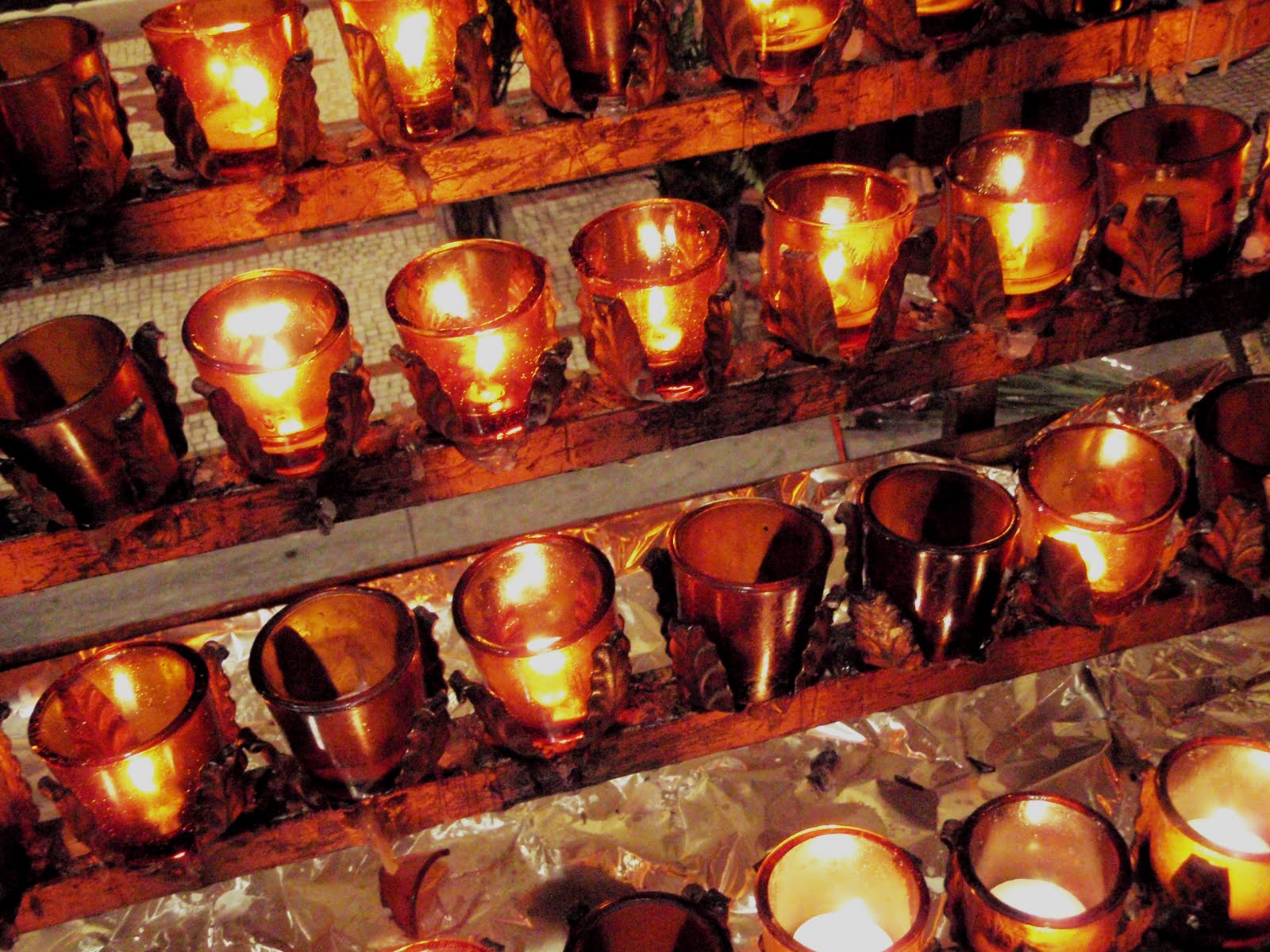
(The image of votive candles at the top is from St Patrick's Cathedral in New York City; the statues of Juan Diego and the Virgin of Guadalupe are from a chapel in the Basilica near Mission Dolores in San Francisco; and the trumpeting angel astride a pulpit is from the American Wing in the Metropolitan Museum in New York City.)

11 January 2011

good news from the archives

The Philharmonia Baroque Orchestra is marking its thirtieth anniversary by launching its own record label, Philharmonia Baroque Productions, and they are very wisely leading off with a treasure from their archives: Lorraine Hunt Lieberson, who had a long association with the group, recorded live in 1995 singing Les Nuits d'Ete and Handel arias. The release date is March 8, and you don't need me to tell you that you have to buy this. You can get it on iTunes or Amazon (though it doesn't seem to be listed yet).

They will be releasing two more discs this year as well: live recordings of the Haydn 88, 101, and 104 (coming this April, in conjunction with their performances of Haydn's Creation) and a studio recording of instrumental Vivaldi (coming next September as they open their 31st season).

Here are the details for the Hunt Lieberson disc:

Berlioz, Les Nuits d’été

Handel, “Figlio non è…L’angue offeso mai riposa” from Giulio Cesare
Handel, “Ben a raggion…Vieni, o figlio e mi consola” from Ottone
Handel, “Mirami altero in volto” from Arianna
Handel, “La giustizia ha già sull’arco” from Giulio Cesare
Handel, “Ombra cara di mia sposa” from Radamisto
Handel, “Ogni vento, che al porto lo spinga” from Agrippina
Handel, Encore: “Qual nave smarrita” from Radamisto

05 July 2010

Are you there, gods? It's me, Marguerite

Almost twenty years of going to the War Memorial Opera House, and the Saturday matinee of Faust was my first trip all the way up to the balcony. I'd been wondering if the romantic nicknames (the heavens, the gods) used by les enfants du Paradis and their raves about the sound were really just compensation for being unable to see anything. I used to sit in Dress Circle, but that was many years ago. Saturday I was up as high as I could go, in the very back row. I thought I was getting an aisle seat, but I was three seats in, in one of the center sections.

So here’s the scorecard: it is warmer up there (not something I like), but not suffocatingly so. The seats are fairly tight but endurable, though I did take advantage of some third-act exits to move over a few seats so that there was no one on either side of me. This turned out to be a bit of a mistake, since it put me that much closer to a five-year-old boy who had had enough by then, and let me just say that taking a five-year-old boy to a four-hour French opera on a sunny June Saturday is not at all a completely insane thing to do. On the other hand, the woman to the left of my original seat had not only taken off her shoes but crossed her legs, so if I had stayed there I would have spent the last hour dreading the moment she violated my space and touched me with her disgusting bare feet. (Why do women think it’s OK to do this in theaters?)

As for OperaVision, well, it is a big plus if, like me, you consider opera to be theater. But, of course, you see only what the camera chooses for you to see, and sometimes you want close-ups when they give you stage views and vice versa. It’s a little disorienting to be about two-and-a-half miles above the stage, up where opera glasses do no good, watching the tiny people move below, framed by two screens on either side showing you the same thing, only much larger. Of course you watch the screens, because you can actually see things happening there. But they flatten the colors severely, so you see a drabber version of what’s on stage. I first really noticed this with the soldiers’ coats, which were a vivid dark teal on stage and a flat steel-blue on screen. The fiery red of Mephistopheles’s motley in the second scene was a subdued red, and the rich velvety blue of Act 2’s night sky lost its bloom entirely.

I’m curious to see how Faust sticks in my memory: as something live on stage, or as a video. There’s this odd thing my memory does with the size of a performer: the more vivid and intense the performance, the larger he or she looms in memory. So for instance when I think of Lorraine Hunt Lieberson burning up the stage as Octavia in L’Incoronazione di Poppea, she’s absolutely huge, as if I were in the front row of a movie theater looking straight up. And when I think of something like the labored antics of The Merry Widow, the singers are all so tiny. But then I go back inside the theater and realize that neither memory could be accurate. But that huge/tiny split is what you really do get, simultaneously, in the balcony. I did feel quite distanced from the action, so that it took me a while to realize that the soldiers’ rousing and patriotic chorus in Act 3, which would otherwise have been a tedious and time-wasting set-piece, was poignantly accompanied by widows and mothers receiving their wounded men, or just the flags given them in memory of the slain, and it took me even longer to be moved by it.

So would I sit in the balcony again? I wouldn’t rule it out. It would be a good way to see something I was curious about but maybe not that vested in seeing, or to see something a second or even third time (but I do have to say that although the seats up there are relatively cheap, that's not the same thing as being actually cheap – my ticket was almost $50, and that’s with whatever discount I got as the possessor of a choose-your-own subscription – anywhere else but an opera house or a football stadium that would have gotten me a seat much closer to the action). I do like to feel more immediacy in the theater, and more connection to what I've paid to see.

There is a nice large promenade back there, and if standing room is as uncrowded as it was that Saturday, it would probably be nice to sit back on one of the plush benches there and listen, only coming up to the railing if you wanted to check out the staging. As for the much-vaunted sound up there: well, it is nice. Oddly enough, it’s more blended and refined, lacking some of the rawness and urgency I hear down in the costly seats. It would have been interesting to have heard Fanciulla in the balcony, to see if the orchestra is as overwhelming as it was below. Of course, it's a little unfair to base this on only one opera, and that opera Faust.

I’m not the Faust-hater some people are, but I think I probably don’t need to see it again anytime soon (though the music is attractive enough so that I would certainly put the CDs on while doing something else). I had also seen Faust last time SF Opera performed it, in 1995, so I knew not to expect the intellectual and spiritual qualities in Goethe’s or even Marlowe’s version of the story (and that’s fine – I don’t think Verdi’s Otello is as deep as Shakespeare’s, either, though Boito and Busoni both show it's possible to bring more depth to an operatic treatment of Faust). But Gounod’s hero doesn’t seem to have any yearnings that couldn’t be taken care of with a prescription for Viagra and regular visits to a gym. It’s hard to believe he has a soul, much less one the devil would struggle to win. No wonder the focus shifts to Marguerite as soon as it can.

Berlioz and Schumann and Mahler set only scenes from Faust, avoiding any attempt to compress the story into a manageable operatic evening. In an odd way Gounod does that too. It's not just that the modern taste is for swifter, more concentrated drama and this is discursive, sentimental, filled with set-pieces that delay the action. (Even with the Walpurgischnacht ballet omitted the action dawdles.) And it’s not just that he concentrates on the affair with Marguerite, which is certainly a defensible way of proceeding. It’s that he indulges himself in the parts he enjoys, that fit his smooth and lovely style (the Act 2 seduction of Marguerite seemed endless – this must be what Act 2 of Tristan is like for anyone who hates Wagner). And then we get four important scenes in the final act treated so rapidly, and with crucial details alluded to so quickly that you could easily miss them (for example, that Marguerite has lost her mind and accidentally killed her child, which is why she herself is condemned to death). But this version is stripped of the details of Mephistopheles's subtle manipulation of Faust, and how Marguerite’s innocence appeals to both the best and worst qualities in Faust, and without this kind of psychological or emotional framework you end up with a story about a creepy old man who wants nothing more than to seduce and abandon an innocent girl.

Seduced and abandoned – yes, Marguerite is a fallen woman. You see how far the story is from our moral framework. Her redemption seems not like a subversive example of a more pure morality, the way it would have in the nineteenth century, but like simple justice. It’s her brother Valentin and Faust whose behavior is not only completely unjustified, but downright repellent in our eyes. Interestingly, the final scene of this staging showed Marguerite ascending a long Caligariesque stairway to salvation (the stairs were extremely effective, and would have been more so if I hadn’t been up in the balcony where about the top third was cut off) while Mephistopheles down below presents Faust with the signed contract and claims his soul. This is of course not Goethe’s ending, and I thought it wasn’t Gounod’s either, but it's remarkably fitting and effective here, since there is no earthly reason why this Faust should be pardoned.

The performers were in good voice the afternoon I went. John Relyea is an imposing Mephistopheles, with surprisingly little to do besides looking suave and slightly menacing. I liked Stefano Secco’s light clear voice as Faust. I’m a long-time fan of Patricia Racette, but I had mixed feelings about her: she comes into her own as the crazed, anguished Marguerite of the finale, crazed and anguished being things she can really commit to, but there was something weirdly campy about her in the early scenes. Maybe that’s inevitable when a diva plays an innocent, naive girl, but she really should not have flipped away the faithful Siebel’s bouquet so quickly once she spotted the box of jewels – that was straight out of Charles Ludlam, and people laughed. Siebel was nicely sung by Daniela Mack, Marthe was the reliable Catherine Cook doing her bawdy older woman thing, and Valentin was Brian Mulligan, who sang the unsympathetic part with beauty and force, though I think if he is going to portray soldiers he should hit the gym a little more often. Giuseppe Finzi conducted fluidly, though occasionally I wanted him to pick up the pace. I didn’t think the music was profound enough for the subject or for slowness. The tunes have been running in my head ever since, though. It’s all so pretty and catchy when you sell your soul!

07 March 2010

a new Lieberson/Lorraine Hunt Lieberson disc

The information below is excerpted from an e-mail sent today by Bridge Records:

On May 1, Bridge Records will release a CD of music by Peter Lieberson with featured performances by pianist Peter Serkin, the New York Philharmonic, conductor James Conlon, mezzo-soprano Lorraine Hunt Lieberson, and the Orion String Quartet. The works included are: "Red Garuda" (Piano Concerto No. 2); "Rilke Songs" for mezzo and piano;"Bagatelles" for piano; and "Piano Quintet". A live performance of Lieberson's "Rilke Songs", performed by Lorraine Hunt Lieberson and Peter Serkin (BRIDGE 9178), was the winner of a 2008 Grammy for "Best Vocal Recording". The present never-before issued studio version of the songs was recorded in 2005 by Lieberson and Serkin. Also on this disc is the premiere recording of Lieberson's "Piano Quintet", played by Serkin and the Orion String Quartet, the dedicatees of this work.

Obviously this is self-recommending, given the artists involved.

The reason Bridge Records is sending me e-mail is because I bought their recent Elliott Carter double-disc set, Volume 8 of their outstanding series of his music. I highly recommend the new disc, and the whole series.

19 April 2009

Scandalize My Name

I recently heard David Daniels with The English Concert; personally, I found it a peculiar evening, though many there seemed to have a better time than I did, which is so often true of my life. I was suffering from allergies, and I suspect Daniels was also affected; I’ve certainly heard him in better voice (though I’ve rarely seen him looking better; he’s slimmed down, though I still appeared to be one of the few people in the audience not mad-crushing on Mr. Daniels), though after a few relatively dry-sounding numbers, and lots of visible swallowing, his voice returned to his usual richer tones.

But I’m making this sound like a David Daniels recital, which is what I walked in expecting; it was actually a performance by The English Concert, led by Harry Bickett, with Bach in the first half and Handel in the second, and arias by Daniels in both halves, stuck like plums in a pudding. I’m sure it was made more or less clear when I sent in my San Francisco Performances subscription a year ago that this was not a regular recital, but since all the advertising features a prominent solo shot of Daniels, I have to forgive myself for forgetting. Not a big deal, especially since I’m full of love for SF Performances thanks to their Elliott Carter weekend and Philip Glass’s Music in 12 Parts, both of which I will be posting about eventually, because they were season highlights – and certainly it’s not as irritating as Cal Performances prominently featuring Yo-Yo Ma on every single program and publicity piece this year, only to restrict tickets to high-level donors – but despite the crisp, rhythmic excellence of the band, and the delightful music they performed sans soloist (the big pieces were Bach’s Orchestral Suite No 1 in C Major and Handel Concerto Grosso in A Major, Opus 6, No. 11, and there were shorter instrumental pieces from Bach’s cantata 42 and a passacaglia from Radamisto), I frankly at this point of my concert-going life would probably not have roused myself to buy a ticket to hear these pieces in the middle of the week. Yes, I know there’s always an audience for whom the familiar pieces are new, but I’m not that audience anymore.

The first three Bach selections, as I have noted, did not find Daniels in his best voice, but he hit his customary stride for the last number in the first half, Erbarme dich – and even before the last note finished vibrating in the theater, some oaf had to be the first to shout out, “Bravo!,” which is irritating enough in an opera house, but utterly bizarre as a reaction to even an average performance, much less a superior one, of Erbarme dich, which should be followed, if not by silence and muffled sobs, then at least by a decent pause.

But then I thought it was just in dubious taste altogether to program snippets of Bach’s sacred music as if they were purely an opportunity for the soloist to shine (we heard Vernugte Ruh’, beliebte Seelenlust, from BWV 170, Qui sedes from the B Minor Mass, Schlummert ein, from BWV 82, and Erbarme dich from the Matthew Passion).

Years ago the Handel & Haydn Society under Christopher Hogwood performed Pergolesi’s Stabat Mater followed after intermission by Stravinsky’s Pulcinella. Richard Dyer in the Boston Globe commented that it seemed in poor taste to follow a meditation on the suffering of Mary at the foot of the cross with a commedia dell’arte bit, and since I heard a performance after the review came out I got to hear Hogwood rather testily defend the programming by saying that Stravinsky had used themes from Pergolesi. But that response indicated that Hogwood didn’t see anything in the pieces but the notes (also, I don’t think the themes Stravinsky used were from the Stabat Mater, which makes his response even weaker).

I felt a better defense would be theological rather than musicological: the sorrowful mysteries are preceded by the joyful mysteries and followed by the glorious mysteries. But with Daniels and The English Concert, there didn’t seem to any logic except that the first half was Bach and most of his big hits are churchy, so that’s what we get, and the second half was Handel so we get arias. It’s not as if the instrumental as well as vocal music in the first half was all “sacred,” to be contrasted with the “profane” second half. The emphasis on vocal display rather than what the music and text meant was emphasized by the fragmentary, highly selective nature of the excerpts. It’s one thing to perform the entire Credo from the B Minor Mass, even if you don’t perform the rest of it (by the way, lovely playing on the oboe d’amore by Katharina Spreckelsen on both this excerpt and the one from BWV 170), but it seemed simply strange to perform just one phrase, because that is the one that highlights the countertenor voice.

I was reminded of a CD I bought years ago, one of the first that made me think, hey, maybe I don’t need to hang on to this one – a recording of an evening of spirituals featuring Jessye Norman and Kathleen Battle. Being a fan of both singers, I bought the CD and gave it several listens, but I liked it less each time I heard it. I didn’t think Norman’s majestic instrument went together particularly well with Battle’s silvery tones; it was like a duet for flute and trumpet. But what really put me off was the whole glitzy, society-benefit aura of the performances – I recall in particular a weirdly campy version of Scandalize My Name. It was just wrong. I thought it was disrespectful to the tradition of the Spirituals, and wondered at the time if anyone would have treated Bach’s cantatas as an excuse for a gala evening.

I don’t think this is just me being fusty. The nuns were right when they told us that baptism will always remain part of you, but I think this is about more than an old-fashioned sense of propriety based on a time and place that have passed by. I have no problem going to hear sacred music performed for money and applause in a theater; whatever your motivation for going to hear the B Minor Mass or the Matthew Passion, if you pay attention you are having a spiritual experience, and it’s a matter for both debate and indifference whether your motivation is Jesus Christ or Johann Sebastian Bach.

In fact it might be helpful to remove this objection from a specifically Christian context and phrase it this way: it’s about whether words and meaning matter in vocal music, and what we feel to be the nature, purpose, and role of music. If it’s all just about purity of tone and vocal display, if you can excerpt Schlummert ein (an aria which, for many people, has been consecrated by the performance of Lorraine Hunt Lieberson) and then follow it with a flashy operatic aria as if both pieces did the same thing, then is there any essential difference between the Matthew Passion and, say, Die Fledermaus?

15 February 2009

LHL at Ravinia

A new Lorraine Hunt Lieberson disc is being released: her recital at Ravinia accompanied by Peter Serkin. This is self-recommending, of course.

Although it is also available from Amazon, my link above is to MDT, a British outfit that often has lower prices (as in this case), even with shipping costs. They also tend to have releases sooner; I've had the Bartoli/Florez Sonnambula for months already thanks to them, and I don't think the Messiaen St Francois I mentioned in a previous post has even appeared on Amazon yet. The only thing you have to watch out for is that the DVDs are all-region, so they'll play on US players.

07 February 2009

By my so potent art

First, some memories for context:

I’m in Emmanuel Church on Newbury Street in Boston to attend a concert, and I’m looking for a toilet. For whatever psychological/theological/aesthetic reason, it’s often difficult to find a toilet inside churches, so I’m wandering around in the basement or off to the side or somewhere else dark and confusing. There’s a middle-aged woman down there looking for the same thing, only she asks one of the singers, a well-known countertenor. He gives her a somewhat brusque reply, not too surprising for a singer interrupted right before a concert by a stranger asking irrelevant questions. But his reaction seems to bother her since back in the pews I hear her telling her companion about the incident. Only in her telling the countertenor (who, for what it’s worth and if my memory serves me, and it may not, was married with children) gives a very snippy, fluttery answer in the high-gay mode. But he didn’t – I heard and saw him, and he sounded like a regular guy brushing off a stranger, not the queeny guy she made him. And this was from a woman musically sophisticated enough to go hear obscure Handel oratorios (that is, not Messiah) done by a small (that is, not prominent with society concert-goers) group. The incident stuck in my mind as a peculiar illustration of the disturbing power of a high but strong voice coming out of a male body.

A second one: I am in Boston Symphony Hall listening to a celebrity violinist also known for his good works (I should look it up, but I think it was Stern). Unfortunately his status meant that lots of people were there who had plenty of interest in either celebrity or good works, but not much in music. Clearly many there thought they were cultured because they were in a famous hall listening to a famous musician, but an actor observing the crowd could have gotten lots of tips on how to portray bored restless noisy indifference. The recital was sort of a disaster, until the encore. The violinist came out and announced in a booming voice that he was going to play a Haydn adagio. I don’t know quite what hit us. But he started playing his Adagio and every single person in that auditorium sat there in utter silence and stillness, transfixed and transported. It’s difficult to describe such beauty, much less how it came out of nowhere, but it reminds me of Larkin’s lines: “On me your voice falls as they say love should, / Like an enormous yes.” And everyone else in that auditorium felt something similar. It’s the only time in my life I’ve felt that kind of rapturous unity with an audience. Sometimes I think I keep going to concerts just in an attempt to regain that moment. It was my girl in the white dress on the New Jersey ferry. Because of that moment, I understand the legend of Orpheus.

One more: it’s late winter, again in Boston. I’ve gone home sick from work. The skies are overcast and wet. I decide to listen to one of the new CDs I’ve bought, the complete recordings of Alessandro Moreschi, the so-called "last castrato" and the only one ever recorded. The afternoon light is grey and cold, and I have a slight fever and a queasy stomach that are disassociating me slightly more than usual from the world around me. I’m listening to the sole survivor of another world, in the scratchy and imperfect sound that was possible during the recording in 1902. It’s like a visit from a ghost, and I ever so slightly freak out. It’s like looking at the stuffed body of the last passenger pigeon in the Smithsonian and trying to imagine crowds of those birds, darkening the sky. It’s like looking at a candle and trying to imagine the sun. It’s like glimpsing a foreign country from the window of a train, knowing that the sliver you see is all you will ever know of that strange land. It’s a vivid reminder of all the irretrievably lost efforts of art. Every time I listen to that recording I ever so slightly freak out in the same way.

So I made sure to get a ticket when Mexico City’s Teatro de Ciertos Habitantes visited the Yerba Buena Center with Monsters and Prodigies: A History of the Castrati. I was even inspired to read at long last a book I had bought years ago that had been waiting on my shelf ever since, Patrick Barbier’s The World of the Castrati, because it was credited as the inspiration for the play.

I can recommend the book highly: it’s informative, humorous but respectful, judicious, thorough, sensitive, dramatic, poignant, and absorbing. Somehow the Ciertos Habitantes managed to present a play largely consisting of chunks of Barbier’s text without capturing a single one of those qualities. It opens with some non-Barbier material: a centaur (so we are told; all we see is a flabby shirtless man with the horsy parts hidden behind a fence; the staging is fairly skimpy on spectacle, which is a problem when you're trying to present the spectacular) and conjoined twins recite some examples of the “monsters” (mostly malformed children) born in the Renaissance and the effect they had.

This may sound unduly callous, but these days there’s a certain academic conventionality to discussions of Renaissance “prodigies” and their cultural meaning. On the other hand, it’s certainly true the Ciertos Habitantes don’t seem unduly sensitive: one fairly extraneous character is a “slave” (he seems to be a South American Indian dressed in a fringed loincloth, I guess as a representative of Natural Man) who gets slapped around a lot – there’s a lot of slapping around on stage – and in one scene they turn the lights out and claim they can’t find him because of his black skin; actually, he’s more of a café-au-lait, but that’s the type of sub-minstrel show material we get when the boys wander from Barbier. I assume all this is meant to put the castrati in the categories of the “monstrous”; they are indeed outside the normal, but there’s a difference between a deliberately man-made and rigorously trained phenomenon like the castrati and an aberration of Nature.

Then we go to Barbier: conjoined twins (not from Barbier, but undoubtedly meant to represent duality or the monstrous or some damn thing) talk at us about how castration is performed. This led to lots of chuckling in the audience, particularly among two youngish women in the row behind me. I have no doubt that these sensitive and intelligent viewers would react in absolutely the same way to a description of female genital mutilation.

There seems to be some sort of thesis here that the castrati represent “Beauty” or “the Prodigious,” which is eventually to be destroyed by Science, an argument made by poets in the past and fundamentalists today. Perhaps I'm reading too much into the play; the various theses don’t make any sense, really, since castration is, after all, a medical and therefore scientific procedure, and the castrati received years of rigorous training, which hardly makes them natural prodigies or freaks. But I’m not going to spend much time teasing out and examining the implications; why should I put more work into the ideas behind this play than the writer, director, and actors all combined? There’s a lot of grandly theoretical conceptual-art-type language in the playbill. What you see on stage is mostly lots of prancing, giggling, and slapping, and lots of talking at the audience. One mentions themes only to counter the argument that one didn't "get" the subtleties of the material. If there’s a puerile and uncomprehending way of presenting something, this group will find it.

One actor – I’m not going to trouble myself or embarrass him by looking up his name – seems to be the chief representative of the castrati. He is short and fat, prissy and pouty, greasy with excess make-up, and he simpers around the stage in increasingly elaborate and intentionally absurd costumes, rendering ridiculous the whole baroque aesthetic of spectacle and disguise. It’s like watching a giant donut hole. A giant effeminate donut hole. A giant effeminate donut hole that can’t sing. Though Barbier makes the point that there is no reason to assume the castrati were all or even mostly – to use an anachronistic term – homosexual, here they are consistently represented as cartoons of flouncy, petulant effeminacy. Sometimes this actor is meant to sing poorly (you can tell by the grimaces of the other actors on stage, which are so much of the “mamma-mia-those-crazy-emotional-Italians” sort that I needn’t describe them), and sometimes he’s meant to sing superbly (ditto), but both sound pretty much the same and both range from the inadequate to the painful. I was reminded several times of American Idol auditions, when you can tell why the singer thinks he or she is good, but you can also tell why he or she is not.

Though the castrati were the great singing artists of their day and the delight of vocal connoisseurs, what you see on stage here are foolish preening caricatures either singing or listening to ridiculous music. We get glimpses of cardinals, always snoozing, and aristocrats, always simpering. We get a poor performance of “Lascia ch’io pianga” (from Handel’s Rinaldo, and two minutes on the Internet, if you’re not already familiar with the opera, will tell you that that particular aria is sung by Almirena, a role created by Isabella Girardeau: in other words, it wasn't written as a castrati aria at all). We get a musicological description of Gluck’s Che faro senza Euridice, which I guess is better than hearing this group try to sing it but doesn't quite capture the aria's grandeur. One of my mother’s college professors had been a Rhodes Scholar, and at every lecture his students would comically and cruelly count the number of times he slipped that fact in, so I hate to be like this, but I need to mention it again: I heard Lorraine Hunt Lieberson perform this repertory live. Don’t try to tell me that baroque or classical art is dated, irrelevant, ridiculous, or incapable of touching the soul in the deepest possible way. This is the first time in my life I’ve sat in a theater thinking, They really should have used pre-recorded music here instead of live.

To make an obvious point, if you don’t respect this music – if you don’t respect the power of art, and of the artists, however strange or unfortunate, who made it, and if you think the people who listen to it are affected poseurs – the whole phenomenon of the castrati is just going to be a silly freak-show spectacle for you. There’s no insight or pleasure to be gained there.

So why, when I have so many better past performances patiently waiting for me to describe them, am I jumping the queue for this tedious debacle? Because of what happened next:

We’re about 90 minutes into the performance, and I’m desperately trying to remember how long this intermissionless show lasts. A couple of people have already snuck out. The entire performance is in Spanish and Italian, and the poorly translated surtitles (which never included the lyrics to the arias, which seems a peculiar choice in a show about musicians) are getting increasingly erratic – zipping by too quickly, or disappearing for long stretches. The “slave” appears again, this time apparently as a French revolutionary. (As I know from Barbier, the French public never really warmed to the castrati, partly because of political and cultural rivalries with Italy, and during the Revolutionary period the feeling was especially intense.) I say he was “apparently” a revolutionary, because the surtitles have disappeared again, and I can catch Liberte, Egalite, and Fraternite, but little else, though frankly I’m not trying too hard. I’m listlessly checking my watch yet again, having given up hope that this anticipated evening would be anything but long and wasted.

And then the woman to my left, who had been sitting there quietly except for the occasional chuckle and a moment when she was rustling in her purse for a butterscotch lifesaver (we were crammed in pretty tightly there) suddenly jumped to her feet! Her voice rang out like a trumpet: “What is this performance? What is going on? Do you know what he’s saying? He’s insulting us! This whole show is an insult! Can’t anyone else speak French? Do you know what they’re saying?”

For a giddy moment I wonder if this is part of the performance. Then I realize it couldn’t be – it’s so much more dramatic and interesting than anything we’ve seen so far. Someone shouts, “Why don’t you leave then?” Her companion looks panicked and starts murmuring, “I’m sorry.” The actors are stunned for a moment and break character. They start shouting at her, I can’t tell what, and she says, “Oh yeah? Come say that to my face, big man! Why don’t you go back to Mexico City! Come here and say that!” She’s not a large or fierce-looking woman, but frankly I wouldn’t have messed with her just then either. The actors soon return to the spirit of the play by reacting in the most juvenile possible manner: they grab the plate of dinner roles that the fat castrato has been gorging on (a fat guy eating – hilarious!) and start throwing them at her. Since I am right next to her, one of them hits my left arm and bounces off. I am collateral baked goods damage! Fortunately they were Parker House rolls – a Dutch Crunch roll could have done some serious damage.

By this time the other woman has managed to take her friend’s arm and persuade her to leave. My ennui has dissipated – I am electrified! For the first time, I really understand how the Italian audiences of the baroque could laugh and chat and flirt during a performance and suddenly be galvanized by a great moment of dramatic truth. At last the evening has given me some insight into the theater of the castrati! I am a strict believer in not imposing your reactions in a way that would disrupt other viewers, but this is a world turned upside down: I’ve just seen the greatest performance of the evening, and heard easily the best voice.

And so, angry blonde stranger on my left, bravissima, bravissima, arcibravissima! Trembling with adoration, I crown you with immortal laurel, and weeping with ecstatic pleasure, I toss roses at your furious feet!

The play resumes; someone dressed as Napoleon is prancing around on stage, and someone is saying repeatedly, “No, Napoleon was a midget!” I gaze wistfully at the roll lodged in the now-upright empty seat beside me. I, who hate food fights, briefly consider tossing it at the youngish women behind me, who are talking again. Their eyeglasses really bug me. You can tell they were carefully chosen to say “We’re stylish and sexy – but intellectual!” I realize I’m just trying to extend a moment that has come to its natural end. I also realize that expecting this mess to become worthwhile and interesting in its last – is it still half an hour? O dear God – is expecting a miracle beyond the capacity even of Lourdes. I normally stick to performances to the bitter end, but I’m realizing that I now have a clear path to the aisle, and so . . .

15 November 2008

daily and random inspirations

After one of my recent postings on Lorraine Hunt Lieberson, artist Andrea Way e-mailed me and told me she had spent last year doing a painting a day, and during the month of September she had listened to LHL while painting. You can check out the fabulous results here. This project reminded me of Suzan-Lori Parks’s play-a-day-for-a-year, some of which I saw at The Cutting Ball (by the way, you still have a couple of weeks to see their latest production, Ionesco’s Victims of Duty, which I highly recommend and hope to write about, oh, soonish; and The America Play by Parks is next up at Thick House Theater). I find the whole “one artistic product per day for a year” idea fascinating. I’ve thought about doing it with haiku, but that always seems too easy to me – I mean, five-seven-five, it’s not that difficult, people – but I’ve occasionally exchanged haiku with co-workers as if we were Heian aristocrats and not cubicle monkeys, and apparently it’s more difficult than I think, judging from the unnatural elisions and other blunders I would see. Maybe I will do that.

Many years ago I was associated with a high-school science textbook that ended up never being published, and one of the suggested (not by me) student activities was to “illustrate the concept of osmosis by performing an interpretive dance.” I found this absolutely hilarious, partly because the target audience probably knew as much about interpretive dance as about osmosis and partly because I could imagine the high-school students who would do this, what it would look like, and how stunned their captive audience would be. Well, damned if an idea that seems silly can't really work: check out Jolene’s lovely choreographed version of her Ph.D. thesis over at Saturday Matinee. See, it's frequently said that life is like high school, but sometimes instead art, science, and athletics can all come together, instead of sitting at separate tables in the cafeteria.

02 November 2008

that I should love a bright particular star

Astonishingly, it was only by a chance visit to ArkivMusic.com, and only because they happened to feature it on their home page when I visited, that I discovered that a Lorraine Hunt Lieberson recital new to CD was coming out in about a week. Such is the shifting-sands nature of home pages that there was no trace of it when I went back, and I had to hunt through their user-unfriendly search system to make sure that I hadn’t dreamed it. You’d think there might be a little more publicity at this point, but perhaps the explanation is just that it’s from Wigmore Hall Live, which is a new and high-quality but I assume fairly small label, rather than a major recording company, if any of those are still around. You can find it here, as you no doubt will want to, since this is self-recommending.

It’s a different recital from the one Wigmore released earlier, which itself had been released even earlier by the BBC. The Wigmore release includes Hunt Lieberson’s spoken introduction to the aria from Ashoka’s Dream, and has an attractive picture of her on the booklet cover and more extensive documentation inside, including the astonishing information that she once sang Deep River in the party scene of Die Fledermaus at the Met on New Year’s Eve. I have heard that it’s usual during this scene for celebrity guests to do a number, though I don’t think that happened during the San Francisco Opera performance a couple of years ago. I think I would have remembered it if anyone had sung about anything at all besides how much they all loved champagne.

Normally I would discourage anything that might make Fledermaus even longer than it already is, but obviously I’d make an exception here. Imagine the Met party crowd on New Year’s Eve hearing this woman step out and sing Deep River. That would sure burn a hole in the evening, and I mean that in the best way possible. But there’s the history of opera as an art form right there: on the one hand, frivolity, luxury, and wealth; and on the other, a capsizing moment of burning truth and beauty.

22 April 2008

LHL CD

So here's something to look forward to: A new disc called Lorraine at Emmanuel: Celebrating the Lives of Craig Smith and Lorraine Hunt Lieberson, containing selections from Bach's cantatas and arias from Handel's Hercules, including the famous mad scene. The performances are from 1992 to 1999.

Oddly enough I found no hint of this album on either Amazon (USA) or Emmanuel Music's website, but according to Amazon UK it's coming out on May 27. Avie is the label and I actually googled them to make sure they weren't a pirate label and it doesn't look as if they are. I know I keep vowing to catch up on CDs before I buy another one, and I know the exchange rate is bad, but I also know I need to have this.

31 March 2008

I once was lost, but now am found

Our industrial and technological age may end up doing us in, but before the waters rise too high - whatever happened to the fire next time? - there is some amazing stuff turning up. I just read in the April Gramophone that the long-lost 1966 BBC film of Billy Budd (with Peter Pears, and with Mackerras conducting) has been found, and will be released in a Britten/Pears set with Peter Grimes and Idomeneo (the opera which sadly lacks a visible sea monster) later this year.


And kind reader ChiChi Fargo sent me the following link to a YouTube video of the 1992 Elmer Gantry workshop with Lorraine Hunt Lieberson as Sister Sharon, which I attended and wrote about here. I haven't seen the video yet, but if anything can finally rouse me to get off dial-up, this is it: http://www.youtube.com/watch?v=miwIaufwgr0

22 January 2008

can I get a witness

I don’t usually see the New York Times, so I am indebted to indefatigable linkmeister Sid Chen of The Standing Room for bringing to my attention the recent article on the new, or finally produced, operatic version of Elmer Gantry, with music by Robert Aldridge and a libretto by Herschel Garfein. It occurred to me that I might post something about it, since apparently I am one of the few people around who actually heard Lorraine Hunt Lieberson sing at least part of the role of Sister Sharon Falconer. I’ve often wondered what happened to the project since I heard the workshop back in 1992. Once the Internet blessed our lives, I would occasionally try to google some information, but rarely came up with much.

I had also wondered occasionally what happened to Composers in Red Sneakers, the composers’ collective in Boston that started around the time I moved there. The Times article mentioned that Aldridge was one of the original sneakers. I should dig out my old playbills and see if I heard anything by him at their concerts – for some reason I didn’t make the connection at the time. I sort of lost sight of the Red Sneaker group even before I moved out of Massachusetts (e-mail has since made it much easier to reach your potential audience), and I had assumed they had dissolved or otherwise imploded, as is the way of collectives. Turns out I was wrong – they’re still going strong, so good for them. I don’t know what they’re like now, but they were known back in the mid-1980s as a fun and informal new music group – this was back when being a fun and informal new music group was considered pretty much an oxymoron, or at least a bizarre and suspicious aberration. I’m not sure where exactly the name came from, but you got free admission to their concerts if you wore red Converse hightops. I had a pair and enjoyed new music, so I went several times. I think the concerts were usually at Memorial Hall on the Harvard campus.

The Elmer Gantry workshop was at the small C. Walsh Theatre at Suffolk University on Beacon Hill. According to my playbill, there were two performances, Thursday February 27 and Saturday February 29, 1992. I was at the Thursday performance. I know this for certain because I bought a libretto ($5) and had both composer and librettist sign it, and Garfein wrote the date. I wish Hunt Lieberson had been available to sign as well; I know there’s something silly about having people sign a piece of paper, which is why I rarely ask for autographs outside of formal signing sessions, but there’s probably some principle of sympathetic magic behind its appeal, and I wish I had had the chance to ask her – at least it would have given me the opportunity to say thank you to her.

I don’t remember where I heard about the workshop, though the Boston Globe seems the likely source. It was open to the public – I certainly couldn’t have gotten in otherwise. I talked some friends from work into going with me – the literary source might have held some interest (one of them actually had a Sinclair Lewis thing and collected editions of his work – not the author I would choose, but I respected it and found it kind of an endearingly offbeat choice), and these were people who were sort of edging into classical music and opera, and I’m sure they went because I said “You have to hear this woman.” I wasn’t really familiar with the lead, Vernon Hartman, but of the other singers Sharon Baker as Lulu Baines and Frank Kelley as Eddie Fislinger were familiar performers; I had often heard them with Lorraine Hunt (her name at the time).

There are two things I remember clearly about the performance. The first is this: The playbill said that the opera's opening scene would not be performed and the workshop would open with the second scene, and the libretto had only a synopsis of the first scene, and I believe either Aldridge or Garfein beforehand summarized the first scene and said that the faculty meeting we were about to see was actually the second scene of the opera, and despite all that, several people started off the post-performance discussion by saying they didn’t think the faculty meeting scene was the best choice as the first scene of the opera. The Times article implied a certain arrogance or at least bluntness on the part of Aldridge and Garfein, but I recall them being exceptionally courteous in the face of this evidence that the people who pay the least attention are always the first to voice their opinions. (By the way, the Times article isn’t quite correct in saying the workshop was of the first act – it was of portions of the first and second acts, and Aldridge and Garfein had a note in the playbill saying that “When complete, Elmer Gantry will be three hours long, in three acts.”)

The second thing I remember is of course Lorraine Hunt’s performance as the Aimee Semple McPherson avatar, Sister Sharon Falconer. While sorting through and organizing my boxes of playbills recently, I was surprised to see that I had heard Hunt as Nitocris, the king’s mother, in Handel’s Belshazzar. Imagine the luxury and folly of hearing her often enough to let some performances slip away from the mind. But others are particularly vivid in my memory (in Handel’s Giulio Cesare and Mozart’s Clemenza di Tito, for example), and one of them is the Elmer Gantry workshop. The Times article referred to a recording of her singing Sharon’s entrance aria. I hope it still exists and is released some day soon. No disrespect to the artist who ended up creating the role, but Hunt Lieberson’s peculiar spiritual intensity brought a special edge to the character – she might be an ordinary woman, she might be a charlatan, or, when you heard her sing, she really might be in direct contact with great powers sweeping through the starry skies, and it was all a matter of faith. The scene I remember most vividly had her crouched down in front of (possibly figurative) incense burners, her hands arabesqueing as if with the scented smoke, while she chanted and sang an incantation filled with deep, vibrant ululations. Afterwards one of my co-workers kept saying, “Oh my God! Oh my God! That thing she did with her voice!” Yep. Exactly. That thing she did with her voice.

06 July 2007

self-evident

Most holidays are so much better in theory than in practice, and the Fourth of July is second only to New Year’s Eve as the perfect example. I spent this one as usual, panicking that some moron with totally illegal fireworks was going to burn my house down, and once you realize that in America these days you can take that statement both literally and metaphorically you understand why I just get disgusted and depressed on the glorious Fourth. (Happy Independence Day, Scooter Libby!) Plus I had to devote a lot of energy to avoiding all sight and sound of the hot-dog eating contest that was dominating news coverage (of course, it’s not as if we’re in a tragically misguided war or anything like that, or sacrificing anything but our civil liberties), in which some American with a name like a minor hit man on the Sopranos reclaimed the speed-eating title from the Japanese man who held it, for which triumph he was wrapped in an American flag. Eating contests disgust me on such a visceral level, are so obscene and immoral in a world of starving people, that I can barely stomach even still pictures. We used to be able to boast of having a government that, you know, considered torture inappropriate for a free nation. Now we’re filled with star-spangled pride that someone could stuff his face faster than someone else. In this country, you can be both obese and malnourished.

And I was also remembering that it was a year ago that I heard with such sorrow that Lorraine Hunt Lieberson died, much too young, and as I was pondering that I heard that Beverly Sills had just died. I never heard her live, so I didn’t have the personal concert-going connection that I had with Hunt Lieberson, but I first heard many operas on her recordings, back when we used to buy things on cassette tape, and there was one in particular in which her cry of “il fantasma!” just burned through me. (I think it was Lucia di Lammermoor, but the great thing about opera is that there are any number of them in which the line “il fantasma!” would fit right in as a logical part of the story.) You just had the feeling that no matter how old she was she still could have kept on giving. What a loss, and what sad times all around. I’m thinking about these two great women whose stories are so different but both so very American, American in a way that I can only hope once again becomes what we mean by “American”: open, independent-minded, strong without bullying, and so very generous in heart and hand and soul.

P.S. I will have only irregular computer access this month, so updating will be a bit sporadic.

07 June 2007

does anyone know?

I have a question about the new "Live from Wigmore" release of Lorraine Hunt Lieberson's 30 November 1998 recital: is this disc just a re-release of the earlier BBC Music release, or is there some significant difference that makes it worthwhile upgrading? I know Alex Ross told us all to buy it, and normally I would do whatever Mr. Ross told me to do, but he didn't say anything about those who already had the earlier issue -- does anyone have any knowledge or opinions?

15 March 2007

a narrative of prepare for saints

This past year has seen so many great artists pass away that I would hesitate to try to list them for fear of omissions. The effect has been of a generation passing on, with the exception of one great singer of our generation, Lorraine Hunt Lieberson, who died much too young. Though I was a devotee from almost the beginning of her singing career, I am just one of many affected by her much too early departure. Her death made me think much more than I had in years about my own youth in Boston and how much of my time has already slipped away. So I was glad to see a tribute page in the playbill for the Berlioz/Foss/Brahms concert at the SF Symphony last September (the Opera, which managed to pay tribute to Elizabeth Schwarzkopf, who had last performed there decades ago, made no mention of the singer who had scorched their stage as Ottavia in Poppea). One sentence jumped out at me and stayed with me perhaps longer than that night’s concert: “She was a San Francisco native, a human being, not a saint, which means she was also more and less than sublime.” It was “a human being, not a saint” that I couldn’t get rid of. Where do they think saints come from? Who do they think saints are? And what do they think saints are?

I’ve always been fascinated by the saints. When other boys dreamed of being astronauts or firemen I wanted to be a saint, preferably a martyr (though I realized much later that what I really wanted was to be the model for a baroque altarpiece). As a child you just realize that these are people who stand out in some good way. Later on you can read about “heroic virtue” and the required miracles and the politics involved in official canonization. But at the core you just have someone who is remarkable for rising above and thereby inspiring ordinary humans enough to be remembered. This may be why “a human being, not a saint” puzzled me. Where was the distinction coming from? Was this perhaps a mild protest against the legend forming before our eyes? Already Hunt Lieberson’s early death has become part of the aura of her radiant artistry. Was there a slight resentment of the amazing gifts this woman had been given? Or just an attempt to keep a friend from slipping away into legend?

Even in the century of recordings there is a justifiable feeling that you just have to have been physically present, that recordings can be almost as unreliable as memory. I’ve always been slightly put off by the death cult around tragic artists like Callas – she was a great artist who lost her art, which is why I call her tragic – but it’s almost inevitable that how a great artist leaves shapes how we hear her even in our memories. Will people who weren’t there believe me when I tell them that every performance I heard from this woman was remarkable? I’ve thought a lot about her since last July, and even though I describe her performances in the same words I always have, I’m sure my descriptions are heard with a refulgent nostalgia they didn’t have before her death.

Because there was something inexplicable about her gift, and the intensity and generosity of her performances. I’m sure highly trained singers were just as curious as I was about this quality. I don’t mean to make her sound like an untutored conduit, some sort of oracle who simply opened her mouth to have glorious sound pour forth in streams of gold. But there was a core there that is obviously beyond technical understanding – if it weren’t, everyone would learn how to harness it. When I heard her I always had the feeling I was hearing something deeply spiritual about life, and not just when she sang Bach or Mahler, but also when she expressed the human agonies of the unhappy women of Mozart or Monteverdi. After her death it occurred to me that, like Mrs. Moore in Passage to India, in certain times and places a cult would have formed around her in acknowledgement of this power. Putting aside plaster statues of sweet-looking people clutching their picturesque attributes, and thinking about the role remarkable people play in our lives, does that make her a saint? Dorothy Day, when told she was a saint, used to say, “I don’t want to be dismissed that easily.” Perhaps the phrase in the Symphony tribute was just an attempt to prevent Hunt Lieberson’s removal from among us?

I don’t know much about her life beyond what is public knowledge, though it doesn’t seem unusual for a woman of her time and place. There’s certainly nothing there that would seem questionable enough to call forth “not a saint, only human” excuses, unlike the life of Schwarzkopf (who, even if we could set aside questions about her Nazi affiliation, and I doubt anyone could know the full truth of that either before or after 1945, seems to have had a habit of hooking up with powerful men who could further her interests). Who knows the truth of anyone’s life? Plenty of canonized saints behaved in ways that look questionable to us.

I feel a bit odd writing about Ms. Hunt Lieberson – so much has been said already; yet her life and art and their meanings feel deeply personal, and I can't quite get my thoughts, which are undoubtedly superfluous to anyone but me, in order. I’m just trying to figure out why that need to say “a human being, not a saint” has haunted me for months. And I don’t want to overstate my thoughts here – I suspect Ms. Hunt Lieberson would be the first to laugh at any even informal canonization. But who knows what ramifications a life like that can have in those who were touched by it, however indirectly? Even if you don’t believe in God, you can’t deny the saints.

16 November 2006

Another day, another pre-order

Amazon is reporting that Lorraine Hunt-Lieberson's recording of her husband's Neruda Songs (Boston Symphony performance) is being released on December 19. (That's my parents' wedding anniversary -- and I can remember that because it's the day 25 years ago when I saw the RSC's production of Nicholas Nickleby on Broadway.) I may even go to a brick-and-mortar store to pick this up right away, assuming I can find one that's still in business.

17 October 2006

even more pre-order excitement

On November 14, the Peter Sellars production of Giulio Cesare is finally being released on DVD. The cast includes his usual troupe at the time, including Lorraine Hunt Lieberson. I haven't seen the film version, but the live version was one of the most indelible opera productions I've ever seen. I think this was the performance that made me realize Lorraine Hunt (as she was then) was not just one of a number of excellent performers but rare and outstanding even in that company.
Sellars's productions were often referred to in a high-concept way (Orlando in Cape Canaveral! Don Giovanni -- in Spanish Harlem!) but it was usually the quiet, reflective moments that stayed in my memory for years: Hunt as Sesto cutting herself while vowing revenge, or Jeffrey Gall as Caesar holding the cask containing Pompey's head and standing in a pool of light backstage mourning the chances and misfortunes of human life.
The Sellars Mozart productions got most of the attention, but his Orlando (at ART in Cambridge) and his Cesare were just as good or better.
My last pre-order note involved a forthcoming Hunt Lieberson disc; at the time I didn't even know what the pieces were except that Harbison was the composer. It turns out it was a setting of Elizabeth Bishop, who wrote the book I referred to as the year's earlier pre-order cause of excitement. And the second disc was by Audra McDonald, who might be singing Kitty Oppenheimer, a role Hunt Lieberson was originally meant to sing. This is the sort of "small world" chain of happenstance and coincidence that gives conspiracy theorists hope.

Amazon has recently changed its listing of forthcoming DVDs in irritating ways: I saw the picture with Susan Larsen descending for her first entrance but it was weeks before I could get any more information, even a price. I saw a three-disc set listed called "Incredible Creatures that Defy Evolution." I thought this might be an interesting examination of the byways and curlicue paths of biology. Or just three hours of lung fish doing whatever it is they do (not much). Or just three hours of Republican party members and Kansas school boards and suchlike creatures. To my disappointment, I think it's closer to the latter: it's some guy going on about creatures that supposedly disprove evolution by their very existence. Ugh. No thanks. If I want to see science mocked, I'll just rent an action movie and watch the hero outrun a fireball.

19 September 2006

pre-order excitement

A week from today (that would be September 26) two CDs are being released of particular interest. I haven't been this hyped up about pre-orders since Edgar Allan Poe & the Juke-Box in March.

1) Naxos is releasing John Harbison's Chamber Music, with Lorraine Hunt Lieberson. I haven't been able to find out much more information about this, from Amazon or the Naxos website (I'm not even sure if "Chamber Music" is the title of the piece or a generic title for the album), but I really don't need anything other than the singer.

2) Audra McDonald has a new album -- Build a Bridge. The product description quoted on Amazon says, "she combines material from precious [I assume they mean precocious but what a funny error] young songwriters like Rufus Wai[n]wright, Nellie McKay and even John Mayer with the work of frequent collaborator and Broadway innovator Adam Guettel, Elvis Costello/Burt Bacharach, Laura Nyro, and Randy Newman." Again, it's the singer (no offense to the song) that is really selling this one to me.

21 July 2006

There's rosemary; that's for remembrance. . . .

Clearly I haven’t felt much like blogging away, so this entry will be in the nature of an entr’acte. I refer you to The Standing Room, which has collected a garland of web tributes to Lorraine Hunt Lieberson. I've been moved by the number of people who only saw her once yet were moved indelibly by her. The world is even poorer without her. I can’t say much more about her loss. (http://www.thestandingroom.com/blog/2006/07/lorraine_hunt_l.html#comments)

I’ve been working a lot in my garden, which is therapeutic. Not so much in a “restorative power of Nature” way; it only takes a few allergy attacks (which have been intense this year) to disillusion me there; maybe the views around Grasmere were more sublime or soothing, but I can’t really do the Wordsworth thing. Cutting stuff back is therapeutic, and there’s a lot of that to be done. For someone with problems dealing with death, I seem to have few qualms about causing it in other realms. But Nature returns the favor: the laurel and the rose have no more value for the universe than the tumor and the virus; to make the point explicit, Lorraine Hunt Lieberson can die at an age when she had so much more to give and in the same week Ken Lay, who ruined the lives of thousands, can die and escape whatever semblance of earthly justice was coming his way, and the universe goes on.

I have a beautiful (I’d say this is an anthropomorphizing statement, but Nature has to appeal to us as much as to the bees for propagation) passion flower vine, but it was growing in the wrong direction and starting to choke my lemon tree. (Yes, I get to choose which direction is the right one. When I bought my house I had some trees cut down, among them a redwood, having learned from my childhood home that a redwood is just not the right tree for a small backyard. When my co-workers found out, it was as if I’d announced I’d gone into church and spat in the holy water font. There’s something about redwoods. No one cared that I planted a fig tree in its place, and no one cared at all that a pine tree was cut down at the same time. One guy said that I was just “imposing my aesthetic” on the place; I didn’t bother to point out that that’s the definition of a garden. There’s a reason Candide ends by “cultivating his garden” as opposed to “reclaiming the wilderness” or “lying down moaning.”) If Bernini designed a flower, it would look like the passionflower: an amazing, energetic mass of twists and curls and tendrils, with flowers exploding into purple aureoles and the various pistils or stamens or whatnot jutting out in an aggressive way. I had to disillusion a friend of mine about the type of passion referred to: the purple is the crown of thorns, and there are other parts that represent the three nails and the five wounds. Of course the common denominator is the word “passion” the root of which is “suffering.” It’s an interesting interpretation to put on this flower, as if it needed some spiritual link to explain it. (There’s also a charming legend about the flower of the rosemary, which is said to be light blue because on the flight into Egypt Mary laid her cloak on it.) Perhaps these tales are just part of the human need to find a story of redemption from the loss that surrounds us.

I have a rosemary plant as well, but I haven’t yet faced cutting it back, since I feel I should be doing something useful with it instead of just tossing it into the compost bin. But I’ve had to pull up a lot of grass and weeds (which are, as the definition goes, just plants we think are in the wrong place) and as I do so I’ve inevitably torn up some of the nearby sage and rosemary leaves as well. I’ve enjoyed their scent on my hands. Requiescat in pace.