21 August 2015
Friday photo 2015/34
adjusted detail of The Tired Boxer, a bronze by Douglas Tilden, from the de Young Museum, San Francisco, August 2015
18 August 2015
Tomato Tuesday 2015/15
Growing tomatoes is how I get through the summer. I do not like the hot weather, and this past weekend there was a lot not to like. The light had a strange pale gray pall to it, an effect of the huge wildfires that are consuming other parts of this bone-dry state. As I've mentioned earlier, this has not been a really productive year for the tomatoes, and I think it must be because of the reduced watering, something I did not realize until too late – mid-August is in fact way too late. Usually this is the time of year when I start tapering off on the watering, keeping an eye out for plants that have maybe run their course and are ready for the compost bin.
There have been some tomatoes, of course. The watering wasn't reduced that much. Below are some that I picked last Wednesday.
Below is another shot of Sungold, just because it looks pretty.
Cherokee Purple, looking exhausted by the recent heat, is carrying nineteen tomatoes, none of them ripe yet.
Michael Pollan had eighteen tomatoes on it, which is fewer than it used to have because at least one dropped off and I saw it lying by the roots of its neighbor, Cherokee Purple.
Actually, Michael Pollan now has about eight tomatoes on it because – yes! at long last! – some were ripe enough to eat. It's entirely coincidental that the two tomatoes I decided to track this season are the slowest of the bunch.
So here's the deal on Michael Pollan: pretty tasty! They have a mild flavor, with a slight tartness to them – a delicate pucker, as if you'd squeezed a few drops of lemon juice on them. Some of the skins were a bit thick, and some had kind of hard pithy areas on their tips; possibly both those things were, again, related to a lack of water. It's a very attractive tomato and would like nice sliced up in a summer salad, though I'm not a big salad-eater and usually just eat the tomatoes on their own, with a bit of salt. I used the fancy pink Himalayan salt on these, because fresh tomatoes are the reason to have fancy salt.
Summer is flying away, as summer does, and I'm always happy to see the autumn arrive, though sadly the past few years we've had many autumn heat waves. But there's a different feel to them; maybe it's that the temperature drops more at night so they seem somehow more tentative. Anyway the sun is setting earlier and the nighttime chorus of crickets now appears when it has set. The figs are ripening; a couple have even turned purple enough to look ripe. I tried one and it was definitely not ripe (and very dry: the drought, again). Another looked promising and I was going to give it another day in the sun and then try it, but as you can see below the birds beat me to it. Nonetheless I am glad to see a few birds back.
There have been some tomatoes, of course. The watering wasn't reduced that much. Below are some that I picked last Wednesday.
Below is another shot of Sungold, just because it looks pretty.
Cherokee Purple, looking exhausted by the recent heat, is carrying nineteen tomatoes, none of them ripe yet.
Michael Pollan had eighteen tomatoes on it, which is fewer than it used to have because at least one dropped off and I saw it lying by the roots of its neighbor, Cherokee Purple.
So here's the deal on Michael Pollan: pretty tasty! They have a mild flavor, with a slight tartness to them – a delicate pucker, as if you'd squeezed a few drops of lemon juice on them. Some of the skins were a bit thick, and some had kind of hard pithy areas on their tips; possibly both those things were, again, related to a lack of water. It's a very attractive tomato and would like nice sliced up in a summer salad, though I'm not a big salad-eater and usually just eat the tomatoes on their own, with a bit of salt. I used the fancy pink Himalayan salt on these, because fresh tomatoes are the reason to have fancy salt.
Summer is flying away, as summer does, and I'm always happy to see the autumn arrive, though sadly the past few years we've had many autumn heat waves. But there's a different feel to them; maybe it's that the temperature drops more at night so they seem somehow more tentative. Anyway the sun is setting earlier and the nighttime chorus of crickets now appears when it has set. The figs are ripening; a couple have even turned purple enough to look ripe. I tried one and it was definitely not ripe (and very dry: the drought, again). Another looked promising and I was going to give it another day in the sun and then try it, but as you can see below the birds beat me to it. Nonetheless I am glad to see a few birds back.
17 August 2015
Poem of the Week 2015/33
Snake
Under the dry swath
a snake crawled out.
Around her the empty meadow
and one flower.
Above, two, three clouds,
a bird flying,
the sun shining.
On the road winding into the distance,
someone's song.
The lonely sound entangles itself
in the grass.
She listens, her head raised
wide-awake into the air.
The sun is shining.
Here's where they killed her mother
with the blade of a scythe.
They'll do the same to her
when she crawls out of the shrubbery.
Her clothes will rot
with their embroideries
and the glow of dew.
Even in eternity, never again
will the same snake sun itself,
nor will the same birds fly,
nor the same flower sprout.
The sun is shining.
Desanka Maksimović, translated from the Serbian by Charles Simic
There is a timeless feel about this scene, which seems like a simple description of a day in the country. The natural elements are put up in what seems an almost overly general way: a flower, two – no, make it three! – clouds, a bird, the sun shining. It's like a child's drawing, in which certain shapes stand for all flowers, all bird, all clouds, and the combination of all of them makes up a landscape. The human presence is only suggested, and in a way that could set this poem in the Middle Ages as well as in some pockets of the world today: the swath suggests that there is a harvest going on, but it (and the killing of vermin) is done with a scythe, not modern machinery. There is a song in the distance; I suppose it could come from a radio, but my first thought was that it had to be someone walking along, actually singing. It's one of those sounds that emphasizes the vastness of the surrounding silence and loneliness. When the poet looks for a description of the snake's rich scales, she compares them to embroidered clothing, which is something a prosperous farmer might have as a prize possession in a time before the mass production of clothing (or electronic goods or fancy cars).
The progression of the poem is the progression of a life: first emergence and basic awareness, then increased, wider-ranging awareness (the song in the distance), then her mother's death and the inevitability of her own. The world seems quiet and empty, but the world is hostile. The sun keeps shining. At its first appearance the shining sun might seem an emblem of cheerfulness, almost conventionally so. As it keeps re-appearing and shining to cap off what seems like the snake's increasingly death-bound life, the sun can seem relentless. And then it seems indifferent, and then we realize that everything we might think about the shining sun – the cheerfulness, the cruelty, even the indifference – is a projection. The sun is vast and far away and we keep revolving around its vastness and its heat and its distance and it doesn't know we're here.
Whenever you start contemplating your individual relationship to the universe in this way, you enter theological realms. Snakes are, to human eyes, strange and disturbing and therefore powerful creatures, and it's no coincidence that snakes slither through the world's religions. In a poem coming out of a country with a Biblical tradition, as this poem does, it's impossible to put a snake in a garden without suggesting the serpent in Eden tempting Adam and Eve to their downfall ("Now the serpent was more subtil [sic] than any beast of the field which the Lord God had made": Genesis 3:1, King James version). But you might also think of Jesus instructing his apostles: "Behold, I send you forth as sheep in the midst of wolves: be ye therefore as wise as serpents, and harmless as doves" (Matthew 10: 16). Making this poem about a snake suggests something about evil and wisdom, and something primal about how we sense the otherness of our world and our deep projections of our problems and mysteries onto our surroundings. This snake herself seems neither evil nor wise, but merely sentient, though perhaps it's not a case of merely so much as of utterly. She lifts her head when she hears song; she feels the sun. Her mother was killed and she too will be killed, in the same way. The poet's reference to the snake as she and the reference to her mother humanize the reptile. We start to identify with her. It's jarring when she suddenly become the impersonal it in the final stanza.
Though the poem makes us think theologically, there is no mention of any deity; the refrain-like reminder in the final line of all but one stanza that the sun is shining is the closest thing the poem suggests to eternity. In the final stanza, the universal, perhaps even generic, quality of this poem's world – the unspecified birds, the vague flowers, even the indeterminate snake that is the star of our show – are suddenly highlighted with a poignant reminder that each of these things is deeply individual and will never recur again in the history of time – a reminder that calls to our imaginations to provide the specifics omitted in the poem. So each of these things – clouds, birds, flowers, snake – both takes in an entire category and is an individual representative of that category. What is true of one of them – that it is a unique individual, that it will never recur – is true of all of them. (This is similar to Gertrude Stein's famous "a rose is a rose is a rose" which means both "roses are all roses and all fall into the category rose" and "a rose is, a rose is, a rose is" which emphasizes the individual nature of each rose.)
Maksimović gives us a contradiction of the Biblical saying that nothing is new under the sun: here, though it all looks like the same old basic country landscape, every single thing under the shining sun, and each combination of those things, is a unique and therefore new moment.
This poem is from The Horse Has Six Legs: An Anthology of Serbian Poetry, edited and translated by Charles Simic. I have an early edition, published when Maksimović was still alive (she died in 1993). It looks as if an expanded edition is now available.
16 August 2015
American Bach Soloists: a virtuoso concert with John Thiessen
Last night I was at my fourth and final concert in American Bach Soloists's summer Festival & Academy. (There were plenty of other offerings, including a two-day baroque music marathon and the traditional Festival performances of the Mass in B Minor, but I did not go to those.) The first three performances I saw linked back to the Festival's theme for this year, Versailles and the Parisian Baroque. Saturday's concert was a bit of a departure, featuring John Thiessen on baroque trumpet – I almost wrote "playing virtuoso music for baroque trumpet" but almost any music written for that ornery instrument is virtuoso by definition. He was joined by Elizabeth Blumenstock on violin, Corey Jamason on organ and harpsichord, Katherine Kyme on viola, Steven Lehning on contrabass, Robert Mealy on violin, William Skeen on violoncello, and Kenneth Slowik on violoncello and viola da gamba.
Given its basic sound, and its consequent association with hunting and war-making, much of the trumpet music was brilliant and stirring in nature. In between horn pieces there were small chamber ensembles displaying a different type of virtuosity. I've heard awkward splats from baroque horns – I remember one performance of Messiah, years ago in Boston, when the usually expert trumpeter suddenly lost it during, of all arias, The Trumpet Shall Sound – but there were none last night, just impressive control and gleaming stretches of music. There were many short pieces, ranging from obscure to familiar, so it was a nicely varied program. First was the Sonata detta del Nero for Trumpet & Basso Continuo by Girolamo Fantini, a piece taken from a seventeenth-century volume offering sample pieces to help aspiring professional trumpeters master their craft. It was brief and brilliant.
The second piece was an air for strings by Marco Uccellini, but not the one listed in the program, which was "un bel concerto" for "la Gallina e il Cucco" – Blumenstock amusingly informed us that "the hen and the cuckoo have flown off" but I did not catch the name of the other piece from that collection that they substituted. After that Thiessen came out again, this time joined by soprano Kathryn Mueller, for Alessandro Scarlatti's cantata Su le sponde del Tebro (On the banks of the Tiber), in which the shepherd Aminta laments his unrequited love. The trumpet is an interesting choice of accompaniment for such a lament; it does its stirring martial thing when he's trying to take heart, or comparing love to war, but there are also long low soft tones that convey surprising degrees of melancholy and despair. Mueller has a clear, bright, and expressive voice. The first half ended with the Sonata in A Major for Violoncello & Basso continuo (no. 15) by Antonio Caldara and then the only trumpet work attributed to Arcangelo Corelli, the Sonata a Quattro for Trumpet, Two Violins, & Basso continuo.
The second half had some more familiar pieces, starting off with Jeremiah Clarke's Suite of Ayres for the Theatre for Trumpet, Strings, & Basso continuo, followed by Purcell's Sonata V in G Minor for strings, and then concluding with Handel's Let the Bright Seraphim from Samson. Mueller rejoined the group for that piece, and it was fun watching her and Thiessen play off each other. All in all a very satisfying concert, even for an audience still buzzing from the revelation of Sémélé.
You can check out ABS's forthcoming season here.
15 August 2015
American Bach Soloists: Semele
When I checked over the schedule for this summer's American Bach Soloists Festival & Academy, one offering that stood out even among the promised abundance was the outside-of-Europe premiere of Sémélé, one of the operas by Marin Marais, a master of the viola da gamba who is better known for his chamber works. I must not have been the only one eager to hear this piece, since ABS had to add an additional performance. That is the performance I attended, on Thursday night. I hope someone who can do something about it is paying attention to this pent-up demand for French baroque opera.
As is often the case in these works, there was a lengthy (roughly thirty minute) prologue. This one involved an inaugural ceremony in honor of the new god, Bacchus – the first bacchanal. Love and wine are invoked. Apollo shows up to approve the proceedings in honor of his half-brother's ascension to the pantheon: a nice example of the Apollonian and the Dionysian joining together. The sun god then calls on the muses to tell everyone how Bacchus came about: in the manner of our comic-book movies, it's the origin story! And that makes up the rest of the opera, though at the end the libretto doesn't actually make it clear that Semele was pregnant when jealous Juno tricked her into making Jupiter reveal himself in his glory, thereby burning the mortal to a cinder and requiring Jupiter to rescue the infant god. Presumably the audience knew the story and could put the pieces together afterward, much as Jupiter did. There are other complications of a romantic nature, typical of dramatic works of this period.
Marais proved a master of evening-length theatricals as well as briefer instrumentals: there was a delightful variety in the score, which was crammed with dances and spectacular effects such as an invocation of the Underworld (a particularly powerful moment for the men of the splendid chorus) and a striking earthquake as Jupiter approaches in his destructive glory.

The performance was done concert-style, with the singers in evening dress and holding scores, and although one of the ways in which Sémélé resembles other baroque operas is the reliance on spectacle and stage magic, this delightful performance was all so fresh and lively you could feel the flowing waters and see the green forest vistas summoned by the vividly pictorial music. (Though I would still love to see a staging, maybe by someone like Mark Morris who could take advantage of the many dance/movement interludes.)
It's all quite sumptuous and extravagant, and was magnificently performed by the chorus, the orchestra, and the very strong line-up of vocalists: Grace Srinivasan (soprano), who on Thursday substituted for the indisposed Julianna Emanski as the Grand Priestess of Bacchus in the Prologue as well as singing her regularly scheduled role as Second Shepherdess; Ben Kazez (baritone) as the Grand Priest of Bacchus; Matthew Hill (tenor) as Apollon; Corbin Phillips (baritone) as Cadmus; Rebecca Myers Hoke (soprano) as Sémélé; Chelsea Morris (soprano) as Dorine, her maid; Steven Brennfleck (tenor) as Adraste, the warrior who thinks he's going to marry Sémélé until he realizes his rival is Jupiter; David Rugger (baritone) as Mercure (occasionally disguised as Arbate, in love with Dorine); Christopher Besch (bass) as Jupiter (occasionally disguised as Idas, mortal lover of Sémélé); Sara LeMesh (mezzo-soprano) as Junon; Ryan Strand (tenor) as the Shepherd; and Hannah De Priest (soprano) as First Shepherdess.
After the intermission there was noticeable attrition in the audience, which was unfortunate but inevitable when your week-night concert doesn't even start until 8:00 PM and lasts a bit over three hours. I wish ABS would join the growing number of organizations with more realistic start times. It was well after 11:00 PM when I arrived at the Civic Center BART station, only to find I had just missed a train and had to wait almost twenty minutes for the next one. That station has really gone downhill over the past year or two. There were people openly smoking drugs down on the platform, without a single BART officer in sight, and that is not the first time I've seen that down there. A successful concert brings with it a letdown as we re-enter the world, and this was more jarring than most, though perhaps it's rather the case that a reminder of the swelling ranks of human misery in our midst brought me closer in spirit to the descending years of the French monarchy.
As is often the case in these works, there was a lengthy (roughly thirty minute) prologue. This one involved an inaugural ceremony in honor of the new god, Bacchus – the first bacchanal. Love and wine are invoked. Apollo shows up to approve the proceedings in honor of his half-brother's ascension to the pantheon: a nice example of the Apollonian and the Dionysian joining together. The sun god then calls on the muses to tell everyone how Bacchus came about: in the manner of our comic-book movies, it's the origin story! And that makes up the rest of the opera, though at the end the libretto doesn't actually make it clear that Semele was pregnant when jealous Juno tricked her into making Jupiter reveal himself in his glory, thereby burning the mortal to a cinder and requiring Jupiter to rescue the infant god. Presumably the audience knew the story and could put the pieces together afterward, much as Jupiter did. There are other complications of a romantic nature, typical of dramatic works of this period.
Marais proved a master of evening-length theatricals as well as briefer instrumentals: there was a delightful variety in the score, which was crammed with dances and spectacular effects such as an invocation of the Underworld (a particularly powerful moment for the men of the splendid chorus) and a striking earthquake as Jupiter approaches in his destructive glory.
The performance was done concert-style, with the singers in evening dress and holding scores, and although one of the ways in which Sémélé resembles other baroque operas is the reliance on spectacle and stage magic, this delightful performance was all so fresh and lively you could feel the flowing waters and see the green forest vistas summoned by the vividly pictorial music. (Though I would still love to see a staging, maybe by someone like Mark Morris who could take advantage of the many dance/movement interludes.)
It's all quite sumptuous and extravagant, and was magnificently performed by the chorus, the orchestra, and the very strong line-up of vocalists: Grace Srinivasan (soprano), who on Thursday substituted for the indisposed Julianna Emanski as the Grand Priestess of Bacchus in the Prologue as well as singing her regularly scheduled role as Second Shepherdess; Ben Kazez (baritone) as the Grand Priest of Bacchus; Matthew Hill (tenor) as Apollon; Corbin Phillips (baritone) as Cadmus; Rebecca Myers Hoke (soprano) as Sémélé; Chelsea Morris (soprano) as Dorine, her maid; Steven Brennfleck (tenor) as Adraste, the warrior who thinks he's going to marry Sémélé until he realizes his rival is Jupiter; David Rugger (baritone) as Mercure (occasionally disguised as Arbate, in love with Dorine); Christopher Besch (bass) as Jupiter (occasionally disguised as Idas, mortal lover of Sémélé); Sara LeMesh (mezzo-soprano) as Junon; Ryan Strand (tenor) as the Shepherd; and Hannah De Priest (soprano) as First Shepherdess.
After the intermission there was noticeable attrition in the audience, which was unfortunate but inevitable when your week-night concert doesn't even start until 8:00 PM and lasts a bit over three hours. I wish ABS would join the growing number of organizations with more realistic start times. It was well after 11:00 PM when I arrived at the Civic Center BART station, only to find I had just missed a train and had to wait almost twenty minutes for the next one. That station has really gone downhill over the past year or two. There were people openly smoking drugs down on the platform, without a single BART officer in sight, and that is not the first time I've seen that down there. A successful concert brings with it a letdown as we re-enter the world, and this was more jarring than most, though perhaps it's rather the case that a reminder of the swelling ranks of human misery in our midst brought me closer in spirit to the descending years of the French monarchy.
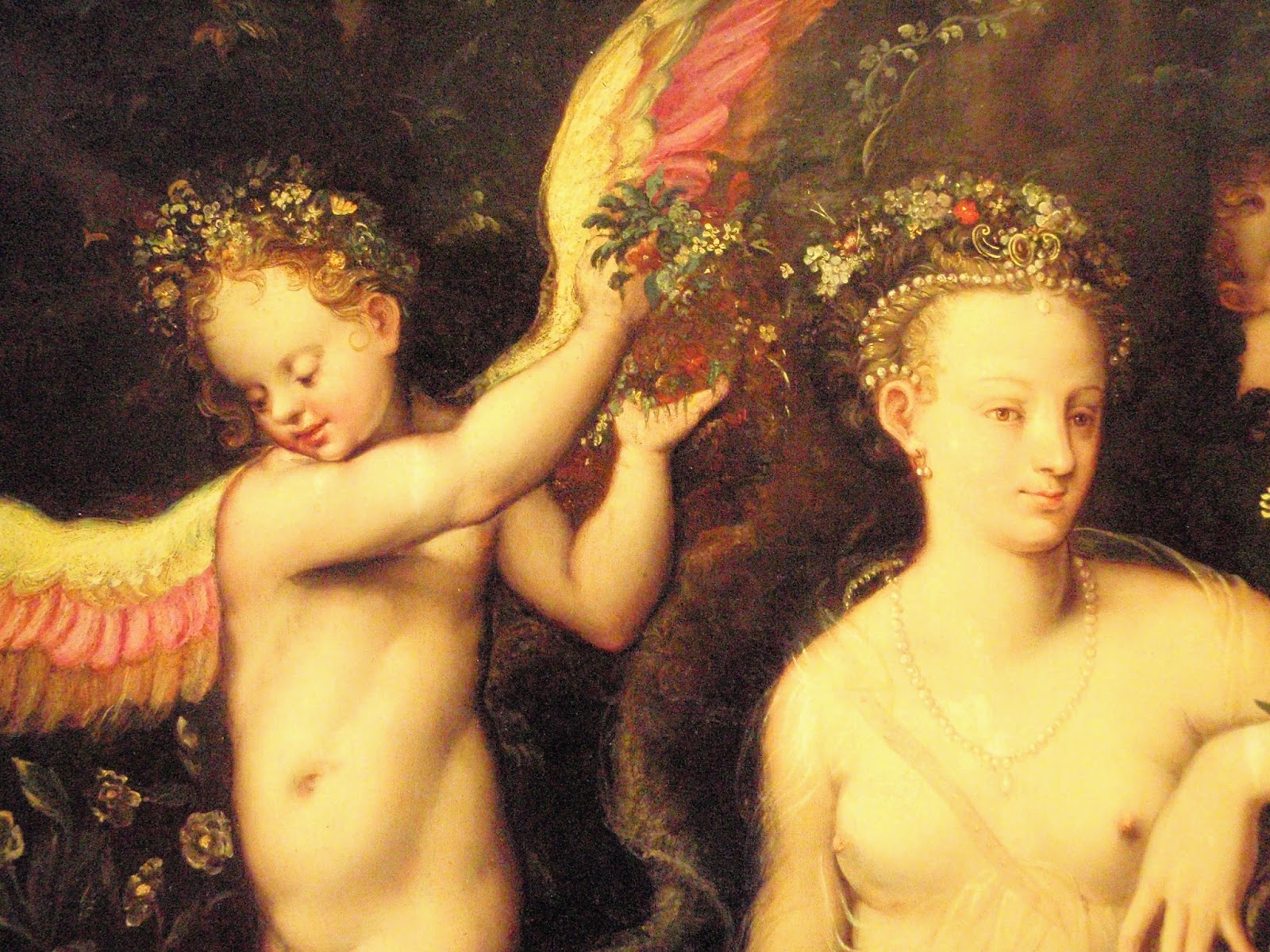
(The photos are details of paintings at the Legion of Honor: the first is Thalia, Muse of Comedy by Jean-Marc Nattier; the second is Venus and Cupid by the School of Fontainebleau; the third and fourth are from Giovanni Battista Tiepolo's The Empire of Flora.)
14 August 2015
Friday photo 2015/33
Graffiti in the restroom at Moe's Books in Berkeley; the shot below was taken a few weeks after the one above
11 August 2015
American Bach Soloists: Versailles & the Parisian Baroque
Aficionados of the baroque have frequent opportunities to hear major and minor works by German, Italian, and English composers, but (apart from the occasional piece by Lully or Rameau) fewer chances to hear their French compeers, so there was a grateful novelty about many of the works presented by American Bach Soloists this past weekend in the opening concerts of their 2015 summer Festival & Academy, which highlights the musicians centered on Versailles and Paris.
As we gathered in the lobby of the San Francisco Conservatory of Music on Friday night, a band of musicians on the third floor above us played Michel-Richard de Lalande's Concert de trompettes pour les festes sur le canal de Versailles, which reminded some of us of the fanfares at Bayreuth signaling the imminent start of the performance. At this first concert, ABS Artistic & Music Director Jeffrey Thomas led three substantial pieces for small orchestra. The opener was Les Élémens by Jean-Féry Rebel, which recreates musically the creation of the world – form arising from chaos – which makes it a very suitable opening number. Thomas started off by having the band play the themes that illustrated the four elements: air, fire, water, and earth. This was quite useful, though some in the audience found in unaccountably amusing. He then went on to talk about the wild opening, which is meant to illustrate primordial chaos. I think it would have been more effective to let the sound speak for itself; it's meant to be jarring and bizarre and would surely have shocked its first audience – it's still enough to startle us out of whatever preconceptions we might have had about the clarity and order of the French baroque. Far better to have the sound hit you than to have someone tell you, in effect, to brace yourself. That aside, I enjoyed hearing this music live (I had only heard a recording before this). As with much baroque music, dance forms are basic, and the world danced itself into being in a wide variety of rhythms and moods. There was a lovely twittering interlude for les rossignols (the nightingales) as well; the melodious birds had a movement to themselves.
That piece was followed by Suite II in D Major, Op 9 no 2 by Jacques Aubert le Vieux. Like many of the other composers featured in these programs, le Vieux was a performer at the French court (in his case, a violinist) and his compositions grew out of the talents around him and the tastes of Louis XIV. After the intermission came the Ouverture & Suite from Jean-Philippe Rameau's opera Naïs; this time the dance forms were actually intended to be danced to (again, catering to the Sun King's tastes; he was a dancer himself). The elegant concert hall at the San Francisco Conservatory of Music used to be a natatorium (swimming pool does not seem the right word), so I guess it was suitable that we were hearing music written about the water-nymph Naïs. The orchestra throughout was clear and lively and impeccably shaped.
The second concert, on Saturday night, had a number of more intimate chamber pieces, rather than the grander statements of the night before. Years ago I visited Versailles and was struck by how utterly displayed everything was; it was beautiful and even overwhelming, but not really a place of intimacy or eccentricity. This is to say that even in these chamber pieces there was a sense of being displayed to the public eye. The performers this time were faculty members of the ABS Academy; their names were grouped in a headnote to the program, and though it was not that difficult to figure out who was doing what, I would have liked to see the individual names by the individual pieces. Other than that the ABS program book was, as usual, a model of amplitude and elegance, full of interesting articles and attractive pictures.
The concert opened with a Suite in D Major by Marin Marais (the viola da gamba master made famous currently by the film Tous les Matins du Monde). He, too, was a performer as well as composer. That was followed by four Airs de Cour (three by Sébastien le Camus and one by Nicolas de la Grotte) sung by alto Judith Malafronte; then François-André Danican Philidor's Sinfonia I in G Minor; then André Campra's satirical cantata Les Femmes, sung by baritone William Sharp, about a man tired of love and women who leaves them all behind to become a hermit (or so he says). Then came the intermission, and after that a riposte to the Campra by Quirinus van Blankenburg, an organist outraged by what I have to say was the fairly gentle satire of Les Femmes into producing L'Apologie des Femmes, in which a man (bass-baritone Max van Egmond) flees the horrors of the wilderness to enjoy the company of a delightful variety of women. It would be amusing to know what the women thought of both these characters.
The concert concluded with two instrumental pieces, the Sonata in A Major, Op 51, no 5 by Joseph Bodin de Boismortier and François Couperin's Troisième Ordre, "L'Impériale" – a cellphone went off during that piece, and I have to say I was dismayed by the number of attendees at this concert who were apparently students at the Academy who pulled out their phones at the slightest pause in the proceedings. The splendid players deserved more attention and respect; they were, in addition to the singers I have mentioned, Elizabeth Blumenstock on violin, Corey Jamason on harpsichord, Steven Lehning on viola da gamba, Robert Mealy on violin, Sandra Miller on flute, Debra Nagy on oboe, William Skeen on violoncello and viola da gamba, Kenneth Slowik on viola da gamba, and Dominic Teresi on bassoon.
The festival is continuing through this week; check here for a full schedule, including the rare opportunity to hear Marin Marais's opera Sémélé.
Tomato Tuesday 2015/14
Let's start off with the cat update: midway through last week I went out to water, and Lovely Cat was sunning himself on the patch of dead lawn outside the door. Once again when I appeared on the scene he moved away. It was a slower movement than the usual bolt, but still he moved away, so I assumed he was still unable to accept that I would not harm or even approach him, and frankly I no longer really cared much, since there's only so much emotional energy I'm going to put into a wandering cat and if he wants to interrupt his sunning to run away from me, then so be it.
But then I realized that what he had done was move off to the side of the yard, a bit behind the birdbath: so presumably he had come to realize that when I entered the yard the birdbath would soon be full and he could have his drink, which he graciously did while I took a number of pictures, two of which you can see here. I used the zoom feature since he is still skittish and I didn't want to get too close. I can take a hint if it's repeated often enough.
The cat is quite beautiful but I would be happy if I still saw the birds I used to see. A year or two ago there were five mourning doves that would hang out back there, and some beautiful bluebirds. Where are they now? The squirrels seem to be gone too, but I don't miss them very much.
Below is a random rose: this is Moonstone, which I bought because Wilkie Collins. It was one of the first roses I bought but though it has grown fairly large it has never seemed quite healthy. The flowers would usually droop in an odd way. The stems looked sturdy enough to hold the blooms, but they had a weird crookneck thing going on. Sometimes you just get a plant that turns out oddly. My sister across town had the same rose and hers never drooped the way mine did. Anyway this one had its head held high so I took its picture. You can see it's a gorgeous flower when it behaves, with pale petals trimmed with delicate pink.
Below is St Patrick, which I've shown here before. These particular blooms oddly lacked their usual greenish tinge on the petals, which is where the rose gets its name (because green equals Ireland and Ireland equals St Patrick). The red-and-white rose you can see through St Patrick's leaves is Betty Boop, keeping company with the saint.
On to the tomatoes. This week I thought I would forego the double shot, since the plants look pretty much as they have the last few weeks, except Cherokee Purple is drooping even more to the right and both are looking thinned out.
Below are some of the fruits of Michael Pollan, approaching edibility. I'm hoping by next week some of these will be at last ripe enough to eat. What you're seeing here is the side that gets the most sunlight, so it looks riper than the backs, which are still a bit greenish.
This week I counted nineteen fruits on Michael Pollan, which is fewer than I said were there last week. I've counted several times and still get nineteen, so last week either I miscounted (at least twice, since that's my minimum count), or a couple of tomatoes dropped off, either eaten by something or possibly just lost due to drought stress. Since the ripest fruits are all still there, I'm thinking maybe they weren't eaten; on the other hand, I didn't notice any fruits on the ground (not that I looked that closely) so perhaps I just miscounted. This is the kind of real-world activity that makes me realize that what scientists do is actually very tricky and somewhat subjective.
Earlier in the season I had thought that the plants were doing well with less water, but now, as I am realizing that I usually have many more tomatoes at this time of year, I'm thinking that the reduced water has led to reduced fruit output. Other than that the set-up is as it has been in previous years: the same sort of compost in the pots, the same locations, and this year maybe even more sun and heat, because that's what the weather has been like.
Below are some close-ups of the heirloom lettuce gone to seed. I love the wrinkled sheet behind them. It started out as a practical way of making the plants more visible in photographs, but I enjoy it on its own now: the folds catch the light like a convoluted cloak slipping off some ecstatic Baroque saint. I have resisted the temptation to leave it up all the time so that I could watch the changing light and shadow on it.
Anyway you can see the little yellow flowers that top the lettuce stalks.
And here is Cherokee Purple. Nineteen fruits this week, and I hope that this plant, too, will have some tomatoes ready to eat in the coming week.
You can see in the photo above that the shoulders of the fruit are orangey-yellow, whereas in the less-ripe specimen below they are still green.
Below is a shoot of Sungold, which is not an heirloom tomato but which is tasty anyway, though I do have to say that this summer it does not seem as deliciously sweet as it has in previous years. This particular shoot has splayed out on its own, ignoring the helpful wire cage meant to lend it support.
Below is one of the little white butterflies that I see frequently. They have pale gray markings on their inner wings and sometimes flutter around in pairs. It's perched on a nasturtium leaf.
The neighbor's berry plants extend over the back wall. The berries are pretty tasty. I suspect birds get many of them, which would be why smaller berry plants tend to sprout up in odd places in my yard.
But then I realized that what he had done was move off to the side of the yard, a bit behind the birdbath: so presumably he had come to realize that when I entered the yard the birdbath would soon be full and he could have his drink, which he graciously did while I took a number of pictures, two of which you can see here. I used the zoom feature since he is still skittish and I didn't want to get too close. I can take a hint if it's repeated often enough.
The cat is quite beautiful but I would be happy if I still saw the birds I used to see. A year or two ago there were five mourning doves that would hang out back there, and some beautiful bluebirds. Where are they now? The squirrels seem to be gone too, but I don't miss them very much.
Below is a random rose: this is Moonstone, which I bought because Wilkie Collins. It was one of the first roses I bought but though it has grown fairly large it has never seemed quite healthy. The flowers would usually droop in an odd way. The stems looked sturdy enough to hold the blooms, but they had a weird crookneck thing going on. Sometimes you just get a plant that turns out oddly. My sister across town had the same rose and hers never drooped the way mine did. Anyway this one had its head held high so I took its picture. You can see it's a gorgeous flower when it behaves, with pale petals trimmed with delicate pink.
Below is St Patrick, which I've shown here before. These particular blooms oddly lacked their usual greenish tinge on the petals, which is where the rose gets its name (because green equals Ireland and Ireland equals St Patrick). The red-and-white rose you can see through St Patrick's leaves is Betty Boop, keeping company with the saint.
On to the tomatoes. This week I thought I would forego the double shot, since the plants look pretty much as they have the last few weeks, except Cherokee Purple is drooping even more to the right and both are looking thinned out.
Below are some of the fruits of Michael Pollan, approaching edibility. I'm hoping by next week some of these will be at last ripe enough to eat. What you're seeing here is the side that gets the most sunlight, so it looks riper than the backs, which are still a bit greenish.
This week I counted nineteen fruits on Michael Pollan, which is fewer than I said were there last week. I've counted several times and still get nineteen, so last week either I miscounted (at least twice, since that's my minimum count), or a couple of tomatoes dropped off, either eaten by something or possibly just lost due to drought stress. Since the ripest fruits are all still there, I'm thinking maybe they weren't eaten; on the other hand, I didn't notice any fruits on the ground (not that I looked that closely) so perhaps I just miscounted. This is the kind of real-world activity that makes me realize that what scientists do is actually very tricky and somewhat subjective.
Earlier in the season I had thought that the plants were doing well with less water, but now, as I am realizing that I usually have many more tomatoes at this time of year, I'm thinking that the reduced water has led to reduced fruit output. Other than that the set-up is as it has been in previous years: the same sort of compost in the pots, the same locations, and this year maybe even more sun and heat, because that's what the weather has been like.
Below are some close-ups of the heirloom lettuce gone to seed. I love the wrinkled sheet behind them. It started out as a practical way of making the plants more visible in photographs, but I enjoy it on its own now: the folds catch the light like a convoluted cloak slipping off some ecstatic Baroque saint. I have resisted the temptation to leave it up all the time so that I could watch the changing light and shadow on it.
Anyway you can see the little yellow flowers that top the lettuce stalks.
You can see in the photo above that the shoulders of the fruit are orangey-yellow, whereas in the less-ripe specimen below they are still green.
Below is a shoot of Sungold, which is not an heirloom tomato but which is tasty anyway, though I do have to say that this summer it does not seem as deliciously sweet as it has in previous years. This particular shoot has splayed out on its own, ignoring the helpful wire cage meant to lend it support.
Below is one of the little white butterflies that I see frequently. They have pale gray markings on their inner wings and sometimes flutter around in pairs. It's perched on a nasturtium leaf.
The neighbor's berry plants extend over the back wall. The berries are pretty tasty. I suspect birds get many of them, which would be why smaller berry plants tend to sprout up in odd places in my yard.
10 August 2015
Poem of the Week 2015/32
Orpheus x 2
Then to the well-trod stage anon,
If Jonson's learned Sock be on,
Or sweetest Shakespeare, fancy's child,
Warble his native Wood-notes wild.
And ever against eating Cares,
Lap me in soft Lydian Airs,
Married to immortal verse,
Such as the meeting soul may pierce
In notes, with many a winding bout
Of linked sweetness long drawn out,
With wanton heed, and giddy cunning,
The melting voice through mazes running;
Untwisting all the chains that tie
The hidden soul of harmony;
That Orpheus' self may heave his head
From golden slumber on a bed
Of heapt Elysian flow'rs, and hear
Such strains as would have won the ear
Of Pluto, to have quite set free
His half-regain'd Eurydice.
John Milton, from L'Allegro, ll 131 - 150
Sometime let Gorgeous Tragedy
In Scepter'd Pall come sweeping by,
Presenting Thebes, or Pelops' line,
Or the tale of Troy divine,
Or what (though rare) of later age,
Ennobled hath the Buskin'd stage.
But, O sad Virgin, that thy power
Might raise Musaeus from his bower,
Or bid the soul of Orpheus sing
Such notes as, warbled to the string,
Drew Iron tears down Pluto's cheek,
And made Hell grant what Love did seek.
John Milton, from Il Penseroso, ll 97 - 108
Here is a poetic diptych from John Milton's early life: a paired consideration of ways to be in the world. He refers to them as Mirth and Melancholy; you could also see them as cheerful or pensive, social or solitary, sun or shade, extrovert or introvert; both states have their attractions and beauties. The two poems are balanced against each other, and what occurs in one will re-occur in a different aspect in the other. Both feature Orpheus and his descent to the Underworld to search for his dead love Eurydice, in each case preceded by trips to the theater. According to the common conception of the type you might think that the melancholy, solitary man would avoid the theater, but Milton's conception is subtler and more elusive, having to do with perspectives and predilections rather than such broad stereotypes – though I should point out that it's only in L'Allegro that he explicitly goes to the theater ("I'll to the well-trod stage anon"), where he sees what were then fairly modern works by Jonson and Shakespeare, both of whom are presented in their lighter moods, along with the sensuous beauty of live music; in Il Penseroso he might be at the theater, or he might be reading these works for the theater of the mind – the social aspect of theater-going is elided; there is no "well-trod" in Penseroso. Whether he's seeing it live or in his mind's eye, the Penseroso theater presents the heavier matter of tragedy, and mostly classical tragedy (he mentions Troy, but also Thebes, which suggests the story of Oedipus and his descendants, and Pelops' line, which covers Agamemnon and Clytemnestra and their descendants Iphigenia, Orestes, and Electra).
Jonson's learned sock refers to the thin-soled light shoe worn by comic actors in the classical world, making this reference to Jonson's satirical comedies itself a witty example of the sort of scholarly learning with which Jonson enriched his plays. Allegro's comic sock is contrasted with Penseroso's buskins (the Buskin'd stage), which are the elevated boots or cothurni worn by the tragic actors of ancient Greece to make themselves look taller and grander – more tragic. Jonson's classical correctness is contrasted with Shakespeare's (alleged) artless profusion; fancy means imagination, so calling him "fancy's child" implies that Shakespeare was sort of a conduit to pure imagination, as unconscious of what he was putting forth as a bird singing in the woods. Of course this is as untrue of Shakespeare as of the bird, but those who value the classical model have always been put off by his profusion and mixture of high and low, which is why his reputation in France has generally been lower than it is in more brooding countries. This view dates back to Jonson himself, actually, and I wonder if Milton got the idea from him and transferred the comparison to classical masters from Shakespeare back to Jonson:
[. . . ] and though thou hadst small Latin, and less Greek,
From thence to honour thee, I would not seek
For names; but call forth thundering Aeschylus,
Euripides, and Sophocles to us,
Pacuvius, Accius, him of Cordova dead,
To life again, to hear thy buskin tread,
And shake a stage: or, when thy socks were on,
Leave thee alone, for the comparison
Of all that insolent Greece, or haughty Rome
Sent forth, or since did from their ashes come.
Ben Jonson, To the Memory of My Beloved, the Author Mr William Shakespeare: And What He Hath Left Us, ll 31 - 40
That excerpt is from one of the prefatory poems to the First Folio of Shakespeare's works, published in 1623. Pacuvius and Accius are Roman tragic poets, whose names survive thanks to a mention in Horace's Epistles, though time has not been as considerate of their now-lost works; him of Cordova dead is Seneca, whose plays were better-known and more influential among the Elizabethans than those of the Greek tragedians. In this poem praising his friend, Jonson cannot resist displaying his own learning, and indirectly praising himself while praising his sometime rival.
Back to Milton, and let's pick up with the Lydian airs. The Lydian mode, one of the ways of organizing musical sounds inherited and adapted from ancient Greece, was the mode of seductive beauty, a mood which often elicits condemnations or warnings about the Lotos-Eaters land it will lead you to. Here Milton emphasizes its seductive sweetness, but there are interesting intimations (which find a later echo in the portions of Paradise Lost describing the overwhelming beauty of Paradise) that giving in to this tempting loveliness will unhinge you: your soul leaves you to meet the notes that pierce it; then there is the further erotic charge of many a winding bout / Of linked sweetness long drawn out, followed by references to wanton heed and giddy cunning. Wanton at this time meant primarily wandering or frolicsome, and heed means to pay attention to something, so the meaning seems to be that the music is playfully distracting and absorbing your thoughts, but there is an undercurrent in wanton of its current primary meaning, sexually promiscuous or lascivious, and heed is most often associated with warnings. Similarly, giddy cunning can refer to something sly and circuitous and dazzling (if you've heard the ornaments in vocal music of this period, you will know what he is talking about here), but cunning of course carries an implication of deceitful, and if you get too giddy you lose your head and get sick. The music untwists the chains that tie / The hidden soul of harmony: it liberates the senses, but perhaps only to take them captive in a different way; perhaps there are dull, sensible reasons why harmony is chained and bound by rules. I sometimes think Milton's insistence on the supremacy of Reason (which, notoriously, led him to place men, whom he saw as more rational, over women, whom he saw as more emotional and intuitive) is at heart a matter of self-preservation: he was so susceptible to seductive, instinctive beauty that in order to preserve a sense of self he had to construct barriers to ward it off.
This luscious description of the Lydian airs segues into the Allegro description of Orpheus: in fact he is not himself singing here – he is brought in to top off the heady description of this music, which is so powerful, so sweet, so overwhelming that not only might Orpheus himself, the ultimate singer, have sung it, but it would have accomplished what his actual song did not: the unconditional return of his dead love. (Eurydice is half-regain'd because Pluto, ruler of Hades, was so moved by Orpheus's laments that he did allow her to return to life – but only if the poet could resist looking back at her until they were out of the underworld. When they had almost made it out he could no longer resist and she melted back among the shades.) The mere mention of Orpheus's story brings in undercurrents of death and dissolution, but its primary purpose here is as a hyperbolic cap to the tribute to music's potentially dangerous beauty. The glancing reference to his tragedy is presented in glowing and apparently retrospective terms: as mentioned earlier, he is not himself singing; apparently his life, as well as his attempt to regain his lost love, are in the past, since he is in Elysium, the portion of the underworld dedicated to the noble and heroic. We know he is there because he is sleeping sweetly (his golden slumbers) on a bed of Elysian flowers. He is awakened by the strains of this music (and again, there is the warning undercurrent: strain is used here in the sense of a piece of music played or performed, but it can also mean pressure or force of a potentially dangerous kind). But this pressure is still sweet, still lovely, half-heard and dreamy among the immortal flowers.
Contrast this with the Penseroso Orpheus. Again, Milton transitions from the stage: this time, we get the noble dignity of Gorgeous (that is, richly beautiful) Tragedy, which glides by, as swiftly as life, in Scepter'd Pall: the scepter is a reminder that most tragedies dealt with rulers and others of high social station, and also of the status of tragedy itself as the sovereign among literary genres. The pall is a cloak or covering, but it often refers specifically to one over a coffin or hearse, and it can also mean to cast a gloomy shadow over something, or to perceive something as casting such a shadow. So with a few brief words Milton has summoned up an image of tragedy and reinforced its traditional status as dignified, royal, somber, and death-haunted. The sad (that is, serious-minded) Virgin referred to might be Tragedy, or the "divinest Melancholy" invoked at the opening of the poem. Melancholy here is more than the gentle sadness the term evokes today; it was considered a physical as well as mental condition (it was one of the four humours that were held to determine personality), and it suggests thoughtful thoughts, conveying a shadowed range from the gently autumnal to the deepest despair.
In Il Penseroso Milton emphasizes its contemplative, pensive side, and its deep meditative beauty. Just as it has its claim on theater in the form of Tragedy, so melancholy has its music. He first seeks the legendary ancient Greek Musaeus (whose name means one belonging to the Muses), and then invokes the other great singer of the Attic myths, Orpheus, whose presentation here is much more poignant than in the golden glances of L'Allegro: this time, he is himself singing, and at the height of both his powers and his anguish, when he is pleading with the King of the Dead to release his beloved. The iron tears are such a vivid and effective detail, suggesting both the obdurate nature of Pluto and the mighty power of the song that could elicit such tears. The wonderfully balanced and rhythmic phrases made Hell grant and what Love did seek sum up the Orphic power with elegant concision. (And this line foreshadows a major theme of Milton's major work, Paradise Lost: the victory of Love over Hell.) The overuse of abstractions can enervate a poem, but Milton deploys them cannily here: among the profusion of specific details, he suddenly strips the plight of Orpheus down to its naked archetypal essentials: Love opposed to Hell. These four lines are some of my favorite lines of poetry. Milton makes a glorious case for the Allegro view, but it's difficult not to feel that his heart is really with Penseroso.
I took these excerpts from John Milton: Complete Poems and Major Prose, edited by Merritt Y. Hughes, though these two poems are often anthologized and would also be in any collection of Milton's major (but non-Paradise-Lost) works. On my last trip to Moe's Books I came across a handsome edition from The Heritage Press of these two poems that included Blake's illustrations; it's out of print but you can find copies on line. The Ben Jonson poem is from the Penguin edition of The Complete Poems of Ben Jonson, edited by George Parfitt. I actually cannot read these poems now without hearing them as set to music by George Frederic Handel (though in hilariously eighteenth century fashion, his librettist had to add a third section praising Moderation), and I can't hear his setting without picturing the Mark Morris Dance Group performing Morris's version (whose costumes were inspired in part by Blake's illustration) – time and experience enrich (or possibly distort) art with a very personal patina whose accretions cannot be removed. For old time's sake I was going to recommend the first recording of the Handel piece that I heard, by Banchetto Musicale (now Boston Baroque), conducted by Martin Pearlman and with a cast – Nancy Armstrong, Mary Westbrook-Geha, Sharon Baker, Frank Kelley, and James Maddalena – that brings back memories of many concerts in Boston long ago, but it seems to be out of print (indeed, completely invisible to sight; I couldn't find used copies on-line either). There are a number of other fine recordings available; I've heard most of these and all have their beauties. Handel's setting is one of my favorite pieces by one of my favorite composers, but – and I'm slightly ashamed of this, but not too proud to admit it – I do think that the solo "Sweet bird, that shunn'st the noise of folly" goes on about twice as long as it really needs to, and I've thought that every time I've heard the piece, live or on recordings. There is now also a DVD of the Mark Morris group performing L'Allegro, il Penseroso, ed il Moderato; I have it but haven't watched it yet. Locals are lucky enough to have the opportunity of seeing the work live next March, presented in Berkeley by Cal Performances.
07 August 2015
Subscribe to:
Posts (Atom)