Dante meets Virgil x 10
Dante Alighieri turns 750 this year. He was born in Florence in 1265; the exact date of birth is unknown, but he mentions that it was under the astronomical sign Gemini, which puts him between 11 May and 11 June, so 1 June is the midpoint there, a symmetry which seems suitable for this poet. In his honor, today we have the passage from the opening of the Inferno in which he first encounters Virgil, who will be his guide through Hell and Purgatory (up to the point beyond which even virtuous pagans cannot go).
First comes the original Italian, then ten English-language versions, two of them in prose and eight in verse. Dante wrote his famous epic in terza rima, an interlocking set of rhymes making ever-present the mystic Trinitarian significance of the number three: aba bcb cdc and so forth. Italian is notably richer in rhymes than English, so finding an equivalent for this significant rhyme scheme is a famous challenge, and each translator has a different way of tackling it. Most try to use some version of the original, often relying on what we might call inexact rhymes in order to stay closer to the meaning as well as to avoid a jog-trot sound.
Mentre ch'i' rovinava in basso loco,
dinanzi a li occhi mi si fu offerto
chi per lungo silenzio parea fioco.
Quando vidi costui nel gran diserto,
"Miserere di me," gridai a lui,
"qual che tu sii, od ombra od omo certo!"
Rispuosemi: "Non omo, omo già fui,
e li parenti miei furon lombardi,
mantoani per patrïa ambedui.
Nacqui sub Julio, ancor che fosse tardi,
e vissi a Roma sotto 'l buono Augusto
nel tempo de li dèi falsi e bugiardi.
Poeta fui, e cantai di quel giusto
figliuol d'Anchise che venne di Troia
poi che 'l superbo Ilïón fu combusto.
Ma tu perché ritorni a tanta noia?
Perché non sali il dilettoso monte
ch' è principio e cagion di tutta gioia?"
"Or se' tu quel Virgilio e quella fonte
che spandi di parlar sì largo fiume?"
rispuos' io lui con vergognosa fronte.
"O de li altri poeti onore e lume,
vagliami 'l lungo studio e 'l grande amore
che m'ha fatto cercar lo tuo volume.
Tu se' lo mio maestro e 'l mio autore,
tu se' solo colui da cu' io tolsi
lo bello stilo che m'ha fatto onore. . . . "
Dante, Inferno, Canto 1, ll 61 - 87
The Charles Singleton translation (1970). This is a prose translation meant to provide a helpful scholarly guide to the Italian, which is on the facing page. Each of the three books in this version of the Divine Comedy comes in two volumes; the first has Italian text and English prose translation, and the second has notes. (Most of these editions have notes of some sort explaining Dante's references; annotation has been considered essential to his work from its first appearance). I'm putting this translation first as a guide to what the Italian says, so you can see how the other translators work with it.
While I was ruining down to the depth there appeared before me one who seemed faint through long silence. When I saw him in that vast desert, I cried to him, "Have pity on me whatever you are, shade or living man!"
"No, not a living man, though once I was," he answered me, "and my parents were Lombards, both Mantuans by birth. I was born sub Julio, although late, and I lived at Rome under the good Augustus, in the time of the false and lying gods. I was a poet, and I sang of that just son of Anchises who came from Troy after proud Ilium was burned. But you, why do you return to so much woe? Why do you not climb the delectable mountain, the source and cause of every happiness?"
"Are you, then, that Virgil, that fount which pours forth so broad a stream of speech?" I answered him, my brow covered with shame. "O glory and light of other poets, may the long study and the great love that have made me search your volume avail me! You are my master and my author. You alone are he from whom I took the fair style that has done me honor. . . ."
The Henry Wadsworth Longfellow translation (1867). Dante was little known in (mostly Protestant) America when Longfellow, the writer of American epics, did his blank-verse translation:
While I was rushing downward to the lowland,
Before mine eyes did one present himself,
Who seemed from long-continued silence hoarse.
When I beheld him in the desert vast,
"Have pity on me," unto him I cried,
"Whiche'er thou art, or shade or real man!"
He answered me, "Not man; man once I was;
And both my parents were of Lombardy,
And Mantuans by country both of them.
Sub Julio was I born, though it was late,
And lived at Rome under the good Augustus,
During the time of false and lying gods.
A Poet was I, and I sang that just
Son of Anchises, who came forth from Troy,
After that Ilion the superb was burned.
But thou, why goest thou back to such annoyance?
Why climb'st thou not the Mount Delectable,
Which is the source and cause of every joy?"
"Now, art thou that Virgilius and that fountain
Which spreads abroad so wide a river of speech?
I made response to him with bashful forehead.
"O, of the other poets honor and light,
Avail me the long study and great love
That have impelled me to explore thy volume!
Thou art my master, and my author thou,
Thou art alone the one from whom I took
The beautiful style that has done honor to me. . . ."
The Dorothy L. Sayers translation (1949):
Then, as I stumbled headlong down the track,
Sudden a form was there, which dumbly crossed
my path, as though grown voiceless from long lack
Of speech; and seeing it in that desert lost,
"Have pity on me!" I hailed it as I ran,
Whate'er thou art – or very man, or ghost!"
It spoke: "No man, although I once was man;
My parents' native land was Lombardy
And both my citizenship were Mantuan.
Sub Julio born, though late in time, was I,
And lived at Rome in good Augustus' days,
When the false gods were worshiped ignorantly.
Poet was I, and tuned my verse to praise
Anchises' righteous son, who sailed from Troy
When Ilium's pride fell ruined down ablaze.
But thou – oh, why run back where fears destroy
Peace? Why not climb the blissful mountain yonder,
The cause and first beginning of all joy?"
"Canst thou be Virgil? thou that fount of splendour
Whence poured so wide a stream of lordly speech?"
Said I, and bowed my awe-struck head in wonder;
"O honour and light of poets all and each,
Now let my great love stead me – the bent brow
And long hours pondering all thy book can teach!
Thou art my master, and my author thou,
From thee alone I learned the singing strain
The noble style, that does me honour now. . . ."
The John Ciardi translation (1954):
And as I fell to my soul's ruin, a presence
gathered before me on the discolored air,
the figure of one who seemed hoarse from long silence.
At sight of him in that friendless waste I cried:
"Have pity on me, whatever thing you are,
whether shade or living man." And it replied:
"Not man, though man I once was, and my blood
was Lombard, both my parents Mantuan.
I was born, though late, sub Julio, and bred
in Rome under Augustus in the noon
of the false and lying gods. I was a poet
and sang of old Anchises' noble son
who came to Rome after the burning of Troy.
But you – why do you return to these distresses
instead of climbing that shining Mount of Joy
which is the seat and first cause of man's bliss?"
"And are you then that Virgil and that fountain
of purest speech?" My voice grew tremulous:
"Glory and light of poets! Now may that zeal
and love's apprenticeship that I poured out
on your heroic verses serve me well!
For you are my true master and first author,
the sole maker from whom I drew the breath
of that sweet style whose measures have brought me honor. . . ."
The Allen Mandelbaum translation (1980):
While I retreated down to lower ground,
before my eyes there suddenly appeared
one who seemed faint because of the long silence.
When I saw him in that vast wilderness,
"Have pity on me," were the words I cried,
"Whatever you may be – a shade, a man."
He answered me: "Not man; I once was man.
Both of my parents came from Lombardy,
and both claimed Mantua as native city.
And I was born, though late, sub Julio,
and lived in Rome under the good Augustus –
the season of the false and lying gods.
I was a poet, and I sang the righteous
son of Anchises, who had come from Troy
when flames destroyed the pride of Ilium.
But why do you return to wretchedness?
Why not climb up the mountain of delight,
the origin and cause of every joy?"
And are you then that Virgil, you the fountain
that freely pours so rich a stream of speech?"
I answered him with shame upon my brow.
"O light and honor of all other poets,
may my long study and the intense love
that made me search your volume serve me now.
You are my master and my author, you –
the only one from whom my writing drew
the noble style for which I have been honored. . . ."
Seamus Heaney, from Dante's Inferno: Translations by 20 Contemporary Poets (1993):
While I was slipping back, about to sink
back to the depths, I caught sight of one
who seemed through a long silence indistinct.
When I saw him in that great waste land
I cried out to him, "Pity me,
whatever you are, shade or a living man."
He answered me, "No, not a living man
though I was once alive, and had Lombards
for parents, both of them Mantuan.
Although I was born sub Julio, my prime
was spent in the heyday of the false gods
when I lived in Rome, in good Augustus' time.
I was a poet, and I sang of that just son
of Anchises who came out of Troy
after the burning of proud Ilion.
But why do you face back into misery?
Why do you not keep on up the sweet hill,
the source and cause of all felicity?"
"Oh, are you then Virgil, are you the fountainhead
of that wide river of speech constantly brimming?"
I answered and for shame kept my head bowed.
"You are the light and glory of other poets.
O let it avail me now, the long devotion
that made me love your book and cleave to it.
You are my master, my authority.
I learned from you and from you alone
the illustrious style for which they honor me. . . ."
The Robert Pinsky translation (1994); this one has the Italian on the facing page:
While I was ruining myself back down to the deep,
Someone appeared – one who seemed nearly to fade
As though from long silence. I cried to his human shape
In that great wasteland: "Living man or shade,
Have pity and help me, whichever you may be!"
"No living man, though once I was," he replied,
"My parents both were Mantuans from Lombardy,
And I was born sub Julio, the latter end.
I lived in good Augustus's Rome, in the day
Of the false gods who lied. A poet, I hymned
Anchises' noble son, who came from Troy
When superb Ilium in its pride was burned.
But you – why go back down to such misery?
Why not ascend the delightful mountain, source
And principle that causes every joy?"
"Then are you Virgil? Are you the font that pours
So overwhelming a river of human speech?"
I answered, shamefaced. "The glory and light are yours,
That poets follow – may the love that made me search
your book in patient study avail me, Master!
You are my guide and author, whose verses teach
The graceful style whose model has done me honor. . . ."
The Robert Durling translation (1996); this is another prose version, meant as a guide through the Italian, which is on the facing page:
While I was falling down into a low place, before my eyes one had offered himself to me who through long silence seemed hoarse.
When I saw him in the great wilderness, "Miserere – on me," I cried to him, "whatever you may be, whether shade or true man!"
He replied: "No a man, I was formerly a man, and my parents were Lombards, Mantuans both by birth.
I was born sub Julio, though it was late, and I lived in Rome under the good Augustus in the time of the false and lying gods.
I was a poet, and I sang of that just son of Anchises who came from Troy when proud Ilion was destroyed by fire.
But you, why do you return to so much suffering? why do you not climb the delightful mountain that is origin and cause of all joy?"
"Now are you that Virgil, that fountain which spreads forth so broad a river of speech?" I replied with shamefast brow.
"O honor and light of the other poets, let my long study and great love avail me, that has caused me to search through your volume.
You are my master and my author, you alone are he from whom I have taken the pleasing style that has won me honor. . . ."
The Robert Hollander & Jean Hollander translation (2000); this also has the Italian on the facing page:
While I was fleeing to a lower place,
before my eyes a figure showed,
faint, in the wide silence.
When I saw him in that vast desert,
"Have mercy on me, whatever you are,"
I cried, "whether shade or living man!"
He answered: "Not a man, though once I was.
My parents were from Lombardy –
Mantua was their homeland.
"I was born sub Julio, though late in his time,
and lived at Rome, under good Augustus
in an age of false and lying gods.
"I was a poet and I sang
the just son of Anchises come from Troy
after proud Ilium was put to flame.
"But you, why are you turning back to misery?
Why do you not climb the peak that gives delight,
origin and cause of every joy?
"Are you then Virgil, the fountainhead
that pours so full a stream of speech?"
I answered him, my head bent low in shame.
"O glory and light of all other poets,
let my long study and great love avail
that made me delve so deep into your volume.
"You are my teacher and my author.
You are the one from whom alone I took
the noble style that has brought me honor. . . ."
The Ciaran Carson translation (2002):
I too was driven by that lupine brute
to stagger back, as down a broken stair,
to where the sun becomes irresolute;
and in that lower place, a shape appeared
to glide across my vision, pale and mute
from long restraint. As through that wasteland weird
he skimmed, I cried: "O pity me, you shade,
or man! Whate'er you be, please make it clear!
"Not man, though formerly a man," he said.
"My parents, you must know, were Lombards true,
for both in Mantua were born and bred.
Under Julius I was born, and grew
to fame in Rome when good Augustus reigned,
and bogus pagan gods were all we knew.
I was a poet, and to some acclaim
I sang of bold Anchises' son, who sailed
from Troy when Ilium went up in flames.
But as for you, why have you left the trail?
Why look so down? Why don't you climb the Mount
of Joy, where every happy thing prevails?"
"Are you then Virgil, that superior fount
which spouts so generous a verbal brook?"
I bashfully replied to his account.
O you, to whom all other poets look!
may that long study and great love endure
which brought me first to delve into your book!"
You are my paragon, my favourite author –
you, the very one from whom I stole
the noble style that critics praise me for. . . ."
01 June 2015

29 May 2015
Friday photo 2015/22

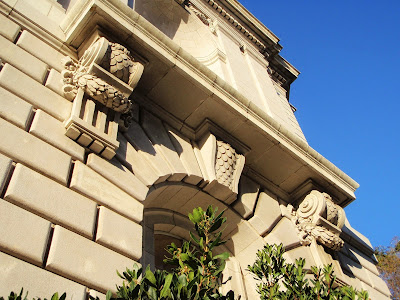
Tomorrow, 30 May, is the feast day of St Joan of Arc, so here is the statue of her outside of the Legion of Honor in San Francisco
26 May 2015
fun stuff I may or may not get to: June 2015
the BART reminder
Again, here's a reminder before you buy any tickets for upcoming events: BART is shutting off part of its tracks on certain weekends through August; since this will affect traffic as well as the rest of the BART system, you may want to check your plans against the latest shut-down dates, which are currently:
* Saturday and Sunday 6 - 7 June, all day;
* Saturday and Sunday 13 - 14 June, all day.
But be sure to check here for the latest information, since they've been switching the dates around, which is annoying.
Operatic
The big item at San Francisco Opera is of course Hector Berlioz's Les Troyens, conducted by Donald Runnicles and staged by David McVicar, with Anna Caterina Antonacci / Michaela Martens as Cassandra, Susan Graham as Dido, Bryan Hymel as Aeneas, Sasha Cooke as Anna, Brian Mulligan as Chorebus, Christian Van Horn as Narbal, and René Barbera as Iopas. But wait! as they used to say – there's more! You can also catch the world premiere of Marco Tutino's Two Women (based on the film starring Sophia Loren, which was based on Alberto Moravia's novel), with Nicola Luisotti conducting and Francesca Zambello directing; this also stars Anna Caterina Antonacci. The Opera is also presenting one of my favorites, Mozart's Le Nozze di Figaro, conducted by Patrick Summers, with a promising cast including Philippe Sly, Lisette Oropesa, Nadine Sierra, Kate Lindsey/Angela Brower, and Luca Pisaroni. Unfortunately it's the same production I've disliked (actually, loathed) in previous outings, but we can't have everything.
You can also go across the street to Davies Hall to hear some opera presented by the San Francisco Symphony. Charles Dutoit conducts a program including Ravel's one-act L'Heure Espagnole with the beauteous mezzo-soprano Isabel Leonard on 4 - 6 June (the rest of the program is Ravel's Alborado del gracioso and de Falla's Nights in the Garden of Spain). Later in the month, as part of their Beethoven festival, you can hear his only opera, Fidelio, led by Michael Tilson Thomas, with an excellent cast headed by Nina Stemme as Leonore and Brandon Jovanovich as Florestan. That's 25 - 26 and 28 June.
Symphonic
The San Francisco Symphony is dedicating most of its month to Beethoven. Michael Tilson Thomas conducts the performances unless otherwise noted. One highlight is sure to be the Missa Solemnis, with excellent soloists (Joélle Harvey, Sasha Cooke, Brandon Jovanovich, and Shenyang) along with our beloved SF Symphony Chorus. The performances will be semi-staged by James Darrah, who directed last year's stunning Peter Grimes at the Symphony as well as a brilliant Don Giovanni for the Merola Opera Program, so that's a good sign. You can experience that on 10 - 13 June. You can hear the Pastoral Symphony along with the Overture to the Creatures of Prometheus, the Piano Concerto No 4 with soloist Jonathan Biss, and the concert aria Ah, perfido! with soprano Karita Mattila on 17 and 19 June. You can hear the Fifth Symphony, the Sanctus from the Mass in C Major, and the Choral Fantasy and Piano Fantasy in G minor (with Biss as soloist again) on 18 June. And you can put all that together on 20 June in the Beethoven Marathon, a recreation of the famously overpacked concert that featured the premieres of the Fifth and Sixth Symphonies along with the Piano Concerto No 4 and the Choral Fantasy. On 30 June you can hear the Fifth Symphony, this time led by Edwin Outwater, along with Rachmaninoff's Piano Concerto No 2 with Garrick Ohlsson as soloist.

If you're not in the mood for Beethoven but you still want to hear an orchestra, preferably playing rarities, then check out the Bay Area Rainbow Symphony's 6 June concert at the San Francisco Conservatory of Music. Titled Portrait of the Artist as a Young Woman and led by Music Director Dawn Harms, the concert features music by three women composers: the Partita for Piano and Strings by Vitězslava Kaprálová, the Piano Concerto by Clara Wieck Schumann, and Serenade by composer, suffragette, and friend of Virginia Woolf – that's not a euphemism, she really was a friend of Woolf's – Dame Ethel Smyth. The piano soloist will be Sara Davis Buechner. Earlier that same day, Buechner will give a program called Crossing the Concourse: Sara Davis Buechner in Words and Music, in which she will (quoting from the press release) "illustrate her life story and transgender journey with short piano pieces, including one of her own compositions." You can find out more and get tickets to either or both performances here.
Theatrical
At Cutting Ball Theater the annual Risk Is This. . . series of new play readings continues; you can still catch Katharine Sherman's nightcap (31 May - 1 June); Andrew Saito's Whisper Fish (7 - 8 June); and Andrew Saito's Beauty Secrets (14 - 15 June). More information may be found here.
Shotgun Players has Heart-Shaped Nebula running through the 14th. On 8 and 9 June they present as part of their "Champagne Reading Series" Madeline George's The (Curious Case of the) Watson Intelligence. A few years ago Shotgun presented another play by George, Precious Little. I had mixed feelings about it, but there was enough there of interest so that I would be interested in seeing another of her plays. You can find out more here.
The American Conservatory Theater is opening a new venue on Market Street, not far from its home theater on Geary: the newly renovated Strand Theater. Like the Geary, the Strand was built in the early years of the twentieth century, but unlike the Geary it suffered a slow yet dramatic decline, ending up as a porn house (which I guess is another business model, like independent bookstores, hit hard by the Internet). It has been thoroughly renovated as a venue for smaller productions, with the hope that it will make a seedy section of Market Street a cultural center; it's opening on 3 June with Caryl Churchill's Love and Information, directed by Casey Stangl; check here for more information on the theater and the play.
Modern/New Music
Composer Terry Riley is turning 80 this year, and he's being celebrated musically:
Old First Concerts presents pianist Sarah Cahill on 19 June in A Piano Party for Terry Riley at 80, in which she will play new works in celebration of Riley's birthday by Samuel Carl Adams, Pauline Oliveros, Gyan Riley, Evan Ziporyn, Christine Southworth, Danny Clay, Dylan Mattingly, Luciano Chessa, Elena Ruehr, and Keeril Makan.
The Kronos Quartet presents a Terry Riley Festival at the SF Jazz Center from 26 - 28 June, with performances of Riley's music by the Kronos Quartet, Wu Man, Zakir Hussain, and others. There's a different program each night – the third night is Riley's vast string quartet Salome Dances for Peace. You can click here to see the first night but go here to the Jazz Center schedule to get to the others (and while you're there you can check out the other concerts going on there in June).
Pierre Boulez is also having a birthday year (his 90th), and he is being celebrated at Ojai at Berkeley (which is what used to be known as Ojai North). Presented by Cal Performances, this year's festival runs from 18 - 20 June. Steven Schick, this year's guest music director, has included lots of other great music, in addition to the Boulez. There are several concerts each day; check here for the full program.
The Center for New Music has its usual wide variety of possibilities; you can check the full schedule here, but some programs that jump out at me are: the Del Sol String Quartet playing Ken Ueno's Peradam on 4 June; Andrew Jamieson's Talking with Spirituals program, in which he improvises on the piano in response to traditional African-American spiritual, on 5 June; Ensemble San Francisco's Amor program, featuring new songs by Jose Gonzalez Granero sung by baritone Efraín Solís as well as music by Mark Ackerley, Osvaldo Golijov, Brahms, and Kodaly, on 11 June; and the Zofo piano duet playing music by Kurt Rohde and Terry Riley on 25 June.
Visual Arts
The DeYoung Museum is hosting JMW Turner: Painting Set Free, starting 20 June and running until 20 September. Like Les Troyens at the Opera, this is self-recommending.
Again, here's a reminder before you buy any tickets for upcoming events: BART is shutting off part of its tracks on certain weekends through August; since this will affect traffic as well as the rest of the BART system, you may want to check your plans against the latest shut-down dates, which are currently:
* Saturday and Sunday 6 - 7 June, all day;
* Saturday and Sunday 13 - 14 June, all day.
But be sure to check here for the latest information, since they've been switching the dates around, which is annoying.

Operatic
The big item at San Francisco Opera is of course Hector Berlioz's Les Troyens, conducted by Donald Runnicles and staged by David McVicar, with Anna Caterina Antonacci / Michaela Martens as Cassandra, Susan Graham as Dido, Bryan Hymel as Aeneas, Sasha Cooke as Anna, Brian Mulligan as Chorebus, Christian Van Horn as Narbal, and René Barbera as Iopas. But wait! as they used to say – there's more! You can also catch the world premiere of Marco Tutino's Two Women (based on the film starring Sophia Loren, which was based on Alberto Moravia's novel), with Nicola Luisotti conducting and Francesca Zambello directing; this also stars Anna Caterina Antonacci. The Opera is also presenting one of my favorites, Mozart's Le Nozze di Figaro, conducted by Patrick Summers, with a promising cast including Philippe Sly, Lisette Oropesa, Nadine Sierra, Kate Lindsey/Angela Brower, and Luca Pisaroni. Unfortunately it's the same production I've disliked (actually, loathed) in previous outings, but we can't have everything.
You can also go across the street to Davies Hall to hear some opera presented by the San Francisco Symphony. Charles Dutoit conducts a program including Ravel's one-act L'Heure Espagnole with the beauteous mezzo-soprano Isabel Leonard on 4 - 6 June (the rest of the program is Ravel's Alborado del gracioso and de Falla's Nights in the Garden of Spain). Later in the month, as part of their Beethoven festival, you can hear his only opera, Fidelio, led by Michael Tilson Thomas, with an excellent cast headed by Nina Stemme as Leonore and Brandon Jovanovich as Florestan. That's 25 - 26 and 28 June.
Symphonic
The San Francisco Symphony is dedicating most of its month to Beethoven. Michael Tilson Thomas conducts the performances unless otherwise noted. One highlight is sure to be the Missa Solemnis, with excellent soloists (Joélle Harvey, Sasha Cooke, Brandon Jovanovich, and Shenyang) along with our beloved SF Symphony Chorus. The performances will be semi-staged by James Darrah, who directed last year's stunning Peter Grimes at the Symphony as well as a brilliant Don Giovanni for the Merola Opera Program, so that's a good sign. You can experience that on 10 - 13 June. You can hear the Pastoral Symphony along with the Overture to the Creatures of Prometheus, the Piano Concerto No 4 with soloist Jonathan Biss, and the concert aria Ah, perfido! with soprano Karita Mattila on 17 and 19 June. You can hear the Fifth Symphony, the Sanctus from the Mass in C Major, and the Choral Fantasy and Piano Fantasy in G minor (with Biss as soloist again) on 18 June. And you can put all that together on 20 June in the Beethoven Marathon, a recreation of the famously overpacked concert that featured the premieres of the Fifth and Sixth Symphonies along with the Piano Concerto No 4 and the Choral Fantasy. On 30 June you can hear the Fifth Symphony, this time led by Edwin Outwater, along with Rachmaninoff's Piano Concerto No 2 with Garrick Ohlsson as soloist.

If you're not in the mood for Beethoven but you still want to hear an orchestra, preferably playing rarities, then check out the Bay Area Rainbow Symphony's 6 June concert at the San Francisco Conservatory of Music. Titled Portrait of the Artist as a Young Woman and led by Music Director Dawn Harms, the concert features music by three women composers: the Partita for Piano and Strings by Vitězslava Kaprálová, the Piano Concerto by Clara Wieck Schumann, and Serenade by composer, suffragette, and friend of Virginia Woolf – that's not a euphemism, she really was a friend of Woolf's – Dame Ethel Smyth. The piano soloist will be Sara Davis Buechner. Earlier that same day, Buechner will give a program called Crossing the Concourse: Sara Davis Buechner in Words and Music, in which she will (quoting from the press release) "illustrate her life story and transgender journey with short piano pieces, including one of her own compositions." You can find out more and get tickets to either or both performances here.
Theatrical
At Cutting Ball Theater the annual Risk Is This. . . series of new play readings continues; you can still catch Katharine Sherman's nightcap (31 May - 1 June); Andrew Saito's Whisper Fish (7 - 8 June); and Andrew Saito's Beauty Secrets (14 - 15 June). More information may be found here.
Shotgun Players has Heart-Shaped Nebula running through the 14th. On 8 and 9 June they present as part of their "Champagne Reading Series" Madeline George's The (Curious Case of the) Watson Intelligence. A few years ago Shotgun presented another play by George, Precious Little. I had mixed feelings about it, but there was enough there of interest so that I would be interested in seeing another of her plays. You can find out more here.
The American Conservatory Theater is opening a new venue on Market Street, not far from its home theater on Geary: the newly renovated Strand Theater. Like the Geary, the Strand was built in the early years of the twentieth century, but unlike the Geary it suffered a slow yet dramatic decline, ending up as a porn house (which I guess is another business model, like independent bookstores, hit hard by the Internet). It has been thoroughly renovated as a venue for smaller productions, with the hope that it will make a seedy section of Market Street a cultural center; it's opening on 3 June with Caryl Churchill's Love and Information, directed by Casey Stangl; check here for more information on the theater and the play.
Modern/New Music
Composer Terry Riley is turning 80 this year, and he's being celebrated musically:
Old First Concerts presents pianist Sarah Cahill on 19 June in A Piano Party for Terry Riley at 80, in which she will play new works in celebration of Riley's birthday by Samuel Carl Adams, Pauline Oliveros, Gyan Riley, Evan Ziporyn, Christine Southworth, Danny Clay, Dylan Mattingly, Luciano Chessa, Elena Ruehr, and Keeril Makan.
The Kronos Quartet presents a Terry Riley Festival at the SF Jazz Center from 26 - 28 June, with performances of Riley's music by the Kronos Quartet, Wu Man, Zakir Hussain, and others. There's a different program each night – the third night is Riley's vast string quartet Salome Dances for Peace. You can click here to see the first night but go here to the Jazz Center schedule to get to the others (and while you're there you can check out the other concerts going on there in June).
Pierre Boulez is also having a birthday year (his 90th), and he is being celebrated at Ojai at Berkeley (which is what used to be known as Ojai North). Presented by Cal Performances, this year's festival runs from 18 - 20 June. Steven Schick, this year's guest music director, has included lots of other great music, in addition to the Boulez. There are several concerts each day; check here for the full program.
The Center for New Music has its usual wide variety of possibilities; you can check the full schedule here, but some programs that jump out at me are: the Del Sol String Quartet playing Ken Ueno's Peradam on 4 June; Andrew Jamieson's Talking with Spirituals program, in which he improvises on the piano in response to traditional African-American spiritual, on 5 June; Ensemble San Francisco's Amor program, featuring new songs by Jose Gonzalez Granero sung by baritone Efraín Solís as well as music by Mark Ackerley, Osvaldo Golijov, Brahms, and Kodaly, on 11 June; and the Zofo piano duet playing music by Kurt Rohde and Terry Riley on 25 June.
Visual Arts
The DeYoung Museum is hosting JMW Turner: Painting Set Free, starting 20 June and running until 20 September. Like Les Troyens at the Opera, this is self-recommending.
Tomato Tuesday 2015/3
The weather has continued to be cool and overcast, which is not good tomato weather. In the last few days it's been occasionally hot, and sometimes the sun comes out, and then the wind kicks up again and it's chilly and the clouds and fog roll back in. I continue with the reduced watering, every two or three days, either early in the morning or as the sun is going down. I took these photos Sunday during one of the sunny intervals of the afternoon. Again, Michael Pollan is on the left, Cherokee Purple on the right.

It's getting difficult to see the plants against the plants behind them, so I hung a pale blue sheet behind these two. The wind was kicking up and kept blowing the sheet down (it was suspended and not very securely from a tomato cage and a stripling pear tree) so I had to move fairly quickly.
Below is a clearer view of Michael Pollan; this week it is 11 inches high (last week: 9 1/2 inches), again measuring the stem from the base up to the top of the main stem. It has no blossoms yet.

And below is Cherokee Purple. This week it is 11 1/2 inches high (last week: 10 1/2 inches, so it grew, but not as much as Michael Pollan). There are seven blossoms on it.

Here are some random roses. The one below is Our Lady of Guadalupe, which I bought a few years ago. The tag was quite blunt about the growers giving the rose that name in order to appeal to the growing Hispanic market, though I always understood that the miraculous December roses in Juan Diego's cloak were red, not pink. Well, a rose by any other name. . . .

The one below is St Patrick, named so because the outer petals of the flower have a marked green tinge and green means Ireland and Ireland means St Patrick. These are past their prime, so the green is not as noticeable and the yellow petals are getting streaked and mottled with dark red. The roses are suffering in the drought. I've had a couple die already, though it's possible that they had more or less run their natural span. I had been watering the roses with water from the leaky faucets, but then I called a plumber so that source of semi-guilt-free water has been reduced. Roses are actually fairly tough, as they have to be to survive in my somewhat haphazard garden.

I mentioned in the first entry that heirloom is one of those words that sells me on a plant right away. Here's proof: heirloom lettuce! It's called Freckle Lettuce. Not a name I care for, and I'm not a big salad eater, but I saw "heirloom lettuce" and had to buy myself one of those little six-packs at my local nursery.

Here's a close-up of these beauties! Yes, the leaves are supposed to look like that. You can see something has taken a little bite out of one of the leaves. I should maybe mention I do not use pesticides or chemicals, so . . . these things happen.

I'm not sure how well this is showing up because the light was momentarily very bright and washed out some of the colors, but the apricots are starting to get a blush on them. I think if you click on the picture to enlarge it you might be able to see it better. My other apricot tree seems to be dead, so I'm glad this one is coming through. I've noticed that some of the little green fruits have already tumbled down – possibly stress from the on-going lack of water? The fruits also seem to be smaller than they used to be.

OK, it's a watering day, so off I go.

It's getting difficult to see the plants against the plants behind them, so I hung a pale blue sheet behind these two. The wind was kicking up and kept blowing the sheet down (it was suspended and not very securely from a tomato cage and a stripling pear tree) so I had to move fairly quickly.
Below is a clearer view of Michael Pollan; this week it is 11 inches high (last week: 9 1/2 inches), again measuring the stem from the base up to the top of the main stem. It has no blossoms yet.

And below is Cherokee Purple. This week it is 11 1/2 inches high (last week: 10 1/2 inches, so it grew, but not as much as Michael Pollan). There are seven blossoms on it.

Here are some random roses. The one below is Our Lady of Guadalupe, which I bought a few years ago. The tag was quite blunt about the growers giving the rose that name in order to appeal to the growing Hispanic market, though I always understood that the miraculous December roses in Juan Diego's cloak were red, not pink. Well, a rose by any other name. . . .

The one below is St Patrick, named so because the outer petals of the flower have a marked green tinge and green means Ireland and Ireland means St Patrick. These are past their prime, so the green is not as noticeable and the yellow petals are getting streaked and mottled with dark red. The roses are suffering in the drought. I've had a couple die already, though it's possible that they had more or less run their natural span. I had been watering the roses with water from the leaky faucets, but then I called a plumber so that source of semi-guilt-free water has been reduced. Roses are actually fairly tough, as they have to be to survive in my somewhat haphazard garden.

I mentioned in the first entry that heirloom is one of those words that sells me on a plant right away. Here's proof: heirloom lettuce! It's called Freckle Lettuce. Not a name I care for, and I'm not a big salad eater, but I saw "heirloom lettuce" and had to buy myself one of those little six-packs at my local nursery.

Here's a close-up of these beauties! Yes, the leaves are supposed to look like that. You can see something has taken a little bite out of one of the leaves. I should maybe mention I do not use pesticides or chemicals, so . . . these things happen.

I'm not sure how well this is showing up because the light was momentarily very bright and washed out some of the colors, but the apricots are starting to get a blush on them. I think if you click on the picture to enlarge it you might be able to see it better. My other apricot tree seems to be dead, so I'm glad this one is coming through. I've noticed that some of the little green fruits have already tumbled down – possibly stress from the on-going lack of water? The fruits also seem to be smaller than they used to be.

OK, it's a watering day, so off I go.
25 May 2015
Poem of the Week 2015/21
The Veteran's vision
While my wife at my side lies slumbering, and the wars are over long,
And my head on the pillow rests at home, and the mystic midnight passes,
And through the stillness, through the dark, I hear, just hear, the breath of my infant,
There in the room, as I wake from sleep, this vision presses upon me:
The engagement opens there and then, in my busy brain unreal;
The skirmishers begin – they crawl cautiously ahead –
I hear the irregular snap! snap!
I hear the sounds of the different missiles – the short t-h-t! t-ht-t! of the rifle balls;
I see the shells exploding, leaving small white clouds –
I hear the great shells shrieking as they pass;
The grape, like the hum and whirr of wind through the trees, (quick, tumultuous, now the contest rages!)
All the scenes at the batteries themselves rise in detail before me again;
The crashing and smoking – the pride of the men in their pieces;
The chief gunner ranges and sights his piece, and selects a fuse of the right time;
After firing, I see him lean aside, and look eagerly off to note the effect;
– Elsewhere I hear the cry of a regiment charging – (the young colonel leads himself this time; with brandish'd sword;)
I see the gaps cut by the enemy's volleys, (quickly fill'd up – no delay;)
I breathe the suffocating smoke – then the flat clouds hover low, concealing all;
Now a strange lull comes for a few seconds, not a shot fired on either side;
Then resumed, the chaos louder than ever, with eager calls, and orders of officers;
While from some distant part of the field the wind wafts to my ears a shout of applause, (some special success;)
And ever the sound of the cannon, far or near, (rousing, even in dreams, a devilish exultation, and all the old mad joy, in the depths of my soul;)
And ever the hastening of infantry shifting positions – batteries, cavalry, moving hither and thither;
(The falling, dying, I heed not – the wounded, dripping and red, I heed not – some to the rear are hobbling;)
Grime, heat, rush – aid-de-camps galloping by, or on a full run;
With the patter of small arms, the warning s-s-t of the rifles, (these in my vision I hear or see,)
And bombs bursting in air, and at night the vari-color'd rockets.
Walt Whitman
For Memorial Day: a poem, written as the Civil War was ending, about what we would now call Post-Traumatic Stress Disorder. In late 1862 the Whitman family received word that Walt's younger brother George, a Union soldier, had been wounded in battle at Fredericksburg, Virginia. Walt, in early middle-age and already known as the author of Leaves of Grass, traveled south post-haste, where he found his brother alive, with only minor wounds. The poet stayed on in Washington DC for the next three years, nursing wounded soldiers (it was not unusual to have male nurses; it was only during the Crimean War of the previous decade that Florence Nightingale's pioneering work led the way to the modern conception of nursing as a suitable career for women). Whitman must have seen not only the physical costs of the war, but the sometimes longer-lasting psychological ones as well. We sometimes assume that in Whitman's poems the voice is always that of Walt Whitman (or, more exactly, "Walt Whitman"), but here he speaks in a different persona, that of a soldier home from the wars.
We begin with the veteran at peace and at home, with his wife and child asleep around him in the "mystic midnight": a time of quiet, when the mysteries of life pulse strongly but serenely and softly in the silence. The year is unspecified, but Whitman is projecting his speaker into the future here, because it is a time when the wars are long over (or, to use the poem's phrasing, "over long"; the inversion of normal word order elevates the speech above the colloquial). These opening lines are long-breathed and calmly flowing, setting an emotional tone of contentment: the family is gathered together in the peaceful night, the wife slumbering by his side, his infant breathing in the other room (the barely perceptible sound of the child's breathing is beautifully summoned by the lapping phrases "I hear, just hear, the breath. . .").
Then the veteran awakes, and the "vision" presses upon him: a vision is usually seen in a dream or trance, and it conjures up both a sense of something hallucinatory, ghostly, and of something hyper-real, something that forces itself into view by occupying all of your sight. The vision is presented as coming from outside of him, it presses upon him – that is, it exerts an almost physical pressure, pushing itself on him – but it takes place in the speaker's "busy brain unreal." In that line, The engagement opens then and there, in my busy brain unreal, the final word unreal can be read as modifying both the engagement and the busy brain: the battle he lived through (the engagement) and all of his whirling thoughts (his busy brain) become one in the unreal, in the vision. It is a sign of danger that in this nocturnal scene of domestic contentment his brain is suddenly busy: restless, filled with thoughts he can't control.
At this point the lines start breaking up; gone are the long-breathing lines of the opening, to be replaced by short lines, broken by dashes, varied by very long lines (often with parenthetical additions, as if they were other thoughts rushing to the surface, elbowing their way in); the calm, silent picture of the veteran's family home is replaced by flashes of remembered moments, and vivid staccato noises. Whitman's words long predate the invention of the movies, but they prefigure the cinema with their quick cuts and rapid juxtapositions as well as their onomatopoeiatic effects: not only in words like snap, shriek, hum, whirr (spelled thus in the original), and crash but also in invented consonant combinations that attempt to recreate and distinguish among the sounds a soldier hears: the t-ht-t of the rifle balls and the s-s-t of the rifles. Even the acrid feel of breathing in the suffocating smoke is brought home.
I'll go into the source for this poem in more detail at the end, as usual, but it's part of a sequence that traces a whole trajectory of war-time feelings, from patriotic pride and fervor to shock and mourning. In short, Whitman recognizes that there is something about war that appeals to human nature, an excitement and potential glory, along with the disillusionment and loss that we tend to associate with war. It is important to recognize this side of war (or to admit its existence). Whitman builds both strands into this poem. There are the realistic details that bring potential death or dismemberment with them (the exploding shells, the grape-shot cutting through the trees) but also memories of his comrades. There is what might seem the odd detail of "the pride of the men in their pieces" (that is, in their particular weapons). Indeed our veteran himself carefully distinguishes among the various types of weapons: the small iron balls (the "grape") from the shotguns, the boom of the cannons, the t-ht-t made by the rifle balls and the hissing s-s-t made by the rifles.
You get the sense of workmen taking pride in their tools, of men feeling that they are involved in something important, and doing it with a craftsman's care (the chief gunner, and the line about him conveys steadiness and efficiency, arranges his piece, selects a fuse of the right length, and then, rather endearingly, leans to one side and is eager to see "the effect" of his shot – not the damage, but the effect, as if he had made an artistic master-stroke and wanted to see if the audience appreciated it). This passage has the important consequence of humanizing the soldiers; without slowing down the swift recollections or going into the quirks of individual characters, Whitman moves the company from generic "soldiers" to particular types of men, ones we can admire.
The Civil War was one of the harbingers of modern warfare in that it was heavily mechanized (hence the vastness of the slaughter). We can see that here in the many types of rifles, shotguns, cannons, and rockets going off. Yet in the midst of this we have remnants of an older type of war, based on a code of personal honor and strength: the young colonel (would an older man know better, have grasped the new situation more keenly? does the colonel's youth carry with it idealism, romanticism, and also recklessness?) leads his regiment, they are in full cry, and he is brandishing his sword. Whitman cuts away, but the fate of the gallant's sword in the face of the enemy's relentless fire is implicit in the next line, in which the speaker sees the gaps cut by their opponent's volleys. The spaces are filled without delay by other men, rushing towards the same fate. The day of the sword is done.
The clouds and the smoke briefly obscure the scene, and there is a lull – a "strange lull," causeless among the chaos, until the battle resumes, louder and more frantic than ever. There is a shout of applause from a distant part of the field: some "special success" but the speaker does not know, and we never find out, what the success was (a hill taken by the men? some individual's particular act of bravery?) – nor do we find out whose success it was. We are never actually told who wins this battle.
The cannons continue blasting "far and near" – and then, in one of those parenthetical remarks that rise insistently with thoughts that the speaker is perhaps trying to suppress, or is partly abashed by, he describes the effect on him of the thundering cannons: rousing, even in dreams, a devilish exultation, and all the old mad joy, in the depths of my soul. Rousing implies not just awakening but something stirring, exciting, enough so to be felt even in dreams: an exultation, one that is felt as devilish, but also an old mad joy (what does old imply here? earlier in the soldier's life, when he first enlisted? or old as in prehistoric, a primal, atavistic thrill in war?) – and he feels this even in his spiritual self, in the very depths of his soul. This fervor is stimulating and also frightening, a profound and terrible insight into the human psyche. (I wonder if Milton is underlying the link between the devilish and the cannons; in Paradise Lost, cannons are invented by Satan during the war in Heaven – see Book 6, from line 470 onward).
With this dark illuminating flash showing the basic human pleasure in violent destruction, the poem starts to draw to its close. The parenthetical remark about devilish exultation is balanced two lines later by one showing the cost of that feeling: the falling, dying, I heed not – the wounded, dripping and red, I heed not – some to the rear are hobbling. Again, the parenthesis holds an insistent thought, one the veteran is trying to suppress; the obvious emotional cost to him is expressed in the broken, abrupt phasing, in which the same pattern is repeated twice: first he spots someone hit by enemy fire, whom he describes in general terms (the falling, the wounded), these terms are then followed by graphic, more painful and exact, descriptions: the falling are dying, the wounded are dripping and red. And each time he claims I heed [them] not: in the rush of battle, he cannot stop and tend to them, but must join with the others in the hastily shifting positions. But now, years later, in his mind, he still clings to the thought that he heeds not the wounded and dying: is it guilt? an attempt to suppress the brutal memories? is he trying to avoid these ghastly inescapable memories of his dying comrades?
The kaleidoscopic details swirl by. In the penultimate line, there is another important parenthesis: these in my vision I hear or see. Whitman gives us a crucial reminder at this point, when we have been swept up by the battle, that the poem opened quite differently: years later, and at peace, before "the vision" began. It's an important reminder because the veteran (and, therefore, we the readers) never actually escape the vision – never actually return in spirit to the slumbering wife and child. In a brilliant final image, the poem ascends above the battlefield into the air, with the sight and sound of the bombs bursting in air, and at night the vari-color'd rockets. There is obviously an echo here of The Star-Spangled Banner (which, though not yet the national American anthem, was a well-known patriotic song): And the rockets red glare, the bombs bursting in air, / Gave proof through the night that our flag was still there.
So Whitman is doing several things here. The use of this song reminds us of the patriotism that is one of the reasons the men are willing to fight. This song also reminds us of another war, the War of 1812, one in a series of wars fought to establish a republic in this country (there are complex issues here, many involving slavery, which I am going to set aside because Whitman himself has set them aside). The anthem also reminds us of the flag, which resonates in the context of this sequence of poems, many of which involve the flag. So there is pride and love of country and the fight for representative government, but there is also the battle at its peak in ways both dangerous and beautiful: mentioning the various colors of the rockets makes them sound like fireworks streaking through the sky, but they were launched with deadly intent. As in the opening of the poem, we are in night-time, not now one of quiet rest, but one in which the sky is torn and exploded by bombs and rockets. War takes over the heavens, and, at a height of noise and violence with all human thoughts and concerns below and behind, we are left hanging at the apex of the veteran's vision, removed from wife and child, caught in remembered glory and terror.
Whitman published Drum-Taps in the spring of 1865; later that year, he expanded the first edition. But after that he gradually began incorporating the poems into Leaves of Grass, rewriting some, cutting others, moving some into other sections of his book. According to New York Review Books, the edition of Drum-Taps that they've just published, edited and with an introduction and notes by Lawrence Kramer, is the first to give readers the book as it originally appeared. It's well worth getting a copy, even if you already own Leaves of Grass; though the stand-alone Drum-Taps and the Leaves of Grass sequence Drum-Taps retain the same trajectory, the earlier book is much broader in its themes, encompassing a wider vision of America as it was and as it should be according to Walt Whitman, with many subtle connections between the poems and a polyphonic use of different voices (Kramer's introduction and notes are very helpful in making some of these connections and pointing out the differences in tone). This poem was one of those retained in Leaves of Grass, in which it is called The Artilleryman's Vision (page 450 in my Library of America Whitman). There are some interesting changes in the poem; for instance, in the later version the mystic midnight is the vacant midnight. I've used the 1865 version.
While my wife at my side lies slumbering, and the wars are over long,
And my head on the pillow rests at home, and the mystic midnight passes,
And through the stillness, through the dark, I hear, just hear, the breath of my infant,
There in the room, as I wake from sleep, this vision presses upon me:
The engagement opens there and then, in my busy brain unreal;
The skirmishers begin – they crawl cautiously ahead –
I hear the irregular snap! snap!
I hear the sounds of the different missiles – the short t-h-t! t-ht-t! of the rifle balls;
I see the shells exploding, leaving small white clouds –
I hear the great shells shrieking as they pass;
The grape, like the hum and whirr of wind through the trees, (quick, tumultuous, now the contest rages!)
All the scenes at the batteries themselves rise in detail before me again;
The crashing and smoking – the pride of the men in their pieces;
The chief gunner ranges and sights his piece, and selects a fuse of the right time;
After firing, I see him lean aside, and look eagerly off to note the effect;
– Elsewhere I hear the cry of a regiment charging – (the young colonel leads himself this time; with brandish'd sword;)
I see the gaps cut by the enemy's volleys, (quickly fill'd up – no delay;)
I breathe the suffocating smoke – then the flat clouds hover low, concealing all;
Now a strange lull comes for a few seconds, not a shot fired on either side;
Then resumed, the chaos louder than ever, with eager calls, and orders of officers;
While from some distant part of the field the wind wafts to my ears a shout of applause, (some special success;)
And ever the sound of the cannon, far or near, (rousing, even in dreams, a devilish exultation, and all the old mad joy, in the depths of my soul;)
And ever the hastening of infantry shifting positions – batteries, cavalry, moving hither and thither;
(The falling, dying, I heed not – the wounded, dripping and red, I heed not – some to the rear are hobbling;)
Grime, heat, rush – aid-de-camps galloping by, or on a full run;
With the patter of small arms, the warning s-s-t of the rifles, (these in my vision I hear or see,)
And bombs bursting in air, and at night the vari-color'd rockets.
Walt Whitman
For Memorial Day: a poem, written as the Civil War was ending, about what we would now call Post-Traumatic Stress Disorder. In late 1862 the Whitman family received word that Walt's younger brother George, a Union soldier, had been wounded in battle at Fredericksburg, Virginia. Walt, in early middle-age and already known as the author of Leaves of Grass, traveled south post-haste, where he found his brother alive, with only minor wounds. The poet stayed on in Washington DC for the next three years, nursing wounded soldiers (it was not unusual to have male nurses; it was only during the Crimean War of the previous decade that Florence Nightingale's pioneering work led the way to the modern conception of nursing as a suitable career for women). Whitman must have seen not only the physical costs of the war, but the sometimes longer-lasting psychological ones as well. We sometimes assume that in Whitman's poems the voice is always that of Walt Whitman (or, more exactly, "Walt Whitman"), but here he speaks in a different persona, that of a soldier home from the wars.
We begin with the veteran at peace and at home, with his wife and child asleep around him in the "mystic midnight": a time of quiet, when the mysteries of life pulse strongly but serenely and softly in the silence. The year is unspecified, but Whitman is projecting his speaker into the future here, because it is a time when the wars are long over (or, to use the poem's phrasing, "over long"; the inversion of normal word order elevates the speech above the colloquial). These opening lines are long-breathed and calmly flowing, setting an emotional tone of contentment: the family is gathered together in the peaceful night, the wife slumbering by his side, his infant breathing in the other room (the barely perceptible sound of the child's breathing is beautifully summoned by the lapping phrases "I hear, just hear, the breath. . .").
Then the veteran awakes, and the "vision" presses upon him: a vision is usually seen in a dream or trance, and it conjures up both a sense of something hallucinatory, ghostly, and of something hyper-real, something that forces itself into view by occupying all of your sight. The vision is presented as coming from outside of him, it presses upon him – that is, it exerts an almost physical pressure, pushing itself on him – but it takes place in the speaker's "busy brain unreal." In that line, The engagement opens then and there, in my busy brain unreal, the final word unreal can be read as modifying both the engagement and the busy brain: the battle he lived through (the engagement) and all of his whirling thoughts (his busy brain) become one in the unreal, in the vision. It is a sign of danger that in this nocturnal scene of domestic contentment his brain is suddenly busy: restless, filled with thoughts he can't control.
At this point the lines start breaking up; gone are the long-breathing lines of the opening, to be replaced by short lines, broken by dashes, varied by very long lines (often with parenthetical additions, as if they were other thoughts rushing to the surface, elbowing their way in); the calm, silent picture of the veteran's family home is replaced by flashes of remembered moments, and vivid staccato noises. Whitman's words long predate the invention of the movies, but they prefigure the cinema with their quick cuts and rapid juxtapositions as well as their onomatopoeiatic effects: not only in words like snap, shriek, hum, whirr (spelled thus in the original), and crash but also in invented consonant combinations that attempt to recreate and distinguish among the sounds a soldier hears: the t-ht-t of the rifle balls and the s-s-t of the rifles. Even the acrid feel of breathing in the suffocating smoke is brought home.
I'll go into the source for this poem in more detail at the end, as usual, but it's part of a sequence that traces a whole trajectory of war-time feelings, from patriotic pride and fervor to shock and mourning. In short, Whitman recognizes that there is something about war that appeals to human nature, an excitement and potential glory, along with the disillusionment and loss that we tend to associate with war. It is important to recognize this side of war (or to admit its existence). Whitman builds both strands into this poem. There are the realistic details that bring potential death or dismemberment with them (the exploding shells, the grape-shot cutting through the trees) but also memories of his comrades. There is what might seem the odd detail of "the pride of the men in their pieces" (that is, in their particular weapons). Indeed our veteran himself carefully distinguishes among the various types of weapons: the small iron balls (the "grape") from the shotguns, the boom of the cannons, the t-ht-t made by the rifle balls and the hissing s-s-t made by the rifles.
You get the sense of workmen taking pride in their tools, of men feeling that they are involved in something important, and doing it with a craftsman's care (the chief gunner, and the line about him conveys steadiness and efficiency, arranges his piece, selects a fuse of the right length, and then, rather endearingly, leans to one side and is eager to see "the effect" of his shot – not the damage, but the effect, as if he had made an artistic master-stroke and wanted to see if the audience appreciated it). This passage has the important consequence of humanizing the soldiers; without slowing down the swift recollections or going into the quirks of individual characters, Whitman moves the company from generic "soldiers" to particular types of men, ones we can admire.
The Civil War was one of the harbingers of modern warfare in that it was heavily mechanized (hence the vastness of the slaughter). We can see that here in the many types of rifles, shotguns, cannons, and rockets going off. Yet in the midst of this we have remnants of an older type of war, based on a code of personal honor and strength: the young colonel (would an older man know better, have grasped the new situation more keenly? does the colonel's youth carry with it idealism, romanticism, and also recklessness?) leads his regiment, they are in full cry, and he is brandishing his sword. Whitman cuts away, but the fate of the gallant's sword in the face of the enemy's relentless fire is implicit in the next line, in which the speaker sees the gaps cut by their opponent's volleys. The spaces are filled without delay by other men, rushing towards the same fate. The day of the sword is done.
The clouds and the smoke briefly obscure the scene, and there is a lull – a "strange lull," causeless among the chaos, until the battle resumes, louder and more frantic than ever. There is a shout of applause from a distant part of the field: some "special success" but the speaker does not know, and we never find out, what the success was (a hill taken by the men? some individual's particular act of bravery?) – nor do we find out whose success it was. We are never actually told who wins this battle.
The cannons continue blasting "far and near" – and then, in one of those parenthetical remarks that rise insistently with thoughts that the speaker is perhaps trying to suppress, or is partly abashed by, he describes the effect on him of the thundering cannons: rousing, even in dreams, a devilish exultation, and all the old mad joy, in the depths of my soul. Rousing implies not just awakening but something stirring, exciting, enough so to be felt even in dreams: an exultation, one that is felt as devilish, but also an old mad joy (what does old imply here? earlier in the soldier's life, when he first enlisted? or old as in prehistoric, a primal, atavistic thrill in war?) – and he feels this even in his spiritual self, in the very depths of his soul. This fervor is stimulating and also frightening, a profound and terrible insight into the human psyche. (I wonder if Milton is underlying the link between the devilish and the cannons; in Paradise Lost, cannons are invented by Satan during the war in Heaven – see Book 6, from line 470 onward).
With this dark illuminating flash showing the basic human pleasure in violent destruction, the poem starts to draw to its close. The parenthetical remark about devilish exultation is balanced two lines later by one showing the cost of that feeling: the falling, dying, I heed not – the wounded, dripping and red, I heed not – some to the rear are hobbling. Again, the parenthesis holds an insistent thought, one the veteran is trying to suppress; the obvious emotional cost to him is expressed in the broken, abrupt phasing, in which the same pattern is repeated twice: first he spots someone hit by enemy fire, whom he describes in general terms (the falling, the wounded), these terms are then followed by graphic, more painful and exact, descriptions: the falling are dying, the wounded are dripping and red. And each time he claims I heed [them] not: in the rush of battle, he cannot stop and tend to them, but must join with the others in the hastily shifting positions. But now, years later, in his mind, he still clings to the thought that he heeds not the wounded and dying: is it guilt? an attempt to suppress the brutal memories? is he trying to avoid these ghastly inescapable memories of his dying comrades?
The kaleidoscopic details swirl by. In the penultimate line, there is another important parenthesis: these in my vision I hear or see. Whitman gives us a crucial reminder at this point, when we have been swept up by the battle, that the poem opened quite differently: years later, and at peace, before "the vision" began. It's an important reminder because the veteran (and, therefore, we the readers) never actually escape the vision – never actually return in spirit to the slumbering wife and child. In a brilliant final image, the poem ascends above the battlefield into the air, with the sight and sound of the bombs bursting in air, and at night the vari-color'd rockets. There is obviously an echo here of The Star-Spangled Banner (which, though not yet the national American anthem, was a well-known patriotic song): And the rockets red glare, the bombs bursting in air, / Gave proof through the night that our flag was still there.
So Whitman is doing several things here. The use of this song reminds us of the patriotism that is one of the reasons the men are willing to fight. This song also reminds us of another war, the War of 1812, one in a series of wars fought to establish a republic in this country (there are complex issues here, many involving slavery, which I am going to set aside because Whitman himself has set them aside). The anthem also reminds us of the flag, which resonates in the context of this sequence of poems, many of which involve the flag. So there is pride and love of country and the fight for representative government, but there is also the battle at its peak in ways both dangerous and beautiful: mentioning the various colors of the rockets makes them sound like fireworks streaking through the sky, but they were launched with deadly intent. As in the opening of the poem, we are in night-time, not now one of quiet rest, but one in which the sky is torn and exploded by bombs and rockets. War takes over the heavens, and, at a height of noise and violence with all human thoughts and concerns below and behind, we are left hanging at the apex of the veteran's vision, removed from wife and child, caught in remembered glory and terror.
Whitman published Drum-Taps in the spring of 1865; later that year, he expanded the first edition. But after that he gradually began incorporating the poems into Leaves of Grass, rewriting some, cutting others, moving some into other sections of his book. According to New York Review Books, the edition of Drum-Taps that they've just published, edited and with an introduction and notes by Lawrence Kramer, is the first to give readers the book as it originally appeared. It's well worth getting a copy, even if you already own Leaves of Grass; though the stand-alone Drum-Taps and the Leaves of Grass sequence Drum-Taps retain the same trajectory, the earlier book is much broader in its themes, encompassing a wider vision of America as it was and as it should be according to Walt Whitman, with many subtle connections between the poems and a polyphonic use of different voices (Kramer's introduction and notes are very helpful in making some of these connections and pointing out the differences in tone). This poem was one of those retained in Leaves of Grass, in which it is called The Artilleryman's Vision (page 450 in my Library of America Whitman). There are some interesting changes in the poem; for instance, in the later version the mystic midnight is the vacant midnight. I've used the 1865 version.
22 May 2015

19 May 2015
Tomato Tuesday 2015/2
Week 2. I'm still trying to figure out best vantage points and so forth for the photographs. Here is our duo. Again, Michael Pollan is on the left and Cherokee Purple is on the right.

Due to the drought I'm trying to water the tomatoes every two or three days, rather than daily. Though honestly I kind of wonder why I'm being so careful when I see people around here hosing down sidewalks, washing cars, running sprinklers on their lawns and so forth, just as if we've actually had adequate amounts of rain in the past four years. Anyway: I'll see how the water reduction goes. It's been OK this week, partly because it's mostly been cloudy and cool – not just in the morning, but all day. We were promised some rain one night, though it turned out it's wasn't even enough to cover the bottom of a bucket I left out.
I might need to increase the watering when it gets hotter and sunnier, which is probably about the time they'll start cutting off water (I don't know what else is going to get people's attention). I do put old torn-up newspaper in the pots with the compost, because I think the paper retains water. I use the San Francisco Examiner for this purpose, since it is printed with soy-based inks on recycled paper and besides is free. I only take one per day, I should point out, because I am the sort of considerate person there should be more of.

This is a solo shot of Cherokee Purple. As of Sunday 17 May it was about 10 1/2" high (not to its very top, but to the top of its main stem). Maybe I should try putting a sheet behind these when I take the pictures.

And this is a solo shot of Michael Pollan; as of Sunday 17 May it was about 9 1/2" high (again, to the top of its main stem). It is more slender than Cherokee Purple. It is also in a smaller pot. There are two different sizes of pot I use. I prefer the larger ones (and so do the tomato plants, I suspect) but they are more expensive and occasionally I interrupt my habitual self-indulgence with semi-pointless economies, and that's where the smaller pots come in. I have experimented with growing tomatoes right in the ground, too, but I consistently get better results from the pots, possibly because of the concentration of high-quality compost that each tomato gets all to itself.

Due to the drought I'm trying to water the tomatoes every two or three days, rather than daily. Though honestly I kind of wonder why I'm being so careful when I see people around here hosing down sidewalks, washing cars, running sprinklers on their lawns and so forth, just as if we've actually had adequate amounts of rain in the past four years. Anyway: I'll see how the water reduction goes. It's been OK this week, partly because it's mostly been cloudy and cool – not just in the morning, but all day. We were promised some rain one night, though it turned out it's wasn't even enough to cover the bottom of a bucket I left out.
I might need to increase the watering when it gets hotter and sunnier, which is probably about the time they'll start cutting off water (I don't know what else is going to get people's attention). I do put old torn-up newspaper in the pots with the compost, because I think the paper retains water. I use the San Francisco Examiner for this purpose, since it is printed with soy-based inks on recycled paper and besides is free. I only take one per day, I should point out, because I am the sort of considerate person there should be more of.

This is a solo shot of Cherokee Purple. As of Sunday 17 May it was about 10 1/2" high (not to its very top, but to the top of its main stem). Maybe I should try putting a sheet behind these when I take the pictures.

And this is a solo shot of Michael Pollan; as of Sunday 17 May it was about 9 1/2" high (again, to the top of its main stem). It is more slender than Cherokee Purple. It is also in a smaller pot. There are two different sizes of pot I use. I prefer the larger ones (and so do the tomato plants, I suspect) but they are more expensive and occasionally I interrupt my habitual self-indulgence with semi-pointless economies, and that's where the smaller pots come in. I have experimented with growing tomatoes right in the ground, too, but I consistently get better results from the pots, possibly because of the concentration of high-quality compost that each tomato gets all to itself.
18 May 2015
Poem of the Week 2015/20
Sister Maude
Who told my mother of my shame,
Who told my father of my dear?
Oh who but Maude, my sister Maude,
Who lurked to spy and peer.
Cold he lies, as cold as stone,
With his clotted curls about his face:
The comeliest corpse in all the world
And worthy of a queen's embrace.
You might have spared his soul, sister,
Have spared my soul, your own soul too:
Though I had not been born at all,
He'd never have looked at you.
My father may sleep in Paradise,
My mother at Heaven-gate:
But sister Maude shall get no sleep
Either early or late.
My father may wear a golden gown,
My mother a crown may win;
If my dear and I knocked at Heaven-gate
Perhaps they'd let us in:
But sister Maude, oh sister Maude,
Bide you with death and sin.
Christina Rossetti
There's a tragic story here, with forbidden love and untimely death, but the intense emotional focus of the poem is not so much on the love or the parents who forbade it or the violent end as it is on the unnamed speaker's relationship with her sister Maude. The story is framed by the struggle between the two young women: we hear little about the young man and nothing about how the speaker met him or what they felt for each other; instead, in the very first lines, she asks (knowing the answer quite well) who betrayed them to her parents. And at this point we don't even know what exactly she feels for the young man, because the main point is her anger with her sister. She refers to her shame, which presumably means her relations with the young man have gone beyond love into physical intimacy and possibly even pregnancy. She uses the word, but as we read on we soon see that shame is not what she feels; though she is held within the social strictures that condemn her lover and their affair, she treats them with defiance. Shame is the term she throws back at her sister; it is the attitude of and probably the very word used by tale-bearing Maude, who is identified by her sister with narrow-minded, mean-spirited moralism.
In the second stanza we find out that the lover is dead. He lies there cold as a stone. We can guess that he was murdered from the clotted curls: clotted can mean to cover something with sticky matter, in this case blood. But it's also possible that the lovers were attempting to flee and in their hurry met with an accident that brought the intended elopement to a bloody end – we're not told; all we really know is that the young man is dead, and by some violent means that, we can infer, was brought on by Maude's betrayal. Even before we are told he is still comely when a corpse we can tell that he was beautiful from the curls, which are kind of short-hand for a somewhat dandyish masculine beauty and perhaps for high social standing as well, as in Othello's "the wealthy curlèd darlings of our nation." Was his (conjectured) social rank the reason for her parents' objections to him? We are never told. All we find out directly about him was that he was beautiful, the speaker loved him, and she continues to love him. The action as presented to us centers around Maude: we don't find out how or where the lovers met or what her parents said to her or how the youth was killed, but we do find out that Maude suspected them, spied on them, and betrayed them to her parents, which precipitated the disaster.
In the third stanza, the speaker rebukes Maude for, in essence, choosing the letter of the law over loving-kindness: she didn't need to spy, or to tattle. The speaker frames this stanza in terms of their souls: more than their bodies, it's their souls, their spiritual health, that matters. Again, as with shame in the first line, the speaker uses the standard language of piety, but on her own terms. The speaker runs down the damage (mixing spiritual with physical) that Maude's act of enforcing morality has caused: first to the young man, now lying there dead; next to the speaker, who has lost her soul mate (and perhaps she also suspects some spiritual damage caused by her cold fury at her sister; in addition, perhaps there's an implication here that, having lost her lover, the speaker is planning to join him in death); and finally to Maude herself, whose betrayal of the lovers has destroyed several lives and narrowed or even destroyed her own soul. And here, in the center of the poem, the speaker slices right to the heart, exposing the selfishness and jealousy and general low-mindedness behind Maude's morality: Though I had not been born at all, / He'd never have looked at you. This may sound spiteful, even cruel, but given Maude's actions, we can't dismiss this remark that way – instead, we get the feeling that the speaker is exposing the truth (possibly as part of her last speech on earth) about the unloved and unloving Maude.
Maude may be living a conventionally virtuous life, but she, not the disobedient lovers, is the one who is presented as truly unethical. The thought here reminds me of the forest scene in The Scarlet Letter, in which Hester asserts to her partner in adultery, the guilt-ridden Reverend Dimmesdale, their moral superiority over the officially wronged husband, Roger Chillingworth, since they have (I'm working from memory, but I believe this is the exact wording) "never violated the sanctity of a human heart." The speaker here joins a great nineteenth-century tradition of women who, guided by their sensual feelings, reject conventional social and moral standards in favor of a bolder, more questioning approach to life (some other examples would be Hester Prynne herself, Catherine Earnshaw in Emily Brontë's Wuthering Heights, Gilda in Verdi's Rigoletto (a characterization which I assume comes from Hugo, though I've never read Le Roi S'Amuse, the play on which the opera is based), and Browning's Pompilia).
After the speaker's piercing remarks on her sister's real motives, the tone switches, as if that remark allowed her to leave behind this troubled earth and direct her thoughts to the afterlife (and to the last judgment she is going to mete out to Maude). In this fourth stanza, it is hinted that the parents, too, are dead, possibly victims of whatever incident or attack resulted in the young man's death. They are spoken of here, and again in the final stanza, as dead, but only in a conditional sense, and nothing is said about their physical bodies, but only about their after-lives: their father may sleep in Paradise, the mother may sleep at the gate of Heaven, and they may wear golden gowns and crowns (symbols of life in Paradise: again, the speaker does not reject the conventional symbols of religion and morality, but she does take her own approach to them). Whatever the parents have done to her and her lover, she has forgiven, but she can't forgive Maude. She contrasts the heavenly rest of the parents with the sleeplessness that will (she announces it like a curse) afflict Maude (perhaps there is a reminiscence here of the guilt-ridden Macbeth: Sleep no more, Macbeth does murder sleep – Maude, too, is responsible for death, however indirectly).
In the final stanza, the speaker reiterates the possibility of her parents getting into Heaven, and then, defying conventional religious and social thought, suggests that she and her lover (the rebellious, carnal pair) may also be admitted into Heaven. Perhaps that is another suggestion that the speaker is planning to commit suicide, joining the earlier hint when she listed her own soul among those destroyed by Maude. (If so, thinking that a suicide could get into Heaven is another act of defiance against conventional beliefs.) She has spoken conditionally and elliptically of her parents and her lover, hinting at a terrible and violent tragedy, but she closes with a final and clear assertion: Heaven remains closed to one party involved in this calamity, and that is Maude, the sneaky guardian of morality. Bide you with death and sin may just mean that Maude will be the only one left in this world of sin and death, since her actions have ended the lives of the rest of them. But the mention of Death and Sin reminds me of Paradise Lost, in which the incestuous self-devouring triangle of Satan, Sin, and Death acts as a diabolical parody of the Holy Trinity. Since the speaker here mentions death and sin, and tells Maude to remain with them, she seems to be reversing conventional definitions of a good daughter and identifying the technically pure Maude with the missing member of the trio: that is, with Satan, the enemy of life and joy and true morality.
I took this from the Penguin Classics edition of Christina Rossetti: The Complete Poems. It was originally published in Rossetti's 1862 volume Goblin Market and Other Poems; in that collection's famous title poem, you'll find a very different story of two sisters, in which one sister risks her life to save the other from supernatural destruction. As with this poem, though, the main emotional focus of that work is the relationship between the two young women.
Who told my mother of my shame,
Who told my father of my dear?
Oh who but Maude, my sister Maude,
Who lurked to spy and peer.
Cold he lies, as cold as stone,
With his clotted curls about his face:
The comeliest corpse in all the world
And worthy of a queen's embrace.
You might have spared his soul, sister,
Have spared my soul, your own soul too:
Though I had not been born at all,
He'd never have looked at you.
My father may sleep in Paradise,
My mother at Heaven-gate:
But sister Maude shall get no sleep
Either early or late.
My father may wear a golden gown,
My mother a crown may win;
If my dear and I knocked at Heaven-gate
Perhaps they'd let us in:
But sister Maude, oh sister Maude,
Bide you with death and sin.
Christina Rossetti
There's a tragic story here, with forbidden love and untimely death, but the intense emotional focus of the poem is not so much on the love or the parents who forbade it or the violent end as it is on the unnamed speaker's relationship with her sister Maude. The story is framed by the struggle between the two young women: we hear little about the young man and nothing about how the speaker met him or what they felt for each other; instead, in the very first lines, she asks (knowing the answer quite well) who betrayed them to her parents. And at this point we don't even know what exactly she feels for the young man, because the main point is her anger with her sister. She refers to her shame, which presumably means her relations with the young man have gone beyond love into physical intimacy and possibly even pregnancy. She uses the word, but as we read on we soon see that shame is not what she feels; though she is held within the social strictures that condemn her lover and their affair, she treats them with defiance. Shame is the term she throws back at her sister; it is the attitude of and probably the very word used by tale-bearing Maude, who is identified by her sister with narrow-minded, mean-spirited moralism.
In the second stanza we find out that the lover is dead. He lies there cold as a stone. We can guess that he was murdered from the clotted curls: clotted can mean to cover something with sticky matter, in this case blood. But it's also possible that the lovers were attempting to flee and in their hurry met with an accident that brought the intended elopement to a bloody end – we're not told; all we really know is that the young man is dead, and by some violent means that, we can infer, was brought on by Maude's betrayal. Even before we are told he is still comely when a corpse we can tell that he was beautiful from the curls, which are kind of short-hand for a somewhat dandyish masculine beauty and perhaps for high social standing as well, as in Othello's "the wealthy curlèd darlings of our nation." Was his (conjectured) social rank the reason for her parents' objections to him? We are never told. All we find out directly about him was that he was beautiful, the speaker loved him, and she continues to love him. The action as presented to us centers around Maude: we don't find out how or where the lovers met or what her parents said to her or how the youth was killed, but we do find out that Maude suspected them, spied on them, and betrayed them to her parents, which precipitated the disaster.
In the third stanza, the speaker rebukes Maude for, in essence, choosing the letter of the law over loving-kindness: she didn't need to spy, or to tattle. The speaker frames this stanza in terms of their souls: more than their bodies, it's their souls, their spiritual health, that matters. Again, as with shame in the first line, the speaker uses the standard language of piety, but on her own terms. The speaker runs down the damage (mixing spiritual with physical) that Maude's act of enforcing morality has caused: first to the young man, now lying there dead; next to the speaker, who has lost her soul mate (and perhaps she also suspects some spiritual damage caused by her cold fury at her sister; in addition, perhaps there's an implication here that, having lost her lover, the speaker is planning to join him in death); and finally to Maude herself, whose betrayal of the lovers has destroyed several lives and narrowed or even destroyed her own soul. And here, in the center of the poem, the speaker slices right to the heart, exposing the selfishness and jealousy and general low-mindedness behind Maude's morality: Though I had not been born at all, / He'd never have looked at you. This may sound spiteful, even cruel, but given Maude's actions, we can't dismiss this remark that way – instead, we get the feeling that the speaker is exposing the truth (possibly as part of her last speech on earth) about the unloved and unloving Maude.
Maude may be living a conventionally virtuous life, but she, not the disobedient lovers, is the one who is presented as truly unethical. The thought here reminds me of the forest scene in The Scarlet Letter, in which Hester asserts to her partner in adultery, the guilt-ridden Reverend Dimmesdale, their moral superiority over the officially wronged husband, Roger Chillingworth, since they have (I'm working from memory, but I believe this is the exact wording) "never violated the sanctity of a human heart." The speaker here joins a great nineteenth-century tradition of women who, guided by their sensual feelings, reject conventional social and moral standards in favor of a bolder, more questioning approach to life (some other examples would be Hester Prynne herself, Catherine Earnshaw in Emily Brontë's Wuthering Heights, Gilda in Verdi's Rigoletto (a characterization which I assume comes from Hugo, though I've never read Le Roi S'Amuse, the play on which the opera is based), and Browning's Pompilia).
After the speaker's piercing remarks on her sister's real motives, the tone switches, as if that remark allowed her to leave behind this troubled earth and direct her thoughts to the afterlife (and to the last judgment she is going to mete out to Maude). In this fourth stanza, it is hinted that the parents, too, are dead, possibly victims of whatever incident or attack resulted in the young man's death. They are spoken of here, and again in the final stanza, as dead, but only in a conditional sense, and nothing is said about their physical bodies, but only about their after-lives: their father may sleep in Paradise, the mother may sleep at the gate of Heaven, and they may wear golden gowns and crowns (symbols of life in Paradise: again, the speaker does not reject the conventional symbols of religion and morality, but she does take her own approach to them). Whatever the parents have done to her and her lover, she has forgiven, but she can't forgive Maude. She contrasts the heavenly rest of the parents with the sleeplessness that will (she announces it like a curse) afflict Maude (perhaps there is a reminiscence here of the guilt-ridden Macbeth: Sleep no more, Macbeth does murder sleep – Maude, too, is responsible for death, however indirectly).
In the final stanza, the speaker reiterates the possibility of her parents getting into Heaven, and then, defying conventional religious and social thought, suggests that she and her lover (the rebellious, carnal pair) may also be admitted into Heaven. Perhaps that is another suggestion that the speaker is planning to commit suicide, joining the earlier hint when she listed her own soul among those destroyed by Maude. (If so, thinking that a suicide could get into Heaven is another act of defiance against conventional beliefs.) She has spoken conditionally and elliptically of her parents and her lover, hinting at a terrible and violent tragedy, but she closes with a final and clear assertion: Heaven remains closed to one party involved in this calamity, and that is Maude, the sneaky guardian of morality. Bide you with death and sin may just mean that Maude will be the only one left in this world of sin and death, since her actions have ended the lives of the rest of them. But the mention of Death and Sin reminds me of Paradise Lost, in which the incestuous self-devouring triangle of Satan, Sin, and Death acts as a diabolical parody of the Holy Trinity. Since the speaker here mentions death and sin, and tells Maude to remain with them, she seems to be reversing conventional definitions of a good daughter and identifying the technically pure Maude with the missing member of the trio: that is, with Satan, the enemy of life and joy and true morality.
I took this from the Penguin Classics edition of Christina Rossetti: The Complete Poems. It was originally published in Rossetti's 1862 volume Goblin Market and Other Poems; in that collection's famous title poem, you'll find a very different story of two sisters, in which one sister risks her life to save the other from supernatural destruction. As with this poem, though, the main emotional focus of that work is the relationship between the two young women.
15 May 2015

14 May 2015
more May music, old & new
After I posted my May preview I found out about a couple more concerts of interest:
Paul Flight leads Chora Nova and soprano Ann Moss, tenor Mark Alexander Bonney, and baritone Ben Kazez in Handel's evergreen pastoral Acis & Galatea, along with Purcell's Beati Omnes Qui Timent Dominum and Jehova Quam Multi Sunt Hostes Mei. That's 23 May at First Congregational Church in Berkeley. You may find more information here.
Wild Rumpus New Music Collective performs a program mostly of world premieres (along with one San Francisco premiere and some pieces that are not premieres but still new) on 29 May at the San Francisco Conservatory of Music. The world premieres are Endless Deeps by Emma O'Halloran, Bloom by Stefan Weisman, and Androgué by Jen Wang. (The Weisman piece is inspired by Molly Bloom's ending soliloquy from Ulysses, and Wang's piece is inspired by fragments by Borges.) The San Francisco premiere is I Will Learn to Love a Person by Christopher Cerrone, using poetry by Tao Lin. The program also includes an arrangement of Beyoncé's Blue by Dan Van Hassel and Steve Mackey's Fusion Time. Tickets are available at the door or in advance here.
And here's another reminder to check BART's capricious shut-down schedule before you make plans. They've been changing the announced dates, sometimes just days before the scheduled shut-down, so even if you think you know when it's happening it's a good idea to double-check here.
Paul Flight leads Chora Nova and soprano Ann Moss, tenor Mark Alexander Bonney, and baritone Ben Kazez in Handel's evergreen pastoral Acis & Galatea, along with Purcell's Beati Omnes Qui Timent Dominum and Jehova Quam Multi Sunt Hostes Mei. That's 23 May at First Congregational Church in Berkeley. You may find more information here.
Wild Rumpus New Music Collective performs a program mostly of world premieres (along with one San Francisco premiere and some pieces that are not premieres but still new) on 29 May at the San Francisco Conservatory of Music. The world premieres are Endless Deeps by Emma O'Halloran, Bloom by Stefan Weisman, and Androgué by Jen Wang. (The Weisman piece is inspired by Molly Bloom's ending soliloquy from Ulysses, and Wang's piece is inspired by fragments by Borges.) The San Francisco premiere is I Will Learn to Love a Person by Christopher Cerrone, using poetry by Tao Lin. The program also includes an arrangement of Beyoncé's Blue by Dan Van Hassel and Steve Mackey's Fusion Time. Tickets are available at the door or in advance here.
And here's another reminder to check BART's capricious shut-down schedule before you make plans. They've been changing the announced dates, sometimes just days before the scheduled shut-down, so even if you think you know when it's happening it's a good idea to double-check here.
Subscribe to:
Posts (Atom)