I’m just too clumsy myself to find pratfalls funny. I once staggered through several rooms of my house with an old dining room table, carefully maneuvering it around narrow doors and trying not to scrape my hardwood floors, until I reached a door too narrow to angle the table through – and it was only then, after several frustrating attempts and some damage to the paint and the walls, that I realized the legs could be unscrewed and removed. And even now, years later, the gouge marks in the kitchen door bear witness to my difficulties negotiating the obvious. And if someone has spilled water on the break room floor at work and not bothered wiping it up because apparently I do not work with adults, then I’m sure to be the one who’s going to slip and land on his ass while badly banging his knee – in fact, it’s going to happen more than once (not in the same day, at least), and the second time is going to be even better because I’m going to be carrying a cup of water which will drench my shirt and pants as I tumble down. But I think even if I hadn't felt the pain I would still not understand people who laugh when other people fall.
A few years back I went to see Goldoni’s The Servant of Two Masters, performed in Italian and in traditional commedia dell'arte style. I loved the sense of theatrical history that comes with seeing something that an eighteenth-century audience could have seen (except for the electric lights and things like that, of course), and I love the visuals of commedia (Jacques Callot! Jean-Antoine Watteau!), but as the three-hour play progressed I realized . . . funny? Not so much. Yet clowns and circuses do fascinate me visually, metaphorically, theatrically, historically, and psychologically, and nothing perks up a movie like a bitter, vengeful, and possibly alcoholic clown (and Rigoletto is one of my all-time favorite operas), but when it comes to laughs . . . I look elsewhere.

I first heard of Lorenzo Pisoni when he performed at ACT several seasons ago in the lead role of The Gamester, an eighteenth-century tale about a young man with two loves: a beautiful young woman and gambling. The thing about addiction stories is that they are by their nature inherently undramatic: the addiction always wins; that’s what makes it an addiction. But Pisoni was dazzling in the role, bringing unexpected aspects of his part to light, and staying true to both sides of the complex character. After that memorable turn I was eager to see him perform again. So off I went last week to Humor Abuse at ACT, his one-man show about growing up in his father’s circus (co-created and directed by Erica Schmidt).
The announced running time of the show was “approximately 80 minutes” but the night I went it was twenty minutes longer than that. I don’t know why, or if that was unusual. I never really felt that the pace was off or lagging. Pisoni commands the stage single-handedly and easily, with great charm and confidence. I find it fascinating that someone as handsome as Lorenzo Pisoni would regularly stick a big red nose and chalk-white make-up on his face. I think he should do a show about that.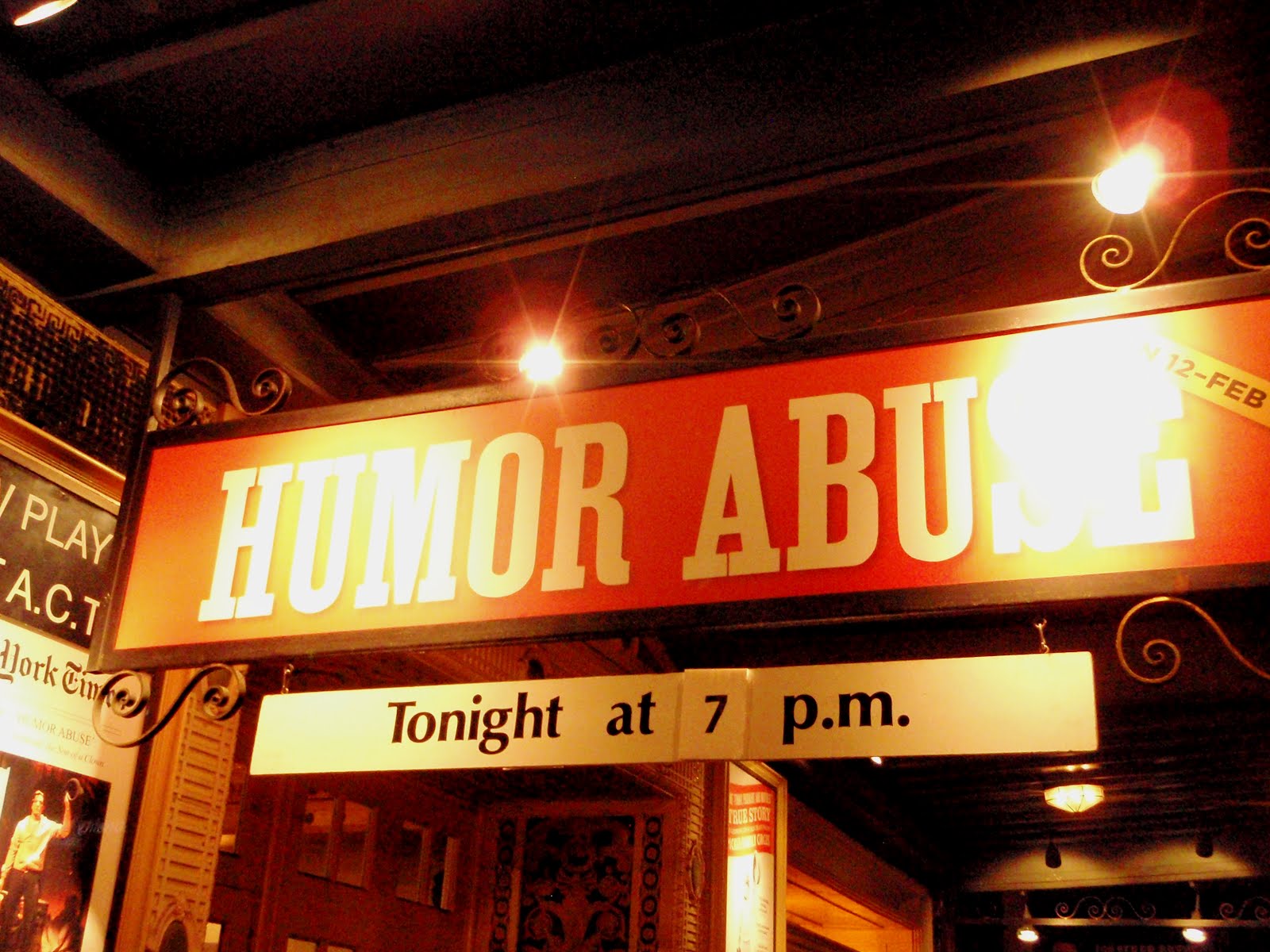
Though the clowning routines were not really the reason I went or the main reason I enjoyed the show (as should be obvious from what I wrote above), I will say right off that I did laugh at them, which is a tribute to Pisoni's skills, even though he claims that his father was the funny one. There is a part with falling sandbags barely missing him as he wanders from place to place on the stage that, while breathtaking, really rattled my nerves.
There is a long rueful routine about the complexities of carrying some suitcases up a flight of stairs which made me laugh because it’s a whole philosophy of life: it’s the sort of thing Keaton would do that would make you understand why he appealed so much to Samuel Beckett. There’s another extended routine, also a study in the frustrations resulting from the simplest actions, in which Pisoni wears swim goggles, an old-fashioned one-piece bathing suit, and flippers, and tries to climb up a ladder so he can dive into a tiny pail of water.
It’s his great skill as an actor that really sells these routines, adding some poetry to their elegant mechanics. At the beginning of the show he gave us some ground rules, announcing that we could eat candy (assuming we had brought some, I guess) and applaud whenever we liked, or “just sit in silent judgment,” a line which gave me my biggest laugh of the evening because that is the sort of thing I find hilarious (because that is the sort of thing I do).
He starts off with a brief history of clowning and his family’s involvement in clowning, both of which spring from commedia dell'arte (his great-grandfather, an Italian immigrant, had joined a commedia troupe). He turns himself into Pantalone and Arlecchino with astonishing speed and thoroughness (maybe he should do a one-man version of The Servant of Two Masters – I'd be up for that), and as Arlecchino he tells a really filthy joke, and then tells us that his father told him that joke when he was seven. So he very skillfully ties his family story in with the theatrical history, though I could have done with a little more background on his parents’ troupe, The Pickle Family Circus. Many of the audience members clearly already knew the background and were there for a nostalgic tumble through a shared past (I saw a number of people wearing Pickle Family Circus t-shirts or jackets, and there was the laughter of sentimental recollection at some of the projected photographs of Pisoni pere et fils), but I really had only vaguely heard of them.
Given the time (the 1970s) and the place (the Bay Area), I assumed there was a countercultural element to the Pickle Family Circus, even before we were told that his father drew clowning inspiration from shamans, medicine men, and the Monkey King. And apparently it really was a family-run circus, though there must also have been other performers involved, but it’s not clear exactly who or how many they were. The set gives a nice sense of what the circus must have looked like, with cut-up rusty coffee cans lined up holding the footlights, and a backdrop duplicating the old circus curtain, with its paintings of local landmarks like the Golden Gate Bridge.
Pisoni’s father seems to have been a charismatic but also difficult man, whose problems with alcohol led to the break-up of his marriage and the circus. He kept performing elsewhere (I wasn’t really clear where – he doesn’t seem like a Barnum & Bailey type and I'm not sure where else a clown would go for work). Lorenzo, not yet a teenager, continued touring with the Pickle Family Circus, taking over his father’s routines. He seems to have been a lonely boy who didn’t realize how lonely he was, or how very young he must have looked as he tried to behave as he thought an adult should. His life reminded me several times of Buster Keaton’s life as a child touring the vaudeville circuit with his parents, while his father drank more and more heavily (which must be especially self-destructive for an acrobatic performer who relies so much on his body, his reflexes and timing). Pisoni traveled with the circus until he reached high-school age, with sporadic but affectionate contact with his father, who remarried and divorced again.
He realized that what he thought of as his father was really his father’s clown persona, Lorenzo Pickle, whose first name he shared and whose routines he inhabited for years. Larry Pisoni remained a mystery to him. It’s a fascinating, fleeting insight into the enigmas of identity, and one of several doublings in the show (he used to share space in the act with a life-size dummy of himself as a child, who made a reappearance in this show). Personally I would have preferred a little less of the clown routines and greater detail about his father and the rest of the family (there are just brief mentions of his mother and sister), and about circus life and its physical and mental toll. On the other hand, I respect the reluctance to impose his own theatrically shaped views of his family onto them. They are individuals with their own views of what happened. Perhaps it’s best to allow only glimpses of the darkness and strangeness and the ultimate unknowability of even those closest to us. The great silences around what we know and don’t know are part of the essential mystery of fathers and sons.

